“No one gets to tell me what to do.” Tate McRae for Perfect Issue Nine.
Tate McRae has been living between hotel rooms and recording booths, her life unfolding at the intersection of jet lag and creative fire. Fresh from headlining London’s O2 arena (twice), reaching TikTok virality with her iconic ‘Revolving Door’ choreography and gearing up to take North America by storm for the final leg of her Miss Possessive tour, the 21-year-old singer-songwriter-dancer is crafting a career defined by emotional candour, artistic clarity and an unapologetic embrace of duality.
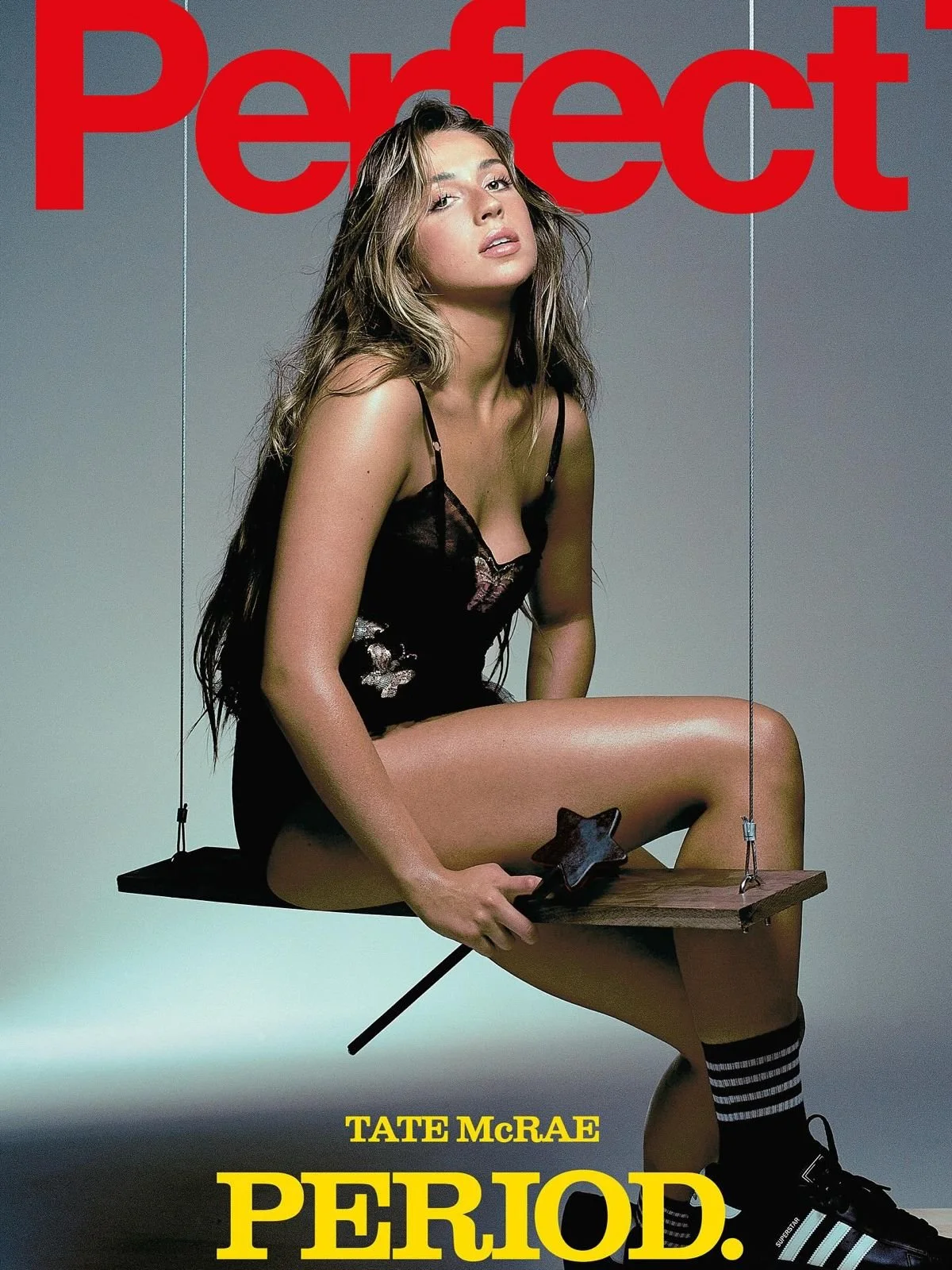
Tate McRae for Perfect Issue 9.
Photographer: Bryce Anderson
Fashion Editor: Katie Grand
Writer: Amelia White
Over Zoom, McRae speaks with a quiet precision: measured, self-aware, and fluent in the language of introspection. Whether unpacking perfectionism, her childhood in Calgary, or the surreal sensation of performing for 100,000 people in Brazil, her voice carries the precision of someone who has always been watching herself from the outside in. She’s a manifester and a meticulous dreamer – someone who keeps a bucket list of wild ambitions, from skydiving to swimming with sharks. And while she might live between cities, continents and stages, she’s still a regular girl, with a typical family who is always on hand to keep her humble – particularly her brother, who Tate tells me is always on hand to give out an eyeroll here and there when he sees how his little sister is now living her life.
Tate and I speak about pressure and power, creativity and clarity and the quiet strength it takes to hold on to your truest self when you’re growing up in front of the world.
I want to go back to where it all began: your hometown of Calgary. Bonfires, ice rinks – a slower pace of life. It feels like the opposite of the world you live in now. What does that contrast offer you when you return home?
It’s quite grounding. Going home gives me a sense of peace and normalcy and helps me stay sane, as well as giving me perspective. There’s such a contrast between the two worlds and I feel lucky to know both sides. When you’re wrapped up in writing and fiction and creativity, you can sometimes lose yourself a little bit. I talk to my parents every day and I feel very lucky to have a family that’s so far removed from this industry.
Does it work the other way as well? Does it give you an appreciation for the glamour and craziness of tours and press?
A hundred per cent. I mean, I feel like I have two vastly different sides of my personality, and when I go to Calgary I feel like I’m a little chameleon. I’ll shape-shift into that version of myself and be sitting at the bonfire with my brother’s friends, and then I’ll go to LA or New York and I’ll switch into my ‘artsy’ side (rolling her eyes).
We have to talk about your Miss Possessive tour! You’ve wrapped Latin America and the European leg, and you’re about to start in North America, kicking off in Canada. What’s been the most surreal moment for you on stage so far?
Oh, there’s been so many weird moments. A year and a half ago, I was playing a 500-capacity room to start off my tour, and then this year we headlined the O2… twice, which was such a bucket list. I got to see Brazil, which I’ve been dying to go to my whole life. And there were 100,000 people at Lollapalooza. I think that’s just dream shit where you’re like, I can’t believe that I get to do this for my job.
Do you feel present when you’re on stage or do you disassociate a bit?
It’s so interesting, because I think it’s a mix of both. I feel like I black out on stage and I feel like this alter ego completely takes over in order for me to not be freaked out by that many people. But then again, I also have moments where I clock back into my regular body and start bawling on stage.
You grew up doing competitive dance, where you’re effectively offering yourself up to be judged. What’s that like, and did early criticism help prepare you for the spotlight?
I’m very open to constructive criticism because I genuinely just love learning. I think it’s so satisfying as a dancer to get a correction and then be able to watch yourself in the mirror, in real time, get better. I think this was maybe a little fucked-up perfectionist thing in my brain, being at a ballet school, but I really was obsessed with that. I would say as a dancer you just get a really tough skin. My mom was my dance teacher my whole life, which is pretty crazy.
You’ve spoken a lot about perfectionism, competitiveness and being your own biggest critic. So many girls and women are their biggest critics and before anyone else has an opportunity to be mean to us, we beat them to it and we forget to be our own cheerleaders. I want to know what have you learnt to say to yourself, to be kind to yourself?
I think that’s such a work in progress. Exactly like you said, if someone says something to me, I’ve definitely already thought it, which is a crazy thing that I’m dealing with. The internet and opinions – it’s just something you have to try and figure out. But I think my favourite thing that makes me feel good about myself is believing in the magic of life and the magic of your mind. I’m very much a big manifester. I believe that everything I write comes true and I think that that is what makes me love myself, actually, is realising how magical you can be.
There’s a quote where you say being on stage is the least anxiety you’ve ever felt. Why do you think that is? What about that space feels so safe for you when you’re arguably your most exposed and on display?
When I was a kid, I was a little more socially awkward and weird. Even by my friends I would constantly get told, ‘You’re so awkward, you’re so strange.’ But the second I got on stage, whether it was competing as a dancer or performing as a singer, it was like, well, all bets are off now because I can be whoever I want. And it gave me that freedom to neglect any insecure part of myself and say, ‘No one gets to tell me what to do for this one hour that I’m on stage – it’s all me.’ And that was such an empowering thing. I think that’s why sometimes I feel like I black out [on stage] or I feel like I turn into a different person, because it’s like a mode you go into that feels freeing; it feels like there’s no one that can touch me up there. That’s why I feel like I could be way more confident in front of 20,000 people than I am in front of eight people at a dinner party.
I think it’s really poignant when you just said ‘no one can touch me’. You’ve spoken about the duality of exploring your sexuality versus being sexualised, and I can’t help but think about the fact that when you’re on stage, literally and figuratively, no one can touch you. It is a true safe space.
It really is. It is my safe space. It’s when the feminine part of me feels the most safe, because the only person who’s in control is me, and sometimes, as girls, you don’t feel like that in your everyday life.
