Myha’la After Industry.
Her breakthrough role as Harper Stern in Industry has put her top of every casting director’s most wanted list. But as filming starts on its final series, Myha’la is looking forward to telling her own stories.
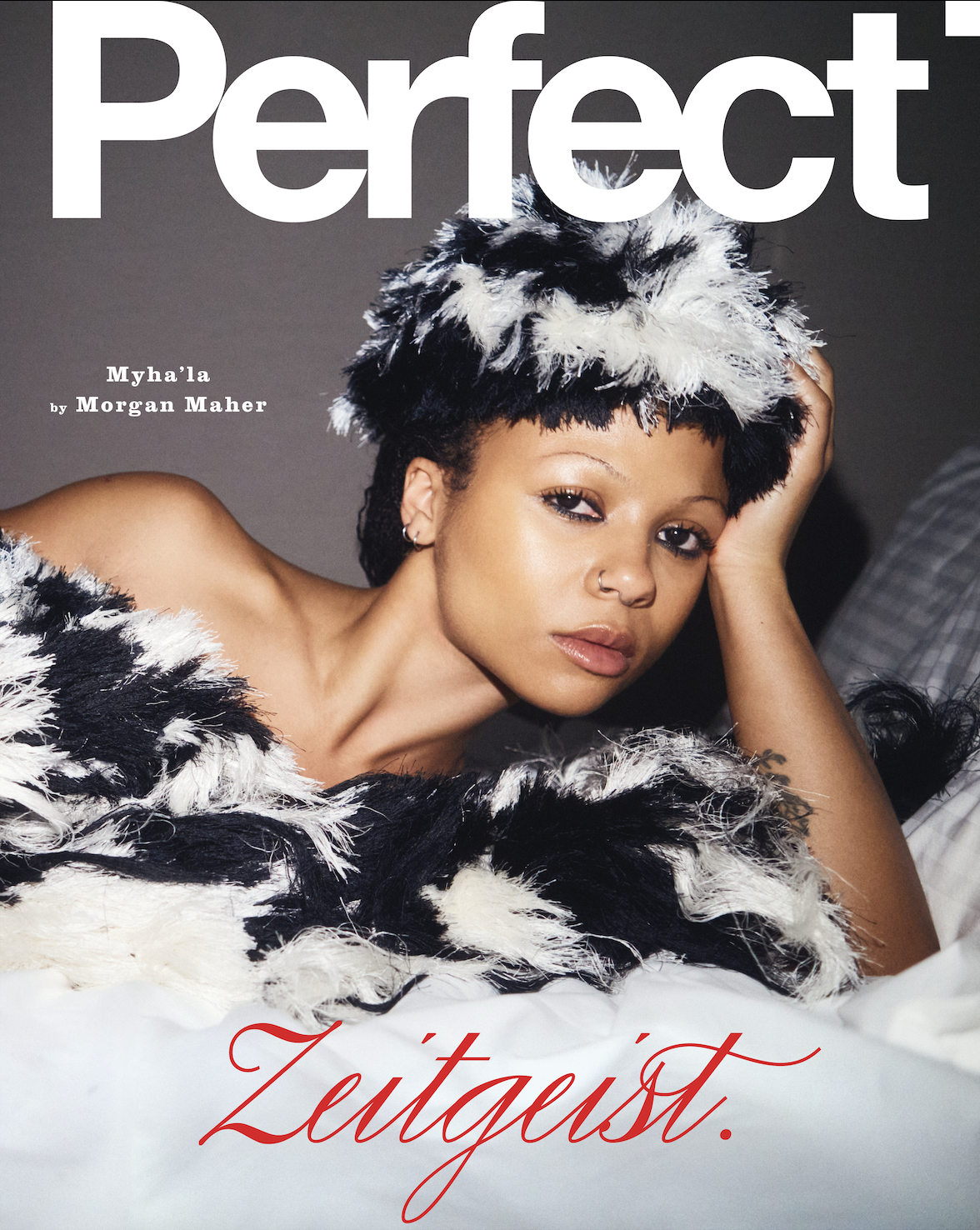
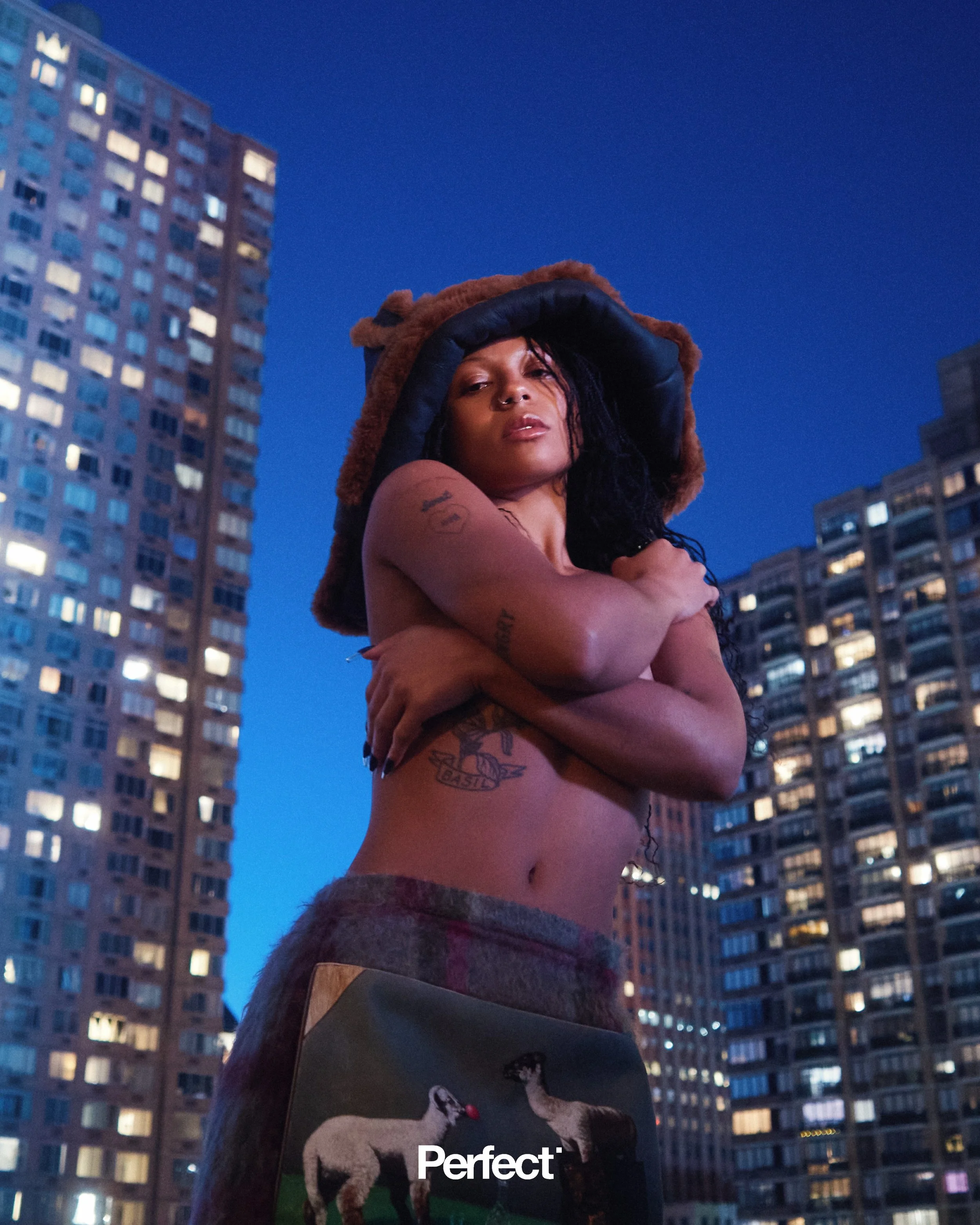
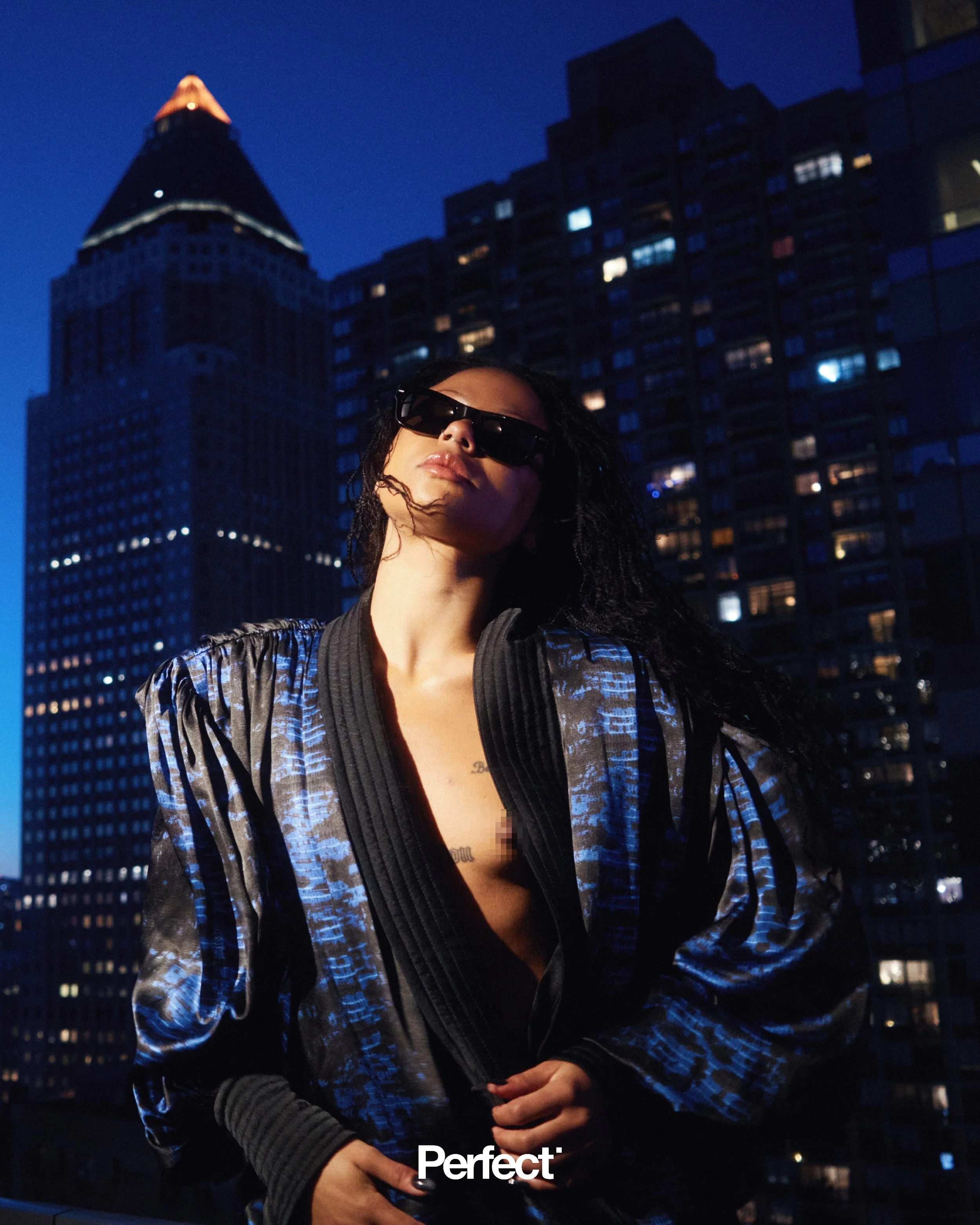
Myha’la for Perfect Issue 11.
Photographer: Morgan Maher
Fashion Editor: Max Weinstein
Writer: Paul Flynn
In March this year, just as Paris Fashion Week peaked, the guest list began swelling for the Perfect event at the Balenciaga store on Avenue Montaigne. Amid a generous display of starry, generation-defining names, a perennial TV favourite was added. Myha’la has been known by her mononym since the end of the first season of Industry, an HBO and BBC co-produced critique of late-stage capitalism refracted through the eyes of the young people it systematically magnetised, then chewed up. If Myha’la, a supremely gifted actor, dropped her surname to suggest a trip towards the iconic, well, her rivetingly complex Industry performance did most of the rest of the work for her.
Myha’la is best known for playing Harper Stern, the ferocious, undeniable young anchor on which Industry moors. Harper is the only character yet to be emotionally annihilated by the career path of cold, hard cash. As slight as she is in physical stature, Harper spreads a dominant, broad, oddly moral arc over the show. She is its unrepentant power axis. She enters her apprenticeship at Pierpoint & Co investment bank on a shaky moral faultline, meaning she is two steps ahead of her competition. She is in complete control of her destiny. She gets the gig. She understands the finer details of amorality. There is, with Harper, in one sense nothing to ruin. ‘She just wants to be the baddest bitch in finance,’ as Myha’la puts it, during a luminescent conversation beamed in from Los Angeles.
Industry was Myha’la’s first proper acting gig. It is her professional school. After the conversation closes, it feels apparent that the show is merely act one for a hungry young performer and storyteller defined by her humour, integrity, candour. Her crowning moment as an actress so far, she says, was not on the Industry set, but looking Julia Roberts in the eye on the set of the 2023 Netflix potboiler Leave the World Behind ‘and realising she fucks with me’. That was a moment.
Yet, for six months a year since 2018, Myha’la has been Harper Stern. Because Industry is filmed in Cardiff, a city she had barely heard of before showrunners Konrad Kay and Mickey Down cast her, she has developed an acute sense of global savvy. Born and raised in San José, the only child of her beloved mother Susan, before Industry she had never left America. If she was raised Californian, her sensibility is discernibly New York.
Eight years is a long time to devote to a show which will rinse you of your emotional faculty. This summer, two months after we spoke, Myha’la shot Industry’s final season. Squeezing in a series of the compelling British reality national obsession The Traitors (of which she could obviously say nothing), before disappearing to Cardiff for a last Industry spell, Myha’la’s star will now ascend from the fashion pages, from Gen Z obsessives with sophisticated screen tastes, straight to the tabloids. At the Balenciaga event, reports came back of Myha’la’s adorable disposition. She turns out to be just as brilliant as prefaced, undaunted by the crossroads her career is about to take, as she moves from critics’ choice, HBO fame into the unforgiving realm of the real world huge.
Can you take me back to the beginning of Industry? What was your first meeting with the showrunners Konrad and Mickey like?
My audition tape was two scenes. I got a callback and they said, ‘We’re going to give you the first four episodes and set up a conversation with you, Mickey and Konrad, to go over their thoughts before you retake.’ They were really complimentary and kind of exactly like they are now. They talk a lot. They use a lot of words when they speak. And I was a little intimidated. I felt quite passionate about the show. Harper vapes in the first season, which is in the script. After the meeting ended, I immediately hit my Juul. I didn’t realise that I’d had it in my hand the whole time, like an absolute crackhead. I met with [director of the first episodes] Lena Dunham and did the same four scenes with her, and then I travelled to Cardiff to test with six other actors…
Were you living in New York at the time?
I was.
Wait, did you even know what Cardiff was?
No, I had to get a passport – I’d never been out of the country. You know when someone is like ‘do this thing’ which you’ve never done before? I’m the kind of bitch that’s like, I don’t have time and it doesn’t serve me to ruminate on whether I can do it or not. Just fucking go. It was only in retrospect that I really thought, what the hell? It’s another country, by myself and I’m performing for Lena Dunham. It was a very out of body experience. I had Ariana Grande tickets for New York and suddenly I couldn’t go. I was literally like, ‘Who wants these Sweetener tour tickets? Anyone?’ (Laughing) I was so pissed.
I have since tried to see her three more times and every time I haven’t been able to. I think it’s a curse.
You had to give up Ariana for Industry?
Right? My sacrifice is that I will never get to see her live, ever.
What was the primary difference between reading Harper in the script and trying her on for the first time in wardrobe?
When I got the show I had a shaved head. In the script I had braids. How fast can
I will my hair to grow? Mickey and Konrad were like, ‘We love your shaved head and think it’s really cool and hardcore – keep it if you want.’ But I really wanted to feel like Harper was not me. In our first fitting she was in jeans and big, chunky vibes creeper boots – two things I never would’ve worn. She didn’t look like me at all, which was awesome. The biggest difference is that Harper on the page was way more outwardly nervous. They wrote that her hands are clammy, she stammers over her words, and I was like, hmm, I wonder if that could be the interior? And what she tries to present to the world is the total opposite? If she’s a nervous girl like this, no one’s going to take her seriously. Personally, as a Black girl going into this office and being nervous, saying ‘I can’t do my job,’ that just did not feel right.
There’s a complex morality underneath Harper. She’s a total fake, completely self-invented, but there’s also this ferocious intellect and fearlessness to her. In some ways, she’s almost the moral centre of Industry because she has decided her own path.
The common misconception of Harper is that she’s a bad person with bad intentions all about hurting people. There’s a huge difference between that person and one who is traumatised and protecting themselves in a universe that doesn’t work for her. When she is behaving, in a man’s game, like a man, as a small woman, the judgements are different. They just are. The perceptions are different. The expectations are different. While Harper’s goal never changes – to be the baddest bitch in finance – she works hard to achieve that goal. She has had a pretty anchored moral centre from the beginning, as much as one can have one in this arena. I really love that you said that. In season four she finally achieved everything she ever worked for. She is who she wanted to be. She has it all. Now what?
Next season is the final.
Right. We start filming in August. The scripts come when they are written. But I haven’t seen any of it yet, just had preliminary conversations with Mickey and Konrad about their hopes and dreams for the season. They know what the ending is and can go towards that, balls to the wall, as they always do.
Will there be tears on the last day of filming?
I have cried so many tears over this show. I feel so aged by this process, in a good way. I have a kind of grounded contentment and confidence and pride in this thing that has defined me for the past eight years. I have grown up on this show. I have refined the kind of actor, the kind
of professional, the kind of woman I want to be in this world and in this industry.
I don’t know that I’ll cry. Honestly, there will be a kind of relief. It does limit the other things you can do. I have stuff I want to make. I want to produce. I want to write for myself.
Do you worry about sharing your stories? I’ve just finished the Lena Dunham memoir, a cautionary tale. You get a thank you in the back.
I have my copy with me, which she sent me. I saw that she mentioned me in the book, which is really touching.
What do you think it is that makes a show like Industry, Girls, Euphoria or Skins resonate so hard with young audiences? What is the confluence of energies that conspires to build generational weight?
It’s lightning. Right time, right place, right people. The thing which all of the shows you mentioned have is a dissenting voice, a generation-defining voice. With Lena, HBO supported her, helped develop her vision, the way that Bad Wolf and HBO have let Mickey and Konrad do their show. This is absolutely theirs. There wasn’t some sixtysomething-year-old white man in a suit. They led our thing. We are young people who are living now. Whatever we are doing should be relatable to us and our generation. You don’t have to try that hard to find a defining voice if you give them the support that they need. There are so many passionate singular voices who have stories to tell, who just don’t have access to that support.
What was your generational TV show?
The thing that captured my spirit was Euphoria. I watched the fuck out
of Skins, but the thing that made me feel my heart inside my vagina was Euphoria.
What’s your New York?
Downtown Brooklyn. Boerum Hill, Fort Greene, Fulton. From the time I could say boo, I said I was going to New York. I was going to be on Broadway. I was obsessed with New York culture and nightlife. I grew up in northern California, basically in the suburbs. San José. I was relentlessly stared at my whole life because I was always doing something funky with my hair or my clothes and I was also the only Black child in my neighbourhood and my school. San José is technically very culturally diverse but all of the diversity is in pockets. I grew up in a white community, so I was singled out. A lot. The first time I went to New York, nobody gave a fuck about me.
I felt so safe and normal, which was such
a relief. I could just be.
What was your performance awakening?
I was always a really performative, dramatic child. I loved Britney Spears. There’s an iconic video of me as a five-year-old doing a dance battle with my cousins. I get up there and I’m twerking and everyone’s like, ‘How did you learn to do that?’ And I’m like, ‘’Cause my momma told me to watch MTV.’
Do you have moments of self-doubt?
Who doesn’t? But I’m never not confident that this is what I was meant to do. Look, I’m a Virgo. I have perfectionism syndrome. I’m so fucking hard on myself. There are times when I feel nervous about something. But now, in my maturity, I feel a sort of electricity around wanting to get it right.
Is writing the same impulse?
Yes, because I would say I’m an intuitive writer, not a writer because I love to write.
I was shooting season three of Industry
and I was working way less. I was at home one day and remembered a story, that I fell in love with my gay best friend in college.
A movie happened in my mind. Because it was a story I felt emotionally connected to, it was like word vomit. Sixty pages came out of my ass in a week.
The gayness of real life can be quite under-told.
My life is so gay and I feel like that is being under-told!
What is the gayest thing about your life?
The gayest thing about my life, honestly, is my marriage (explodes laughing). My husband will tell you that this is true. I feel like it’s come full 360 and that marriage is maybe the gayest thing you can do in 2026. Turn 30. Get married. To a man. You know what I mean? It was not on my bucket list. It was not on my manifestation board. The thing that feels grown and mature about getting married – which also feels kind of gay – is, because I didn’t imagine it for my life, what it invited me to do was shift my perspective. It was important to [her husband] Armando. No one’s ever relied on me like that. I now had permission to empathise with other ways of life.
Do you enjoy a Fashion Week? Is it about enjoyment or work?
I do! I love fashion. That’s one of the pillars of the relationship with my mom. She has immaculate taste.
What’s her name?
Susan, and she is the queen of my life. Our thing is thrifting. We would always pop into a goodwill and she’d be like, ‘Look, baby, look!’ while pulling out a pristine pair of Prada loafers. She was the one who really inspired this love of fashion history and legacy in me. It’s so beyond her, what I do. It’s too much to think about because she’s not done any of these trips with me yet.
In 2026, how much time does an actor have to give to living online?
This is up to you, sweetie. I am a child of the internet. I am a proper Millennial/Gen Z cusper. I grew up with the internet. The way I wanted a MySpace, so fucking bad. This is my life. I’m a Tumblr girl. I have a close and personal relationship with the internet and I enjoy being online because I am also a fan of the discourse, I love the TV, I like to be entertained. Sue me! I also sometimes battle with how the internet has become not just about interaction and engaging with people and that I am sometimes obliged or encouraged to use it, to be monetised. Sometimes that makes me feel like I am not being authentic and that really claws at me. ‘You have to post!’ No. You don’t. If you don’t have an online presence, you’re not going to fucking die. It’s not compulsory. That’s just one avenue. It might be the most common one, but if it doesn’t work for you, don’t do it. There are plenty of successful actors who don’t do it at all. I think Mikey Madison has no social media. And she does have an Oscar. She’s fine!
What does Industry tell us about late-stage capitalism?
That we’re fucked. Industry tells us that late-stage capitalism and the people that benefit the most from it have an evil, evil attachment. Greed moves the ceiling. If all you ever want is money, success, power, then the ceiling keeps moving. You’re just going to want more. It’s just going to fuck you. Your spiritual core gets smaller and smaller the more greedy you are.
How did a show that started about a group of people affected by late-stage capitalism end up being condensed to the story of two women?
Because the most interesting version of anything centres two women.
Perfection. Who’s the person whose opinion of your work you care most about?
I’m inclined to say my mom, honestly. She’s definitely the person whose responses I get the most emotional about. She was the one who said, ‘Go do this thing, this is yours for the taking.’ Then
I think secondary, not one person but other actors that I admire. Like, the day that I really knew that Julia Roberts respected me as a peer on that film [Leave the World Behind], I was like, fuck yeah (laughs). There was a day when I was like, she fucks with me. Yes. Absolutely magic. Tracee Ellis Ross stopped me at the Vanity Fair Oscars party and made me cry with what she said to me. The thing that I get so often from women of colour in the industry is how glad they are that Harper exists.
And how many people get to say that?
Exactly.