Jessie Murph Won’t Hold It In.
No one channels twisted wit and raw, tortured emotion like Jessie Murph – Alabama’s answer to Amy Winehouse, who counts Alessandro Michele and Elton John among her fans.
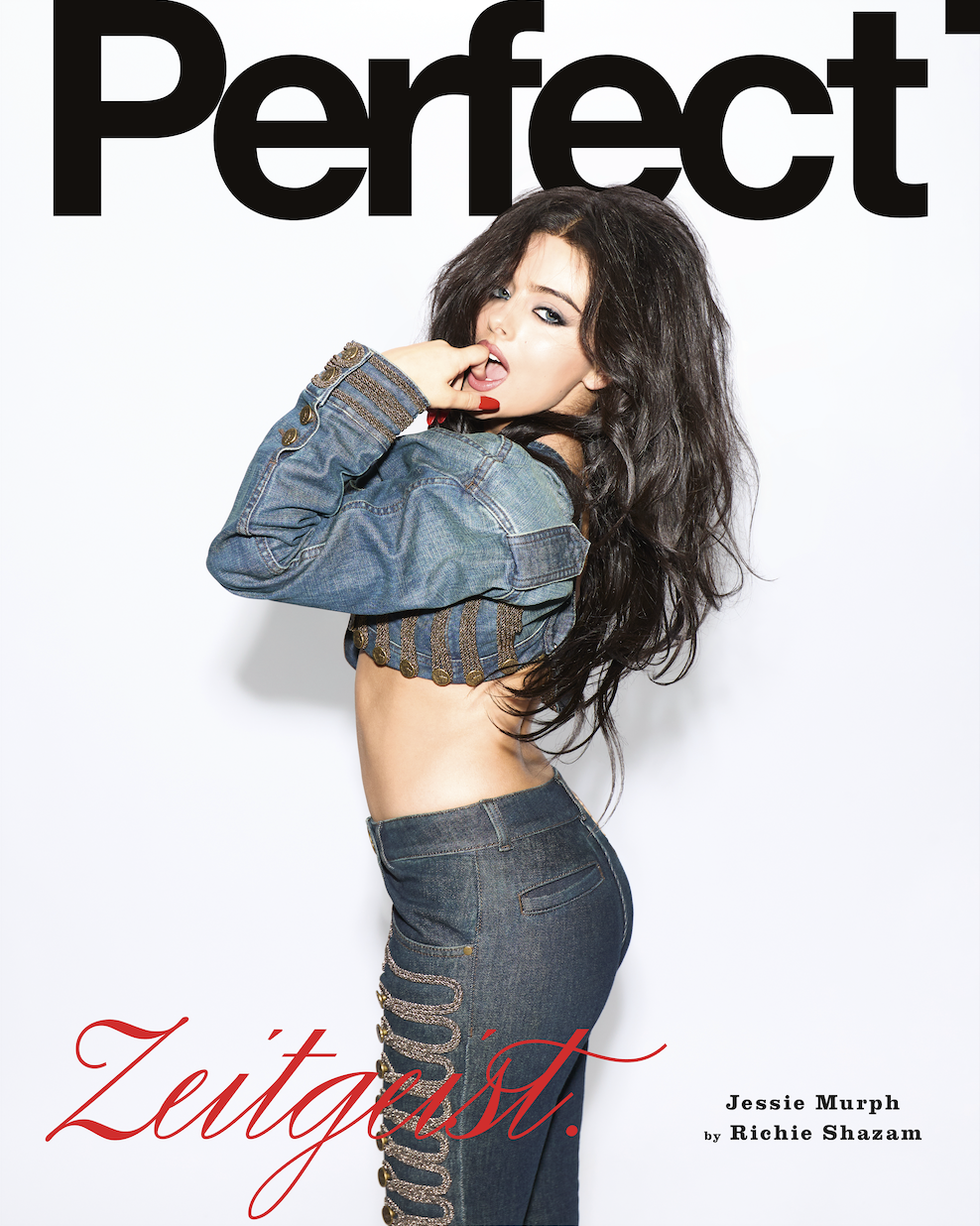
Jessie Murph for Perfect Issue 11.
Photographer: Richie Shazam / Shazam Studios
Fashion Editor: Max Weinstein
Writer: Joe Bromley
It was the middle of the night in New York and Jessie Murph was feeling ‘fucking crazy’.
Earlier this year, the 21-year-old American singer-songwriter had returned from a disastrous romantic trip overseas and could not face going home alone. Instead, she called her A&R and demanded that ‘anyone with some instruments’ be sent to a Brooklyn studio. They succeeded. Between midnight and 6am, ‘I just wailed on the mic and let everything out,’ she says. ‘The main song of my [new] record happened that night. They’re all just playing, doing some sick shit, and it comes into a sound that is really raw, soulful and bluesy.’
Off the cuff, fairly chaotic, fervently passionate: this is the essence of Murph who, for those yet to come into contact with her, can be best understood as Alabama’s answer to Amy Winehouse. Her genre-hopping sound mixes haunting vocals with trap rap, sugary pop and country undertones, while Golden Era Hollywood looks, vocal acrobatics and a penchant for posting have made her catnip for the TikTok generation: she has 11.7 million followers on the platform, 1.9 million on Instagram and almost 11 million monthly listeners on Spotify.
We are speaking via Zoom, where she has her phone propped up against a window for good lighting, from a twee, pattern-wallpapered room in Los Angeles. She bowls in with a bouncy Southern twang, wearing a pale green floral square-necked babydoll dress by the LA label For Love & Lemons. Her long, coal-black hair is down and pushed behind one ear, which she persistently retucks with acrylic nails. She sips from a supersized coffee cup which dwarfs her sculpted face. Though shy at first, she is immediately warm and progressively playful.
At 4ft 11in, she may be petite but her star was sent stratospheric by last year’s album Sex Hysteria, which debuted at number eight on the Billboard 200. A 1960s-inflected record that veers from bruised ballads to moody R&B, it includes her biggest solo hit, ‘Blue Strips’, which has clocked 227 million Spotify plays and counting. ‘It’s a silly pop song,’ she says.
‘I was really panicked about people hearing that and thinking, “She’s just a pop artist.”’
In reality, her best songs – ‘Heroin’, ‘Wildflowers’ and ‘Wine’ – are rich in tortured emotion. On stage, this volatility becomes physical. Currently on the festival circuit across the US and Europe, she begins sets dolled up in vintage frocks before ending on her hands and knees, hair soaked and knotted across her face, as she belts into the microphone with almost blood-curdling vigour. ‘Just kind of letting myself be raw and vulnerable,’ she says, comically understating the gravitas of her live performances.
Since her third album release, Murph has garnered significant praise – and not just from doomscrollers. On Elton John’s Rocket Hour podcast, he told her she looked and sounded ‘a million dollars’ and that her songwriting was ‘off the charts’. As a lifetime fan, it was a compliment she will never forget. ‘I think about that once a day. It is actually my Roman Empire,’ she says.
Her current Priscilla Presley meets Dita Von Teese look (punctuated by the odd pair of hot-pink leather cowgirl hotpants) has attracted the fashion industry’s eye, too. Alessandro Michele flew her out to attend his Valentino couture show in January. Clips of her singing Nina Simone’s ‘I Put a Spell on You’ at the after party went viral, with viewers startled by the gravelly voice emanating from this diminutive, porcelain figure.
‘It was a whole new world. Alessandro’s attention to detail is just like nothing I have seen… and I just love getting dressed up, too,’ she adds, her Alabama drawl at its strongest. Chanel is a favourite (‘I wear it a lot when I can’), but thrifting makes up the bedrock of her wardrobe. ‘I’m a frequent Etsy, Facebook Marketplace woman,’ she continues, proudly. Her current obsession is with heels from the 1920s and 30s. ‘They are so much more comfortable. I’m strictly on heels – I haven’t worn flat shoes in maybe five months, so finding vintage shoes is my biggest hobby.’
Any recent shoe-shopping has been procrastination, however. Murph’s upcoming album is 80 per cent complete; she plans to wrap up recording soon and release it before the end of the year. ‘I’m fucking dying to get music out,’ she says. ‘I start to lose my mind a bit in this mode because you’re just contained to yourself.’ The next album is rooted in the late-Sixties American music scene, ‘very Janis Joplin, Jimi Hendrix – that era,’ she explains. ‘It’s played with a band, it’s live and there’s no AutoTune on the entire record.’
Her preferred songwriting method is freestyling. ‘I’m never, ever thinking
about things before I say them in songs.
I typically like spurting it out on a mic.’ Her seriousness cracks. ‘Spurting is a terrible word! Sorry,’ she laughs, hands on her face as she leans into her chair. ‘I like to think I am a transmitter of the emotion that I’m feeling – being a channel,’ she says. For her latest project, that is ‘heartbreak, perseverance and strength’.
She is commendably unafraid of provoking her listeners. ‘I always want to make stuff that’s polarising. I think it’s beautiful when half the people hate it and half the people love it,’ she says. Take her hit ‘1965’, performed on Jimmy Fallon last July, in which she muses on life as a housewife six decades ago. ‘I might get a little slap slap,’ she sings, followed by the kicker: ‘But you wouldn’t hit me on Snapchat.’ It is her satirical edge cutting through. ‘It will always be a theme in my music, as long as I’m the one writing. Which I will always be,’ she says.
The shadow of her youth is a darker constant. Born in 2004, she was raised by an alcoholic father alongside her supportive mother, both of whom worked in the family transmission shop in the mid-size town of Athens, 25 miles west of Huntsville, in the Bible Belt. She is the middle child between two brothers and grew up counting the days to her escape.Many of her tracks take a scalpel to her childhood experiences. ‘The Man that Came Back’, which she wrote in 2017 but only released eight years later, is most revealing of her father. To gentle piano taps, she details being six years old in a violent home: ‘Running from the sound in my nightgown, screaming through the walls / He was angry, she was trying,
I could hear it all.’
‘I can’t imagine he hasn’t heard [the song],’ she says of her father today. ‘But it’s something that doesn’t get discussed. We don’t speak much anyways,’ she says uncomfortably. Then, after regaining composure with a short breath: ‘If I’m feeling something, I gotta say it. I gotta say it, or it’ll eat me alive. I have to get the feelings out or they will swallow me. Everything I’m saying is just true. If I’m saying true things, it’s not really that fucked up.’
As a girl, she threw herself into figure skating, track and cheerleading, while recording Amy Winehouse covers on an iPad from the age of eight. When TikTok arrived, it was a natural fit, and she began populating her account with singing videos as an adolescent. They landed her in trouble – she recalls running laps at school as punishment for posting clips with swear words. ‘All the opinions and judgement that I faced just drove me to want it all more. So God bless them,’ she says.
A light at the end of a tunnel appeared at 15, after she posted on TikTok and headed to cheer practice. When she returned, ‘It was going viral. It was the craziest feeling. I remember just feeling so much hope, and like everything was in its right place.’ She moved to Nashville alone ‘the second I turned 18 and was allowed to move out legally,’ she says, before relocating to LA the following year. A record deal came with Columbia in 2021, followed by her debut track ‘Upgrade’ (‘I recorded half of it on an iPhone,’ she sighs), the album drowning in 2023, and later collaborations with Diplo, Polo G, Jelly Roll and Teddy Swims.
For all the messy glamour and powerhouse vocals, Murph remains a refreshingly oddball young woman. She collects pocket watches and old postcards. Recently she has taken up teddy bear taxidermy, ‘like Doc McStuffins,’ she
says. And while she professes not to be much of a partier, her go-to drink is a Malibu pineapple, and she can be swayed by the occasional mushroom trip (‘God, they are great!’).
She is now ‘the first one in my family to see a million bucks,’ per her ‘Gucci Mane’ lyrics, and splits her time between Los Angeles and New York. Soon she will make her leap to the Big Apple full time, having fallen for her life there. Her routine is not to be sneered at: studio from 4pm until 5am, home, sleep until 1pm, then a walk through the park, coffee, and back to the studio – interrupted only by shows and church on Sundays.
‘There’s just a beautiful realness and struggle in New York that reflects where I am right now,’ she says, with a smile. ‘I might come back [to LA] one day, but I think for now I’m a New York lady.’