Robert Wun on his refusal to compromise when it comes to creativity.
Being invited to join the couture schedule in Paris meant that London-based designer Robert Wun would never have to temper his vision for the sake of commerciality. We catch him just before his joyfully imaginative ‘Childsplay’ show to talk about his refusal to compromise when it comes to creativity.
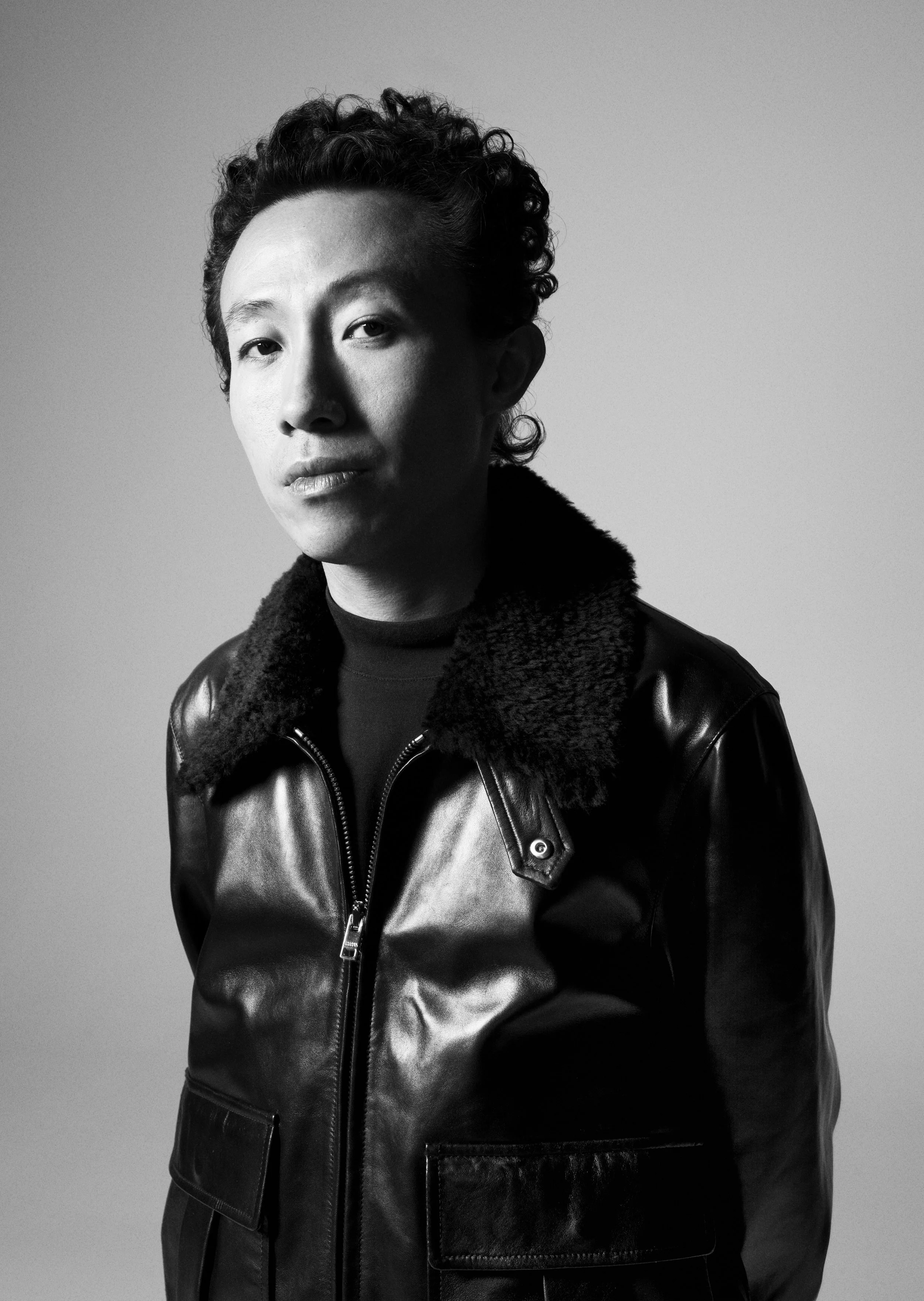
Robert Wun for Perfect Issue 11.
Photographer: Willy Vanderperre
Fashion Editor: Katie Grand
Writer: Murray Healy
Robert Wun’s haunting, unearthly, sculptural couture dominated this year’s Met Gala. He dressed the Broadway producer and artist Jordan Roth in a long ochre gown, complete with a ghostly humanoid figure rising over his right shoulder, reaching forward as if to engage Jordan in an embrace, or a stranglehold. The Thai fashion entrepreneur Nichapat Suphap in a black gown adorned with four animatronic hands the colour of quicksilver that moved with unnervingly human-like fluidity. Lisa from Blackpink in a sparkling white lace dress, a shroud suspended over her head by an extra pair of arms that extended from her shoulders. Beyoncé in a figure-hugging black fishtail gown embellished with swirls of golden Swarovksi crystals sparkling like an aerial view of a city lit up at night.
In all, the designer created eight looks for the event – haute couture’s most high-profile showcase, its influence carried beyond fashion and into the heart of mainstream culture by the world’s news media, who never fail to cover it in detail. Within the fashion press, meanwhile, the verdict on the night was unanimous, with headlines such as ‘Robert Wun: 1. Everyone Else: 0’ and ‘Robert Wun Owned the Met Gala’.
Several of those guests wearing Robert Wun were longstanding clients. ‘Mrs Carter has always been a good supporter,’ Robert tells me, a month after the Met Gala. Their relationship dates back to 2023, when Beyoncé wore a custom black ruffle-covered blazer and half skirt inspired by a look from his debut couture collection on her Renaissance world tour. Lisa, Jordan Roth and the tennis player Naomi Osaka were all returning clients too.
Red-carpet events provide a natural environment for the spectacular nature of haute couture, and much of Robert’s most photographed work has been for celebrities picking up awards: Nicola Coughlan at Cannes, Florence Pugh at the Critics Circle, Skin from Skunk Anansie at the palace getting her OBE. The pop icon’s stage is another fertile arena for the couturier: he dressed Beyoncé for her Cowboy Carter tour too, Björk for her Cornucopia tour, and Adele and Lady Gaga for their respective Las Vegas residencies. Gaga is his longest serving celebrity client: she bought two pairs of shoes from his graduate collection at the London College of Fashion way back in 2012.
The way high fashion and celebrity interface on the red carpet is often brokered by PR teams: the celebrity offers the designer mass exposure, so the clothing is offered for free; the star might even receive payment to wear what they’re wearing. But this is not how it works with Robert Wun. ‘I have always been standing on the opposite side of that game. If you want to wear me, you have to pay for it,’ he says. The lavish nature of his creations belies the modesty of his operation. As an independent designer working with a team of 12 out of a studio in an old warehouse in East London, he simply can’t afford to give clothes away – particularly when each item takes months of highly labour-intensive work.
‘But also, where is the respect for the designer’s work if we just keep on doing shit for free? What’s the point? I always think that if you’re good enough, people should pay for your work.’ He says he felt very proud that he and his team were able to dress their clients for the Met without compromise on this point. ‘I’m so grateful for all the incredible artists and clients that we work with, that they give me that respect.’
Has he encountered public figures approaching him for looks expecting to get them for free? ‘Oh, absolutely. Yeah. And then we just politely say, “What’s your budget?” And then it ends right there. Sometimes after a few attempts they understand that they need to pay. But you have to stand your ground.’
The Met Museum also bought three looks from Robert’s past couture shows for its permanent collection; they feature in Costume Art, the latest blockbuster fashion exhibition overseen by the museum’s creator in charge, Andrew Bolton. ‘Bless Andrew,’ says Robert. It was Andrew who had tipped him off that the edict for this year’s Met Gala would be ‘fashion is art’ – which would make Robert an obvious go-to for guests wanting to make a credible statement. ‘I met Andrew at my show in July last year, and then we met for coffee, where he inquired about buying those looks. And then he told me that, well, the theme is right up your street, so you need to be prepared.’
The phrase ‘fashion is art’ could serve to caption any Robert Wun collection, including those from the time when he was technically creating ready to wear. When we meet, it’s five years almost to the day since we last got together for an interview, in the days before his switch to the haute couture schedule. One of the topics we spoke about back then was how his bespoke way of working – primarily making custom pieces for individual clients, just him and his two studio assistants – sat at odds with the large-scale industrialised production usually required of ready to wear. It was potentially an issue; his business wouldn’t be able to expand in the way the fashion industry expects of brilliantly gifted young London designers.
But then it was always clear that Robert Wun wasn’t going to compromise for the sake of others’ expectations. Each collection continued to be an intelligent inquiry into the architecture of clothing, with orchid curves and swift tail-feather shapes, corsetry and armour, and boning and pleating that required hours of meticulous handwork. He grew slowly, at a pace that allowed him to maintain the quality he demanded. He refused to engage with the technical and financial distraction of catwalk shows – ‘You spend all this money on a show that can actually be done in a photo shoot,’ he told me at the time. Reflecting on that period today, he says, ‘I just took my time to really take care of my clients and to build my finance.’
Then in 2022, ANDAM, the French government-backed organisation responsible for promoting and funding the most promising new designers, invited him to enter its Fashion Awards, where prize winners receive significant financial and strategic support. At this point, Robert didn’t even have a current collection, as he’d decided to skip a season. ‘They were like, it’s fine, just enter your most recent one. So I did, and I got shortlisted.’
He was conscious that he was up against established designers with big budgets: ‘My fellow nominees had turnovers of a few million a year.’ They were also names he had admired for a very long time: Peter Do, Heliot Emil, Botter. ‘I remember very specifically telling my two lovely team members, “Our job here is to not embarrass ourselves and try our best,” because I wasn’t expecting to win.’
Then came the big day in July when the hopeful designers are grilled by the ANDAM jury about their collection and how they envision expanding their business. ‘I entered the room without talking any numbers or any financial ambition – simply as a designer who wants to do what I love to do for the rest of my life.’ As it turned out, ‘They felt like that’s what was missing in the industry, so they gave me the Special Prize’ – €100,000 and a year’s mentorship from the president of the jury, Bruno Pavlovsky, also Chanel’s president of fashion at the time.
He recalls their first meeting, in October 2022 at the Chanel headquarters on rue Cambon. Robert found his new mentor refreshingly direct. ‘He asked me, “So what do you think we’re going to do?” And I said, “Well, it’s a mentorship, so I suppose we’re here to talk about what you think my business should be like.” And he basically said that talk is useless – “We are here to do something. So tell me, what do you want to happen?”’
Robert revealed that he felt ready to stage his first runway show. ‘It was always my dream to be able to do something physical. He was like, “OK, do you have something to show me?” And I brought out my iPad and showed him a few pieces that I was working on – it was hardly a collection yet.’ It was at this point that the word ‘couture’ entered the conversation. ‘That word came from him. He was the one to say, “Well, this is couture.”’
In hindsight, it’s clear that the highly sculptural and exquisitely fabricated nature of Robert’s work warranted classification as couture, but this had never occurred to the designer himself. ‘I never linked myself with couture, because I have so much respect for that craft. But coming from him? It was a lot, you know.’
The next day Robert had a meeting scheduled with the Fédération de la Haute Couture et de la Mode, the French fashion industry’s governing body. They too thought he should be on the haute couture schedule and encouraged him to apply, but he needed a sponsor from a Federation member. Robert thought to ask Pavlovsky, who had recently become the Federation’s chair. ‘They told me that, well, Bruno had never really sponsored anyone in his whole career. I thought, it won’t hurt to ask.’ Pavlovsky said yes, and Robert applied.
The Federation’s verdict came by phone from Paris in early November 2022. ‘It was 9am in London and they’d just finished the meeting; I got all 24 votes.’ This was the first time in the Federation’s history that a designer was accepted onto the haute couture schedule with a unanimous verdict. Robert was also the first Hong Kong-born designer to be invited to show during couture week. ‘That was something very life-changing for me – I’ve never really said this before, but now, looking back, it was. Because I’d been in London for so long, and you always look at Paris with admiration, almost as a goal that would not be easy to achieve. And when that suddenly all happens, it is very rewarding.’
Robert and his team now had only two months to create a couture collection and stage a catwalk show. His response to the enormity of the challenge before him was to face up to his anxieties honestly and channel them. He called that collection ‘Fear’. It was fuelled both by his fear as a designer staging his first ever show – ‘I had no fucking clue how to do it!’ he laughs – and also his fear of failure in the context of the couture atelier: the fear of imperfection in this most perfectionist of practices, the fear of stain as a form of sin. He started thinking about the worst fates that might befall the pieces being assembled in his studio. ‘What if a dress got burnt before the show? What if a model drank coffee and spilled it all over it?’ And then he turned that on its head. ‘What if the thing we worry about most is the concept itself, and we turn that into craftsmanship?’
He aestheticised these nightmare scenarios to manifest them as craft, and they have spilled out across his collections ever since. Lace textures created by cigarette burns; red wine stains that bloom like flowers; paint splats like expressionist art; seams that gape open like wounds, and clusters of miniature red paillettes as blood. And, most of all, the trickle of raindrops from a disastrous drenching described in tiny glistening crystals.
Significantly, ‘Fear’ was scheduled as the grand finale to January 2023’s couture week, and the faith placed in him by the Federation was duly rewarded by unanimously rapturous reviews. And then almost immediately Robert demonstrated his determination to keep doing things his own way. ‘We were supposed to do the July show as well, but I stopped that. I was like, OK, it was a success, great. We’ve got a few new couture clients too, which is fantastic. But I need to reset a little bit. I need to figure out how many more people I need to get in, how to build that infrastructure to take care of our clients, to set up appointments, where’s the showroom going to be and so on.’
How did the Federation feel about him immediately skipping a season? ‘I think they were very understanding about it.’ But he did sense a little regret in their response. ‘They were like, “Oh yeah, well… it would be a shame, because you had a great start…” But it is what it is. I don’t think I will ever blindly follow a schedule just because there’s external pressure for me to do so; I just never operate that way. I’m very grateful to be on the schedule – it’s a privilege. But I don’t feel the need to always have to squeeze it out every single time.’
When this conversation takes place, the next couture week is only a month away, and Robert will be on the schedule again. This will be his seventh show, and the fear that fuelled his first has long abated. ‘I’m no longer in the state where I used to be when I did the “Fear” collection. I don’t have that sense of panic or that sense of worry any more, because I’m used to it, I know how to operate within the pressure. And I’m very proud of my team that they’re able to also keep on doing all this incredible work and under this pressure.’ Somehow, he notes, ‘They’re all very chill at the same time too.’
While there’s less trepidation about the practical aspects of staging a show, a sense of anxiety about being a creative in the spotlight continues to shape his work. His spring 2026 collection was about this very subject, almost autobiographical in its self-referentiality. It was presented in three parts: ‘Library’, harking back to his student days, when his vision as a designer was unsullied by commercial expectations; ‘Luxury’, when the reality of running a business in the fashion industry bites; and ‘Valour’, representing the courage to keep creating without compromise in the face of self-doubt and external pressures. The gown Beyoncé wore inside the Met on the night of the gala was adapted from the closing look of that show.
The final section featured a golden coat bearing a dagger which protrudes from the left breast as though it has been stabbed through the heart. This was not offered, Robert explains, to be interpreted literally, as an act of violence: it is a symbol of ‘self-sacrifice for the greater good, for the good of keeping on creating’. ‘Like, you’ve reached that state where you’ve sacrificed so much, and ultimately it’s not even about how many people you could please or how many rewarding things that you can get out of it.’
For Robert Wun, when it comes to couture, doing it for the love of it has become both the motivation and the reward. ‘Nothing is more powerful than doing it for love, for the people who love you as well. So from now on, I always operate by love.’ On those days of doubt, or when he feels stuck creatively, ‘I always remember how many people had my back and believed in me since the very first day, and who still continue to support me.’