The Return of Rina Sawayama.
After taking time out to recharge in Tokyo, where she became Haku Vodka’s first global brand ambassador, Rina Sawayama returns to the world stage triumphant. Coming soon: a new film, a new TV show and an as yet untitled new album – which promises the best music she’s ever created.
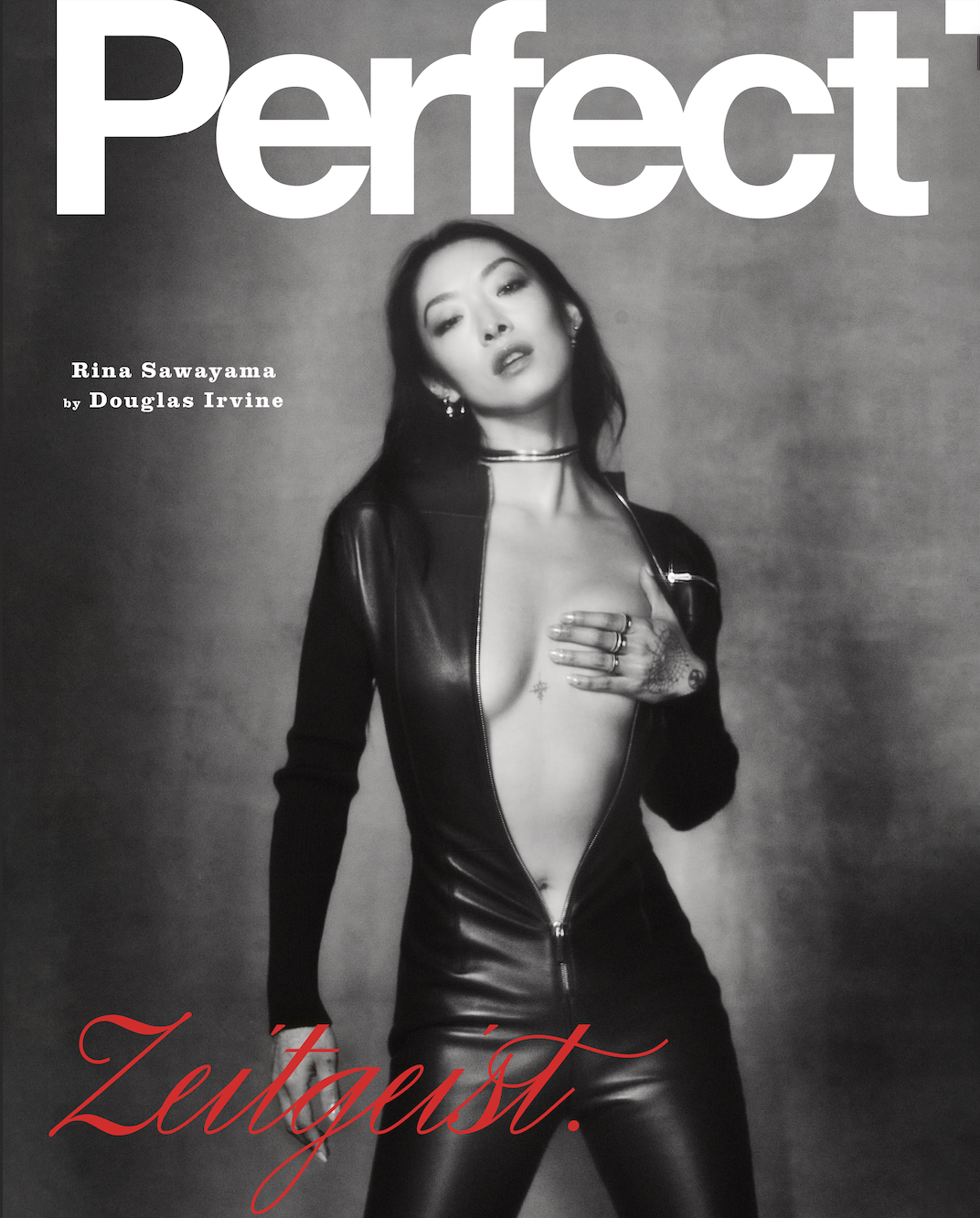
Rina Sawayama for Perfect Issue 11.
Photographer: Douglas Irvine
Fashion Editor: Nilo Akbari
Writer: Joe Bromley
This September, it will be four years since Rina Sawayama last released a song.
The Japanese-British singer’s millions of fans – known as ‘pixels’, after the glitchy digital world of her 2017 debut EP, Rina – have religiously followed her through sugary dance-pop, genre-warping bangers and softer, storytelling ballads, but the wait for more has been excruciating. Now, finally, it is coming to an end.
‘There is new music coming,’ Rina says from a sweeping hotel room in Budapest. The artist behind ‘Chosen Family’, the touching queer anthem she went on to duet with Elton John, and camp-pop banger ‘This Hell’, is off duty, having wrapped the Hungarian leg of filming the previous day on Caine, the upcoming action thriller in which she reprises Akira, her character from John Wick: Chapter 4. Today, she appears almost weightless: make-up-free, dark hair pooling over bare tattooed shoulders and dressed in a simple black bandeau. The following day she will fly to Hong Kong to finish the film. Acting has become one of the more enriching side quests of her time away from the mic; she will also appear in Will Sharpe’s upcoming romcom series Prodigies, opposite Ayo Edebiri and John Malkovich, on Apple TV, though no official release date has so far been announced.
Predominantly, though, she has taken the period of privacy to process the sharp, bumpy rise to acclaim that followed her breakout debut album Sawayama in 2020 (‘I still stand by that album. I think it’s a sick album,’ she notes), later cemented by Hold the Girl in 2022. It was a wild ride, and one that saw her make a trailblazing change to the UK music industry.
After Sawayama was ruled ineligible for the Mercury Prize because she was not a British citizen, her campaign, aided by fans who whipped #SawayamaisBritish into a frenzy and the support of Elton John, opened eligibility at both the Mercury Prize and the Brits to artists who had lived in the UK for more than five years. She was promptly nominated for the 2021 Brit Rising Star award.
Now, Rina says proudly, ‘I’m in a really good place – and I wasn’t two years ago, I really wasn’t. I signed my first album deal when I was 29, which is so not the norm for someone in my genre. I had to learn a lot of things quickly. It was very exciting, but there were a lot of challenges and politics that came with it. Now I’m in a place where I am free to creatively do what I want.’
After four years spent promoting two albums back to back, headlining multiple tours and shooting and promoting John Wick: Chapter 4, culminating in the gruelling 20-date Hold the Girl: Reloaded tour, which began on 9 June 2023 and ended in New Orleans on 9 October, she says: ‘I was pretty burnt out.’ Afterwards, she disappeared to Tokyo for two years. It was the first time she had lived there since she was five, when she spent a year in the capital having been born in the rural Japanese area of Niigata.
‘It was a culture shock, because I grew up in London,’ she says. In Tokyo, ‘I look like everyone else, whereas in London I don’t, but I still didn’t feel Japanese. It was a weird introspection of identity, kind of flipped around to how I felt growing up in the UK.’
She worked there, too. A new partnership sees her become the first global ambassador for Haku Vodka, by Japanese spirits giant The House of Suntory. Her campaign, ‘Made to Shine’, is built on the idea of standing out. With a video directed by Lady Gaga collaborator Frank Lebon and stills by her friend, the photographer Thurstan Redding, it captures Sawayama moving through Tokyo by night, an icy martini in hand.
“The fans have waited this long, so I know it needs to be the best that I’ve ever done.”
It is a message that lands naturally with an Asian queer pop star who has built a career out of making difference feel powerful. ‘A big part of queerness is this relationship with shame, which is such a dark thing to start off with,’ she says. ‘But so much self-reflection can come from the feeling of shame. I think it’s that resistance to shame which makes queer culture so beautiful.’
It also taps into her love for a night out in Japan. ‘I get to go around different cities around the world, but to me, Tokyo has the best nightlife and bar culture, hands down,’ she says. Nights in the gay district of Shinjuku helped ‘fill the well’ when it came to finding inspiration to write again in 2024. ‘I also need to read lots, to be alone and to listen to lots of music, which being in Tokyo really helped with,’ she says.
Her time away also coincided with a period of distance between herself and her label since 2019, Dirty Hit. The relationship had become strained, and boiled over during her Glastonbury 2023 performance when she called out The 1975’s lead singer Matty Healy, a former director at the label who still owns a minority stake. ‘Tonight, [her song ‘STFU!’] goes out to a white man that watches Ghetto Gaggers and mocks Asian people on a podcast. He also owns my masters. I’ve had enough!’ she said, impassioned, to the crowd.
‘I’m very proud of that girl. I wouldn’t take it back. But at the same time I think there are different ways to communicate, and that’s something that I’ve learned as I’ve gotten older,’ she says today. ‘I had a lot of repercussions that then made it very difficult for me to create. I had to do some introspection. What do I want people to remember about me? Is it the Glastonbury moment, or is it my records?’ Today, relations are much warmer. ‘We have a really good working relationship,’ she says, happily.
With the return of Rina will come the best songs she has ever written. ‘I’ve spent a lot longer on this record. In the past, especially with the second album, I wish I’d spent more time writing, crafting and developing the sound and refining the track list,’ she says. ‘I’ve recorded so many more songs, 50 demos at least.’
As for the mood: ‘I’ve leant into darkness and intensity,’ she says. ‘I always joke that I really want to write background music but it just never happens. I think what I’m good at is mixing genres, telling a story and making people feel. All those songs have that in it. Eighty per cent of the album could be singles.’
Model looks, and standing at 5ft 7½in, her eye for visuals and edgy fashion credentials (a regular on front rows, Gucci’s Demna invited her to his February Milan show, while go-to looks revolve around tough-girl leather, metal-studded gowns by Luis De Javier and Matrix-y, blood-red leather overcoats by Marine Serre) mean the world around the album is as important as the tracks themselves.
‘People think, OK, album done, finished, released,’ she says. ‘But also the fans deserve an amazing campaign, an amazing visual world, amazing music videos. They’ve waited this long, so I know that it needs to be the best that I’ve ever done.’ Whether it will see her lean deep into gothic, in keeping with the new sound, ‘or go opposite to that’, makes up ‘the sort decisions I’m making at the moment.’
Rina arrived in London in 1995, when her father, who worked in Japan Airlines’ head office, was transferred to the British capital. Five years later, once the family had secured indefinite leave to remain, he returned to Tokyo and her parents separated. ‘That was pretty tough,’ she says. ‘Parents separating, big financial changes in the household. I remember feeling that in the air, and the tension between my parents a lot.’ At 10, it was decided she would stay in the UK, and she began English school.
‘I remember really finding it hard to assimilate,’ she says. ‘But what I found united us was music.’ She taught herself S Club 7, Atomic Kitten, Hear’Say, Sugababes, Kylie Minogue and Holly Valance songs, becoming obsessed with ‘pop girl music’ because, she says, ‘it meant I would not get bullied or left alone.’ That Y2K sound would go on to inform her own tracks. Instead of being ‘this weird Japanese girl who couldn’t speak English’, she became the girl who would ‘do music and sing with us’.
At St Marylebone CE secondary school, she started performing. ‘I’ve been singing in front of 800 people since I was 12,’ she says. ‘Hence why I love performing now. I feel so at home when I’m on stage.’ She went on to earn a place at Cambridge to study politics, psychology and sociology. It was, she says, ‘one of the hardest times of my life,’ not least because ‘a couple of them will make it known that you’re there because you’re a minority pick.’
Still, she graduated, found her ‘chosen family’ and came back to London determined to make music. To fund it, she worked in an ice cream van, the Apple Store, as a nail technician and as a loan administrator, while paying rent for the room she had grown up in. ‘It was pretty hardcore,’ she says. Her self-funded debut EP, Rina, began gaining traction online, earned praise from The Needle Drop and helped her build enough fans for a ‘tiny, tiny tour’. The launch of her debut album ‘then changed my life’.
With a renaissance in sight, Rina is under no illusion the industry is in a better place than how she has left it. ‘There’s always this conflict between commerce and art, and that presents itself in unfair deals or the tension between the label and the artist. That will exist forever because you are commercialising art,’ she says. ‘I don’t think the artist’s biggest struggle is the music-making.’
But it is the rise of AI that keeps her up at night. ‘It frightens me, and I don’t even know what the solution is,’ she says. ‘At the same time, I do think that the best artists are the ones who can recreate feeling, and I think it’ll be a while before AI can do that. When I see AI art, it makes me feel sick.’
She continues to be driven by the knowledge that her audience still exists.
‘There will always be people who are looking to music and art for the feeling,’ she says. ‘It gives you an escape, it gives you love, it gives you anger, it gives you this expression. I want to hold that hope that there are people who want to feel through their music.’ As long as they do, Rina Sawayama will be there to soundtrack it.