Zara Larsson, From Stockholm to the World.
A Swedish creative troika assembles to celebrate the land of midnight sun, as the slow-burning, now ubiquitous pop sensation Zara Larsson is photographed by Sølve Sundsbø and interviewed by Bryan Yambao.
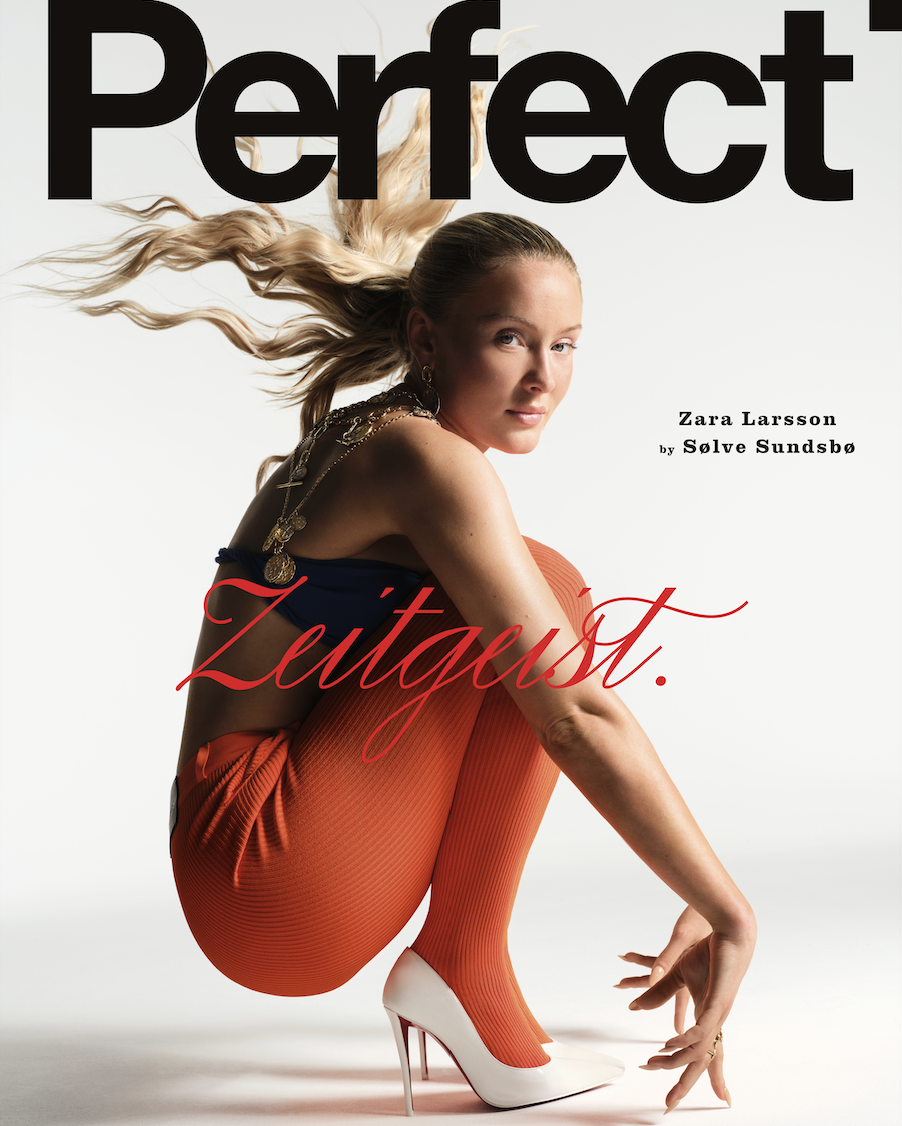
Zara Larsson for Perfect Issue 11.
Photographer: Sølve Sundsbø
Fashion Editor: Cher Coulter
Writer: Bryan Yambao
Zara Larsson is not new, not sudden, and not asking permission. With her fifth album Midnight Sun, the Swedish pop star is finally making the machine bend towards her.
Zara Larsson is a hometown hottie, which is not the same thing as a hometown girl.
A hometown girl is supposed to be humble, grateful, normal, forever explaining how fame has not changed her. A hometown hottie is more dangerous. She can leave, become global, turn herself into a full pop weather system
and still somehow look like someone
you might see at the supermarket in a hoodie, no make-up, buying ground beef for Taco Fridays.
Stockholm was having one of those obscene summer days when the city starts behaving like it invented light. Twenty-nine degrees Celsius. The lakes doing the absolute most. Polar bears looking suspiciously like people lounging by the water. The Swedes pretending not to notice how good they look. I am sweating in my house, preparing to interview Zara Larsson on Zoom, which feels both correct and deeply unfair.
Correct because Zara is everywhere this year: in my feed, on festival stages, in glitter, in flowers, in the eternal blast radius of her album Midnight Sun. Unfair because she is not here.
She appears from Gdynia, Poland, with mussels and fries, hours before she goes on stage. I am in the city she still calls home. Stockholm made her; pop took her elsewhere. She has barely been home this year – two weeks in total, she tells me – but she still looks emotionally local.
On stage, Zara is all voltage: powerful voice, body, hair, face, choreography, stamina, the kind of confidence that makes a crowd behave badly in public. Online, she is looser and more direct. Bare face. Grey knit cardigan. Swedish bluntness. Glamour off, charisma very much still on. She is too electric to be ordinary and too blunt to be mysterious.
Zara has been famous in Sweden since she was a child. She was 10 when she won Talang, the Swedish version of Got Talent, with the sort of voice that makes adults say very adult things about destiny. Then came the hits: ‘Uncover’, ‘Lush Life’, ‘Never Forget You’, ‘Symphony’. The songs travelled everywhere. For years, the voice was famous before the star fully came into focus.
That is the strange injustice of some pop careers. You can have global hits and still feel slightly misfiled. What Zara needed was not another hit, but a world that felt unmistakably hers.
Midnight Sun gives her that. In 2026, the title track earned Zara her first Grammy nomination, in the Best Dance Pop Recording category, which is less a discovery than a delayed acknowledgment. The industry did not invent this moment. It finally caught up to it.
The project’s real achievement is larger than validation. It is Swedish summer, Eurodance, flowers, dolphins, camp, glitter, friendship and late light. It is big, glossy pop, but this time the gloss does not swallow her. It reflects her.
Calling her a new discovery would be absurd. Zara Larsson is not new. She is not sudden. She is not an overnight anything. She is a woman who has spent more than a decade inside the pop machine and has finally made it bend toward her. Now she has heat.
The hometown girl became a hometown hottie.
Everyone else has to sweat.
“With Midnight Sun, I wrote all the songs, and I decided who I wanted to create this world with. I immersed myself in things that I care about but previously felt I didn’t have the knowledge to do.”
I’m in Stockholm. Do you live in Stockholm full time? How often do you come home?
I do, but this year I haven’t really been home at all. I’ve been home for, like, two weeks in total. But it’s still where I get my mail. (Laughs) When people ask me where I live, it’s Stockholm.
I googled your tour calendar and thought, what the fuck?
(Laughs) Yeah, it’s packed. But it’s fun. It’s been so much fun this year.
Everyone keeps saying you’re having a breakthrough moment. You’ve been on people’s radar forever. How do you feel about that word, ‘breakthrough’?
I definitely feel that there’s a shift in my career and in how people are reacting to me and my music. I was lucky enough to have a really big hit with my first song, ‘Uncover’, in Scandinavia. Then ‘Lush Life’ and ‘Never Forget You’ went really well. But it never felt like one song was building up to something bigger. It felt like I had these big songs, and they weren’t really tied to my artistry. I was speaking to my former label about this, and they were like, ‘Yeah, we’re going to see if we can put you in Best New Artist for the Grammys.’ And I’m like, I don’t even want that. That would downplay the 13 years of me being an artist. I’m not a new artist.
But that’s why I like ‘breakthrough’. It feels like the whole world is looking at me at the same time. Before, this song was successful over here, and another song a year later was successful over there. Now it feels like it’s all coming together quite nicely.
The thing that feels different from the outside is that this moment is not just about one song. It feels like a whole Zara world. Are you more in control now – with the music, performance, image, everything?
Yeah. That’s the biggest difference with Midnight Sun compared to my other albums. I feel like one day I just woke up. I started working with my friend Vendela Hyde, who is also managing me now, and I realised, wait,
I can do all of this. I think it was a confidence thing. I started out so young. I had just turned 13 when I signed my record deal.
I always picked my songs, but a lot of it was handed to me. It didn’t really grow from inside of me. That made me confused about, well, what do I think?
And Midnight Sun came from you?
For the first time, I did all that with Midnight Sun. I wrote all the songs, and I decided who I wanted to create this world with. The visual world is made with director Charlotte Rutherford. The songs are made with a small team who I love. Everything else is done by a small team. I immersed myself in things that I care about but previously felt I didn’t have the knowledge to do. It was like, well, I don’t know how to program lights, so I don’t think I can say much about that. But you don’t have to know. You can just say, ‘I don’t like that’, or ‘I like this a lot.’
You just have to have an opinion.
Exactly. You don’t have to physically know how to do everything. You just have to express your opinion on every single thing with people that you trust.
The fan-onstage videos have become their own religion. How did that start?
I was super inspired by Green Day. We
were watching them at Coachella, and
I loved the energy they brought to their show. They really connected with the audience. It reminded me that a live show is about something happening right here, right now, that cannot be replicated the same way next time. So for the next show, I decided to bring someone up during ‘Lush Life’. I kept doing it for a while, just to sing with people, dance with them, jump around and have a good time. Then, near the end of the tour in Amsterdam, one girl came up and actually did the dance. It wasn’t planned at all. She just did it.
And then she created a whole movement?
She kind of created a whole movement of people starting to dance to the song on TikTok. Now it’s something people expect to happen when I bring them up. You can’t really plan it. If you create a space for fun things like that to happen, they usually grow organically and become what they’re supposed to be.
What is the most Swedish thing about you that LA, America or the music industry cannot take away?
In many ways, I do consider myself quite Swedish. But I also consider myself quite American in how I think, what I feel about things and how I look at myself. I really appreciate that Swedish culture is very socialistic, or that it’s ‘you’re not better than anyone else, but you’re also not worse’. I like that idea. But personally, not that I think of myself as better, but I do think of myself as special. And I do want more for myself. I like that that’s the culture in society – but for me, I’m like, no. I need to go beyond that.
Jantelagen! That very Scandinavian idea that you’re not supposed to think you’re better than anyone else.
Yeah. Something you can’t take away is some sort of baseline equality that I just have in me. I really, truly see everyone as no one better or worse than anyone in my crew, on my team, than myself, my management. I think it’s really important to treat people with equality and respect.
“The older I get, it’s becoming clearer and clearer to me that my passion and what I really care about is people coming to my shows. For me, the ultimate success would be a stadium world tour.”
When you’re at home in Stockholm, can you go to the supermarket? ICA Maxi? Can you do regular things?
I do. I go out with no make-up. I don’t care. But if I go out, I have to be prepared that if someone wants a picture, what do I want to say to that? I hate to say no. So, yeah, I live my life very normally.
It’s usually kids, right?
For real. It really is. If I see a group of young people, or school’s out and everyone’s walking home and I see a big group of 11-year-olds, I’m like, fuck. Picture time.
And in America?
In America, when I’ve taken a picture with someone at a mall, I’ve had someone else come up to me and be like, ‘Oh my God,
I really want to take a picture with you too.’ And then after they’ve taken a picture, it’s like, ‘So what do you do?’ And I’m like, well, you don’t know me? Why do you want to take a picture with me?
Do you feel creatively inspired by being in Stockholm?
Stockholm to me is the place where I go to not work at all. Since I’m not home that much, I try to go there and not work. Being inspired, I figured out, is about living my life. It’s not inspiring to always work and never have time for your friends and family. To stay inspired and to love life, you also have to live it. That’s what I do when I’m in Sweden. I spend time with my boyfriend, my sister and my friends. I go out and eat. We go to restaurants or to the countryside. That fuels my soul a lot.
How do you measure your own success as an artist? Charts, streams, exposure, applause?
The older I get, it’s becoming clearer and clearer to me that my passion and what
I really care about is people coming to my shows. For me, the ultimate success would be a stadium world tour. People have taken time out of their real lives. They paid money to experience this with their friends, and I get to be on stage and sing live. The live culture of it all is what I really, really care about. And what’s been so amazing about Midnight Sun is I feel like it’s gone beyond just a good album or a good song. People are being invited into my world by putting on their outfits and their flowers and the glitter and the colours. The culture around it is how I feel successful.
Not just the song being played on the radio a lot?
That’s being decided by a very small group of people in the industry. Even the Spotify charts and all of that, I think it all goes hand in hand. But ultimately, I just want people to really, truly fuck with it in real life. I see that the clearest at a live show.
I don’t know how you do it. Performing every day, every two days, every three days. Where do you draw that energy from? You’re performing tonight and you’re eating…
(Laughs) …My mussels and my fries. It’s like you clock into work. The more you do it, the more comfortable you get and the more stamina you build. I was off for 10 days a couple of weeks ago, and I did not really move an inch. I was just lying flat, eating, napping, watching movies, maybe going outside, looking at the clouds, lying down. Then I came back to the stage and I was like, oh. You lose it so fast. But it’s exciting. I’m at a point in life where I feel really comfortable performing. I don’t get nervous. I just get excited.
That’s crazy!
I’m at work. It’s like going to the office. But my office is in front of thousands and thousands of people.
Over the years you’ve been very vocal on what you believe in. What is the most adult lesson you’ve learned from all these years?
(Laughs) Oooooh!
We don’t have to go there.
When you say that, it makes me think of when I lost… I’ve lost many deals, honestly, over things that I’ve said and stuff that I’ve done. But I don’t think that’s a lesson.
You don’t?
Not really. It’s not like I’m like, oh shit, I lost this deal, I shouldn’t have done that. I’m honestly like, OK. I don’t give a rat’s – I really don’t. I think it taught me to not make myself smaller or smooth over my morals for a bag. If that’s going to cost me my morals, or not saying things, or having to censor myself, or apologise for things that I actually don’t want to apologise for, then I don’t think it’s a loss.
You’ve been willing to say things even when there was a cost.
At least, I think so. Some people might disagree and say, oh, you’re fucking crazy, or why would you say that, or you’re wrong about this. But I think I’m right. (Laughs)
Have you always had the freedom to express what you think?
Yeah. I think I’ve always found it really important for people to know my opinions. I would have been like this no matter if I
was a singer or not. It’s just part of my personality. I’m very opinionated. And I love a good argument. I’m curious. Honestly, I’m curious about people. I love humans! I love connections! I feel like if
I spent enough time with anyone in a room, I could get along with anybody. We would find common ground. I may disagree with people’s opinions, but at the core of it, I care about human rights, feminism, whatever, because I care about people. Some people are stupid, but when people are racist, it’s not because their soul is bad. It’s because they don’t know better.
I have empathy for that, in a way – but also, damn, you guys are stupid.
That’s the balance.
The older I get, I realise I feel more sad about that than angry. But anger is good to have, because it makes you do things. Anger is the one emotion that makes you get up and get active.