Cara Delevingne Is Finally Singing Her Own Story.
Modelling and acting made her a household name. But it’s only since she started making music that Cara Delevingne has found a way to take full command of her creativity and public image.
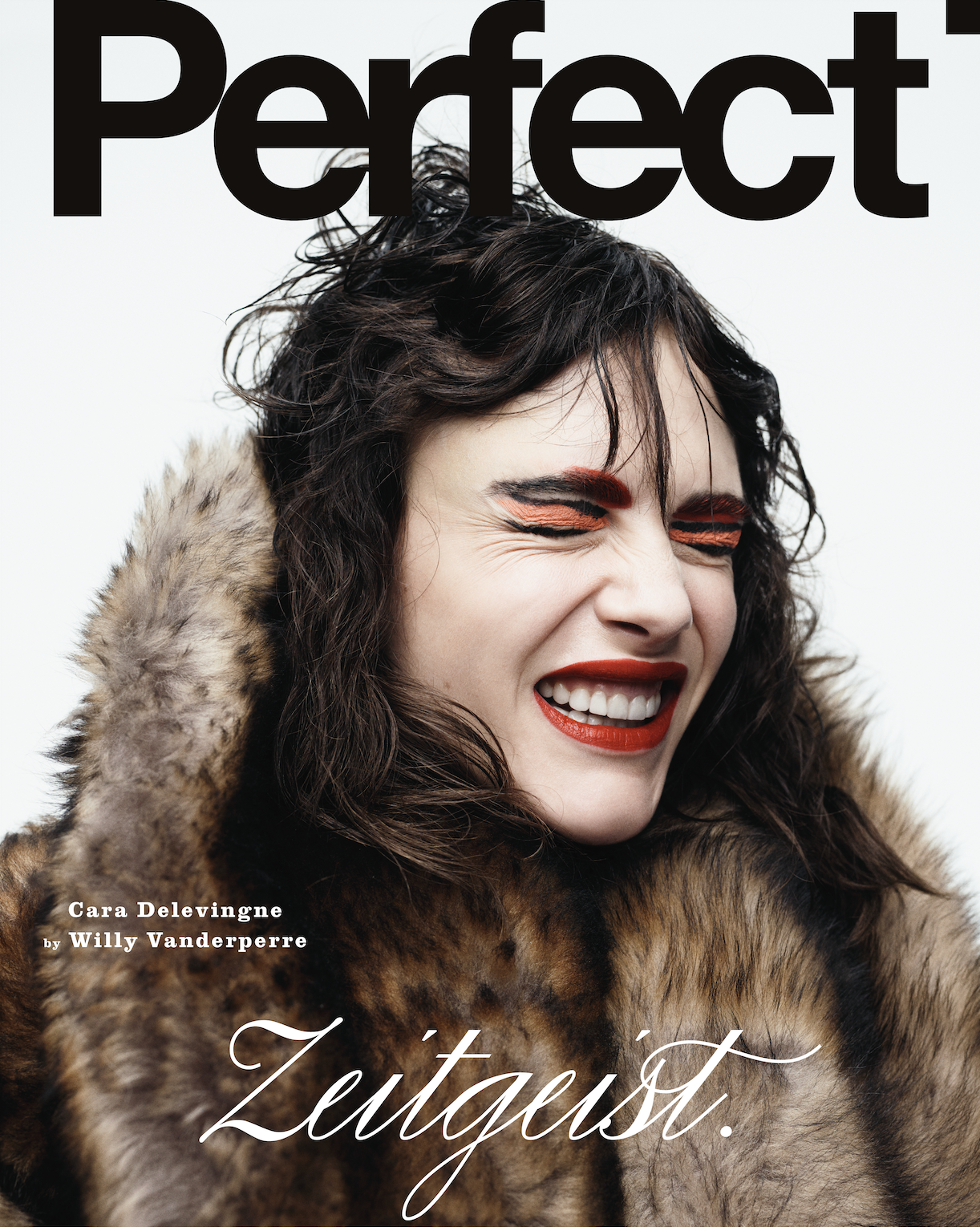
EJAE for Perfect Issue 11.
Photographer: Willy Vanderperre
Fashion Editor: Katie Grand
Writer: Taira
It is six o’clock on a sweltering London evening; the city is locked in a heavy, sticky heatwave. I am sitting still behind my laptop in a darkened, boxy kitchen, with a humdrum fan failing to stir the torpid air. On the screen, Cara Delevingne breezes into view from a crisp morning in Los Angeles. Fresh out of the shower and effortlessly in motion, she apologises cheerfully before switching her camera off to get ready for the busy day ahead. Tonight brings her first US gig, leading up to the release of her debut album.
And for much of our time together, I am listening to a voice seamlessly weaving vulnerability and self-assurance into the fabric of our dialogue. There is something fitting about that. Cara has spent the better part of her career being framed to be looked at. Today, she is reclaiming her narrative through sound, and is still in the process of recording new music. In the middle of our conversation, she will climb into her car and drive to the studio before hitting the stage.
Having moved through similar professional worlds, navigating the hyper-visible economy of the industry, I recognise the tension between performance and selfhood. It is easy to become trapped in a mirror maze of frozen stills. Yet what strikes me about Cara is not a sense of conflict, but a kind of hard-earned serenity and self-ownership of her journey. She speaks with the confidence of someone who has made peace with the fluidity of the self. There is power in that. The energy is entirely palpable through the screen, leaving me emotional at times.
That honesty pours through her album like a dam relieved of its weight. Her music carries a cathartic intentionality that resists containment, conveying the story of an artist no longer fleeing the currents of her own melody – its transitions inspiring a journey through shapes of identity.
It’s honestly been so exciting to see this new chapter for you. And you seem more assured and comfortable with your identity these days. So I wanted to ask whether it feels that way to you too.
Oh, definitely! More than I can really put into words. It’s a feeling… It’s a daily thing. Of course, there are days that feel so vulnerable and raw, especially recently towards releasing this music. There’s been a lot of self-doubt and self-destructive rhetoric coming in. I can feel my brain trying to tell myself that I’m not good enough… [But] I constantly like to challenge myself to grow. By doing things that make me uncomfortable – especially something like music, which has been my dream forever – it allows me that space to really step into that belief in myself, in art, creativity and expression. It’s been just so transformative. So I’m glad that it reads like that to people outside myself!
I remember you mentioned recently that you’ve shifted your focus toward projects that you genuinely care about, rather than working just for the sake of work. What was the internal catalyst for that shift?
I think in your twenties, you feel like time is limitless, life is long, and you’re kind of invincible – you can keep going and going. [So] I didn’t take time to think about what I really wanted; I was always acting on a whim. But it just came to a point where I can’t do my best work unless I really can dedicate myself to something wholly. And making space for that is really important.
I think it happened throughout my twenties. Doing Cabaret in the West End made me realise how much I enjoy fully immersing myself in a project, with the space and the time around it to breathe and process it. Because these jobs are really cathartic. And giving space and the time to actually feel that, and to be proud of it, and to congratulate yourself. It’s all been a big lesson for me.
How have you been able to work out the difference between what you want to do and what others want from you?
Mm… I don’t think about what others want from me at this point. As humans, we generally think a lot about what other people think. But actually, humans are more selfish than that. I think people aren’t really that bothered, genuinely. It’s not about what anyone else wants; it’s about what you want. And I think I’ve been really trying to follow the beat of my own drum.
“I knew I had to really work on the relationship with myself first. And that was kind of the priority before anything else”
You’ve been making music privately since you were a kid – playing the guitar, drums and piano. How did you start forging your relationship with music?
Growing up with sisters, I definitely discovered music through them – creating dance routines and performance, and hearing people sing and speak. Through music, I just felt an immediate sense of connection with people I didn’t know. And I think that sense of community through music is a really powerful thing. Instruments were something I wanted to play from as soon as I can remember, for being able to express by using writing and instruments.
And why does now feel like the right moment to share your music with the world?
Um… I don’t know. It’s like having a baby – I don’t think there’s ever a right time. But everything aligned in that way. I’ve been working on this project for… I feel like my entire life, but actively for the last three or four years. I wished it to be as soon as possible. But somehow, taking my time with it felt right. I knew I had to really work on the relationship with myself first. And that was kind of the priority before anything else. I have such respect for music. It’s like a tree growing, or growing your own garden – there’s no point in speeding things up and missing really important steps. And I think it has really helped me grow and feel confident in my voice and artistic presence.
What do you think is so special about music in comparison to other forms of creative expressions that you’ve been involved in?
I think with music, you really are the artist. You get to have a full range of your tools – different brushes and paints. And whatever you create is really a pure expression of art for me. If I was good at painting, I would do that. But to me, music is the thing I’m good at, and the thing that I can do and understand. I think a lot of healing can come through music and sonics… Words are incredible, but they are quite limited. So through music, I think you can really express and show an array of emotions.
Is it a matter of having control over your work? As you say, you’ve got the artistic tools in your hands to produce your creation.
Yeah! There’s something incredibly powerful about that… and scary! And exposing. But there’s so much freedom. You’re really plucking things out of nothingness and making them into something. There’s nothing quite like that feeling.
In the past, you’ve mentioned that you are good at avoiding things, and that you’ve been running away from your issues since you were a kid. Do you think music gives you a space to be able to face them?
I think for all humans it’s a lot easier to avoid the truth, because it can be painful and ugly. Facing stuff can be really uncomfortable. And yes, music is a way of doing that – but also making something good out of something bad. If I get upset or angry, I will feel these emotions. As an artist, I always feel like being able to create something that people can relate to, out of the painful emotions, makes it easier to deal with them.
That’s wonderful. Now, let’s talk about your music video. When I experienced your music with the video, it felt like a crystallisation of everything you’ve done. Did you already have these exact visuals and concepts in mind while writing the tracks, or did they evolve later while collaborating with Jessica [Lee Gagné, the Hollywood cinematographer who directed the video to Cara’s first two singles, ‘I Forgot’ and ‘Out of My Head’]?
Some of them… but they changed through time. When I’m in the writing process, it’s super visual. And then, as the album came together, I was finding it really hard to picture myself within the music. And working with someone as incredible as Jessica to make that come to life… We were definitely on the same page for a lot of it. It was different in some ways. But that feeling of zooming in and out of things, and feeling very surreal and not knowing what’s a set – I wanted it to feel confusing, because that’s how life can feel sometimes.
From the visuals, I felt so many things, but one of them was an embodiment of the fashion industry, in terms of the performativity aspect. Do you think your experience of modelling has impacted upon your identity outside of work?
Yeah! I think everything I’ve done up until this point has influenced the art I make now. For me, as an artist, using everything I’ve been through is the key. It’s also stopped me from relying too much on fashion, and more on the visual world-building. Especially with the hair and the make-up – I really tried to avoid making it too much about fashion, or leaning too heavily onto that.
Yeah – which I thought was really nice, because it was almost starting as a fresh canvas, as you, as Cara. On the subject of identity… Because you’re so open, the industry often highlights your advocacy for mental health, addiction and the LGBTQIA+ community. Does it ever get exhausting to be treated as the face or spokesperson for a community?
No. I think the place for me, where I’ve always felt welcomed with open arms, has been the queer community. I’ve never felt such a sense of joy and pride and belonging, in the sense that we’re all different. Celebrating each other’s uniqueness, while having a common thread of feeling marginalised or oppressed in some way… there’s a real beauty within that. I think incredible art comes from that. Adversity and pain always creates. And I feel so grateful for being in the community. Even if I wasn’t… well, I can’t imagine ever not being queer (laughs). But even if I wasn’t, I think I would always find myself attracted to this community. So it never feels like a burden. It feels like an honour and a gift, and something I really believe in.
I wanted to ask you about that, mainly because I remember you saying you dislike labels, and you struggled with your own queerness as well. So it’s nice to know you feel that way.
Yeah… people sometimes get that confused. For me, labels – and I find the same thing with words – can be very limiting. And labels and words mean different things to different people. What may make me feel really strong and what I use as a word of affirmation may be offensive to someone else. But I think sometimes people can hide behind labels or… get stuck, or get upset. I think a lot of discourse comes from the misuse of words. So that’s kind of more what I mean.
Yeah, because there’s sometimes policing going on within these labels, no? It’s supposed to be liberating for everybody.
Exactly.
I totally understand. That’s why I choose not to put any label upon myself as well, because it feels quite divisive rather than welcoming and liberating.
That’s really interesting… I think for me, the rule for labels is that they can change. But I think for a lot of people, they use it as a word that is fixed.
Yeah, when it’s rather fluid.
It is fluid. It can change, it’s about exploration. You can try on a label, and take it off again. Or it can develop… It should mean something at that moment, but that moment isn’t fixed. It’s just interesting how different people use them and the relationships they have with them.
“Doing things that make me uncomfortable – especially something like music, which has been my dream forever – allows me space to really step into that belief in myself, in art, creativity and expression.”
Related to labels, you’ve now been known in so many different forms – model, actor, writer and musician. How do those labels matter to you? Or how would you like people to understand you in the future?
I think in terms of jobs, I also hate labels! (Laughs) But I don’t mind. People can see me however they want to see me. I don’t want to force people to see me in a certain way – like, ‘Oh! Don’t forget I’m a musician’, you know? I think if anyone experiences what I create, whether that be a picture or a song or a movie, then I feel very grateful.
What do you hope this music allows people to see about you that they haven’t probably seen before?
To me, it’s just a whole new level of vulnerability. I hope people can understand me a little more. And within understanding me, understand themselves. I hope it allows people to ask questions, and to give themselves grace and patience. Especially for those in the entertainment industry. Through my music, I want people to see the idea that ‘I now have my shit together’ or ‘people know what they’re doing’ or ‘they are better than anyone else’ is totally false. We all struggle. No one’s better than anyone else. And music is a global language that everyone can speak. I think that’s really special.
You’re so brave to be so vulnerable. Were you not ever scared to be so open, and to share very honest opinions about the industry?
I think the one thing that I get scared of isn’t standing up or speaking about something I believe in. Fear is an incredible thing. I think I’ve had a bad relationship with fear, I think nothing used to scare me. But now I have a very healthy relationship with fear, because if you can face your fears, it can set you free. Obviously fear has an element that keeps you alive, but it can also keep you very stuck and stagnant. So constantly trying to push and move forward to me is always the goal.