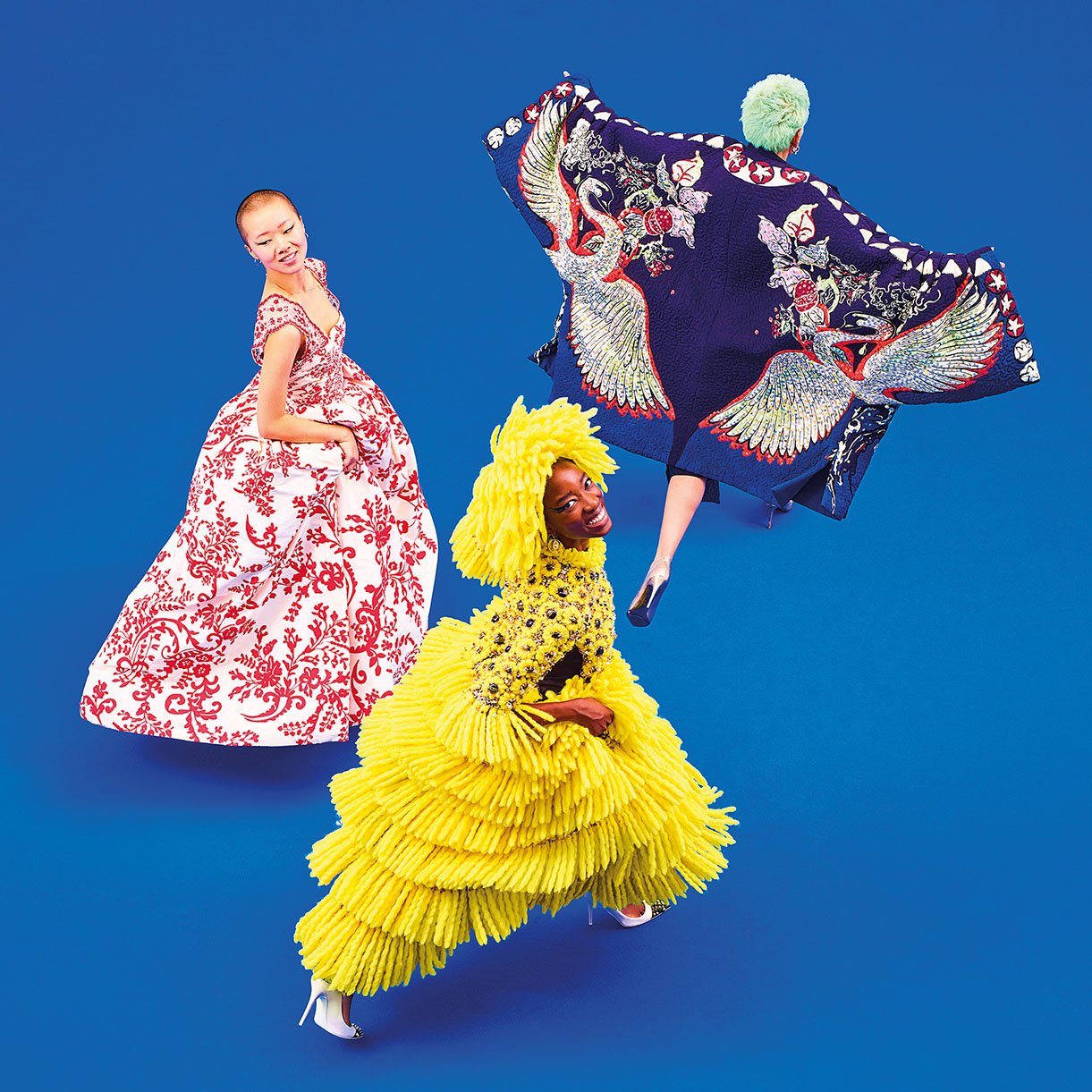
For a designer, Pierpaolo Piccioli makes quite a philosopher. Or is it the other way around? ‘The aesthetic goes to the identity,’ Piccioli offers during a Zoom call from his studio in Rome, where he’s at work on the couture collection set for Venice in July. His succinct, heady proclamation evolved from the starting point for his spring 2021 ready-to-wear collection into a defining tenet now applied broadly to his approach as creative director at Valentino. It goes to the heart of the photographs on these pages, created by Maurizio Cattelan and Pierpaolo Ferrari in concert with Piccioli and Perfect founder Katie Grand.
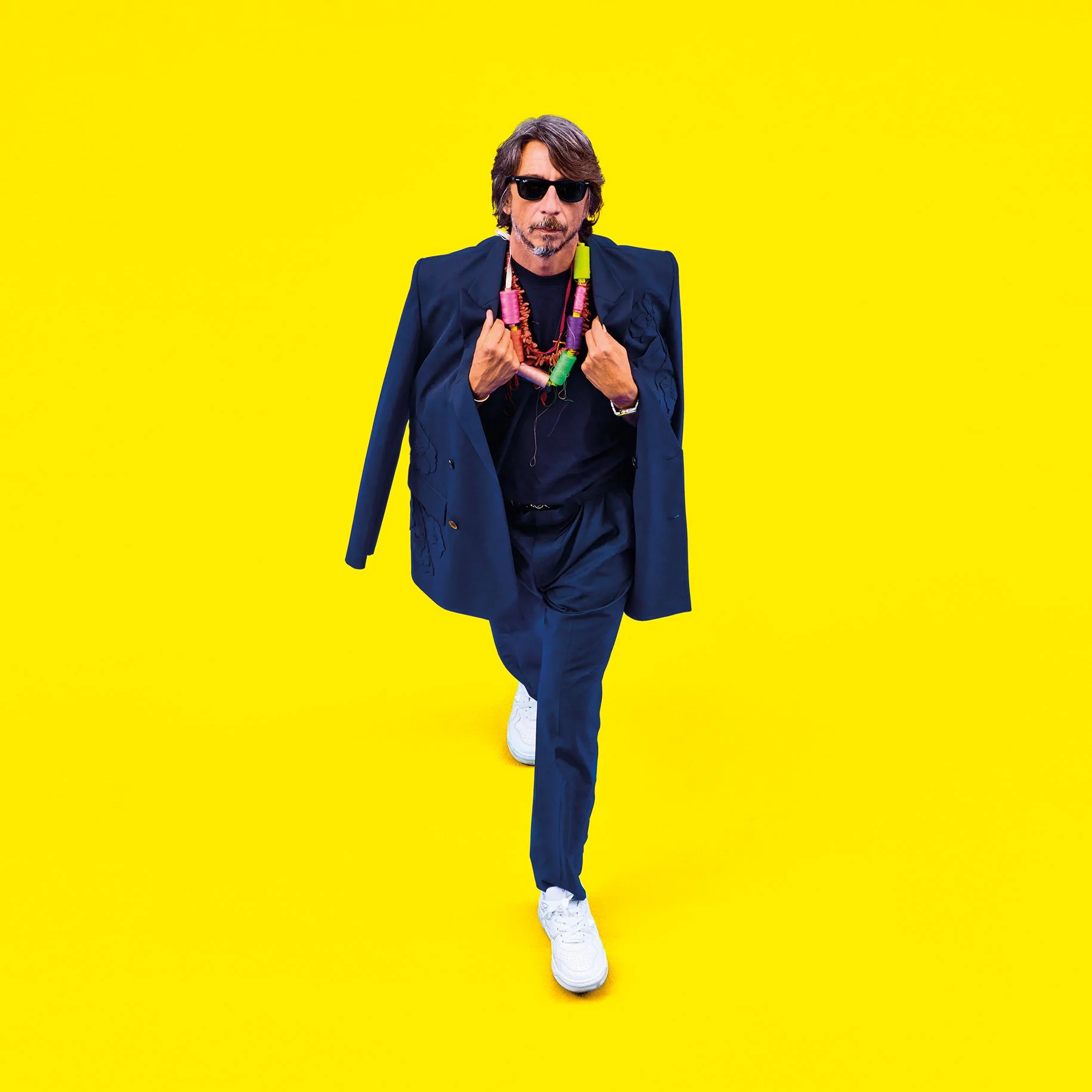
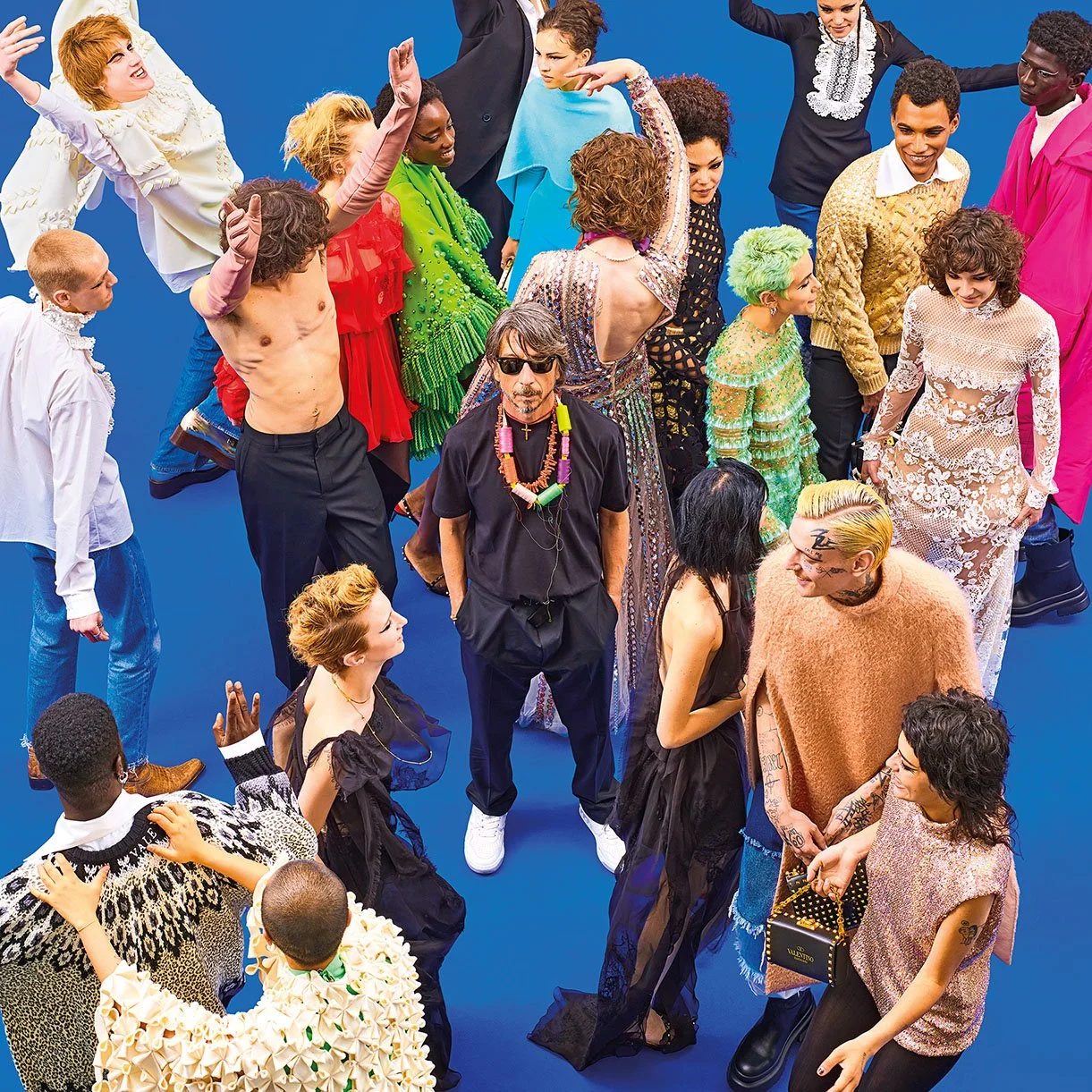
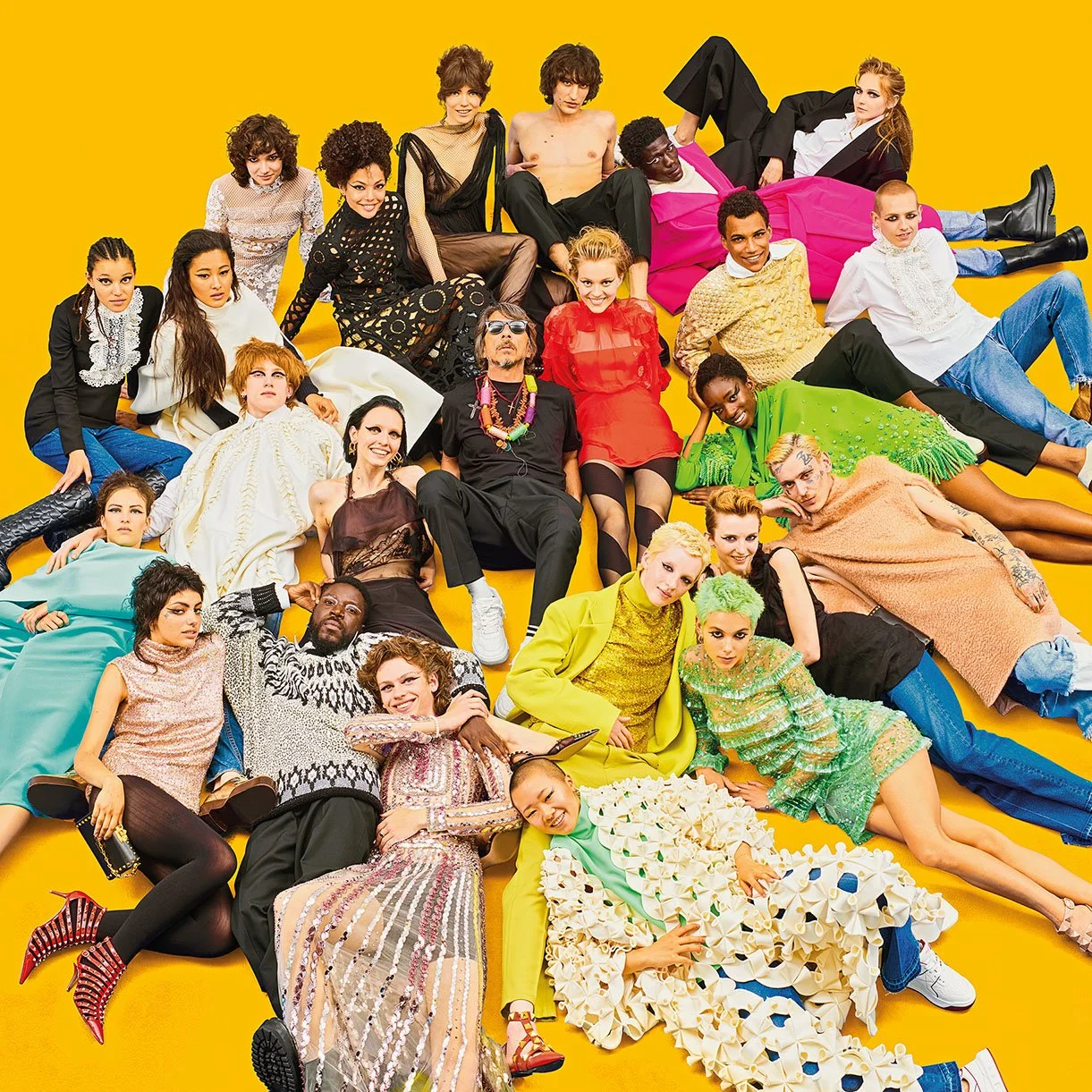
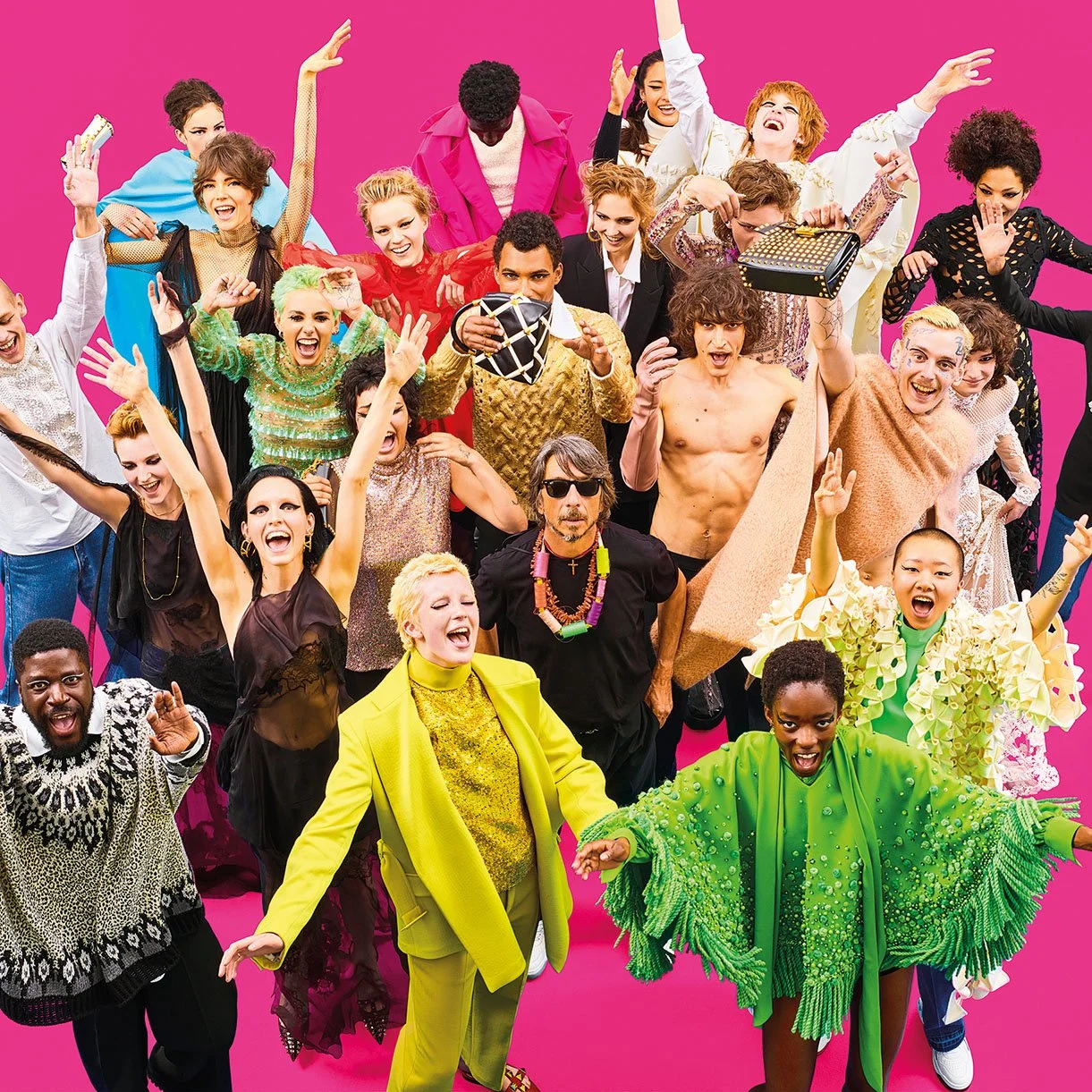
For years now, Piccioli has been on a magical, career-defining run during which his seasonal shows have exceeded monumental expectations with extraordinary beauty and exquisite audacity. The clothes are impeccably crafted, their often-dramatic silhouettes worked in interesting materials and daring invocations of colour unparalleled since Yves Saint Laurent. Sometimes, apparent simplicity masks essential intricacies of construction as well as hidden touches, often on the inside, known only to the wearer.
Yet visual splendour is only part of the power of Piccioli’s fashion. At a Valentino show, the emotion is palpable, and the designer strives for that emotion to move beyond the runway in a very personal way. When Piccioli says ‘the aesthetic goes to the identity’, he means that the person wearing the clothes creates an identity for them independent of what he as their creator may have intended. He cites two models from the Cattelan/Ferrari shoot, Florence in the yellow pantsuit, shown on a man in Piccioli’s January couture show, and a young man named Cosmo, wearing a sequinned dress.
‘If worn by a beautiful, classic model, it’s a beautiful, classic dress,’ Piccioli observes. ‘Worn by Cosmo, a guy who is used to wearing these kind of dresses with denim underneath, it is exactly the same dress. But the way he wore it completely changed the meaning of the dress. It became less classic, something beautiful but with a new life. It’s the same with Florence wearing an outfit for a man.’
Both Cosmo and Florence, as well as the numerous other models on the shoot, had input into what they would wear – the looks assembled from the current ready-to-wear and couture collections. He sees the clothes as conduits to forging a ‘community of humans’ essential to his vision for Valentino. He wants you to feel a part of something, yet feel like yourself, and perhaps find yourself in his clothes. ‘For everyone just to be themselves, everything real and authentic,’ he explains.
“Good taste and bad taste don’t exist. It’s always good when you are authentic and faithful to yourself.”
Piccioli talks frequently about the ‘couture values’ that set the tone for the house, and the necessity of interpreting those values in a 21st-century context. When he asserts that ‘I want Valentino to be a manifesto of inclusivity, freedom, equality and truly beauty of the house and the culture of this house’, one senses genuine depth of conviction. Yet at times, high-minded conviction and pragmatism make sweet sisters. The shows on which Piccioli made his name were extravaganzas in which reality receded behind rapturous flights of fancy. He became associated with the grand gesture – the remarkable gown, the indulgent proportion, the sartorial dream. Such reverie inspires and awes, but it does not necessarily translate to everyday life and wardrobes. Therefore, in recent seasons, Piccioli has determined to highlight the real clothes as well. His most recent couture, for spring 2021, took a surprising, spare turn. In ready-to-wear, the shirt provided inspiration for spring 2020; autumn 2021 was almost all black and white, cut sharp and super-short.
‘It’s important for me to stress this idea,’ Piccioli acknowledges. ‘It is super important to get real life into the brand. Otherwise you just do a mind exercise. Good clothes are to be worn. I don’t care what you look like or how you wear them. People have to feel confident, and use the dresses as an expression of a personality. That’s it.’
The freedom to find one’s self in Piccioli’s clothes has made him a favourite of celebrities. Two of the biggest stars out there, Lady Gaga and Zendaya, started out wearing the clothes and now have formal relationships with the house. Zendaya is the face of Valentino; autumn marks her second campaign for the house. Gaga is the face, and voice, of the fragrance Voce Viva. ‘Gaga is a daring artist who uses her talent to stand up for the values she believes in,’ Piccioli notes. ‘Zendaya is already a symbol of equality. She is a young woman but she is fierce. She is very aware of who she is.’ And oh, yes, there’s the talent thing. ‘Sometimes today people don’t talk about talent. Talent is a super important value. Being famous doesn’t always mean being talented; you can also be famous today on TikTok, which I respect. But Zendaya and Gaga are talented artists.’
They are but two of the famous, talented women who have worked Piccioli’s Valentino on the red carpet to diverse effect. Among the many: Elle Fanning (storybook romantic in full-skirted flowers at Cannes in 2019); Cynthia Erivo (futuristic chic in structured neon green mesh at this year’s Golden Globes); Caitriona Balfe (siren sexy in a black gown with pink chiffon overlay at the 2020 Oscars) and Gemma Chan (a great big fashion-fabulous pink tent at the 2019 Oscars). Such sightings aren’t confined to the red carpet; Dua Lipa’s endless white wonder of a gown from the autumn 2020 couture presented at Rome’s famed Cinecittà studios might be the most over-the-top fashion statement ever made on Saturday Night Live.
Then again, maybe not. For this year’s (quite peculiar) Oscars ceremony, Best Actress winner Frances McDormand wore what was, in the lingo of New York’s old Garment Centre, a schmatta, shape-free and plain (but for its sleeves, frothed up with feathers). The following Saturday, a similarly bedecked Kate McKinnon paid worthy homage in a skit about a game show: ‘I’m here to buy, um, more grey sack dresses.’ Conversely, also to the Oscars, Carrie Mulligan wore a full-skirted, glistening gold gown that referenced old Hollywood, but with a bare-midriff update. And in her alluring, languid yellow gown and undone tresses, Zendaya looked otherworldly, like a modern-day, fully-dressed Venus on the half-shell.
Piccioli calls his friend McDormand ‘a very free woman’ and her dress from a prior season ‘a perfect choice; a good representation of her role in Nomadland.’ (McDormand doesn’t always dress down; in 2018 she went wacky-haute and headdressed to the Met Ball.) ‘Frances and Zendaya and Carrie Mulligan all chose from my collections,’ Piccioli continues, ‘but they were all different, and they were all fantastic on the red carpet. They did not have a common aesthetic. They had a common identity, which was about their individuality, their freedom and their independent states of mind.’
In March, Piccioli enlisted British singer-songwriter Cosima to perform during his autumn show in Milan. Cosima wowed with her rendition of ‘Nothing Compares 2 U’. She was wowed by her interaction with Piccioli, and found a duality in his work – ‘tough and romantic in equal parts’ – to which she responded. ‘His clothes speak to the rebel in me as much as they speak to the romantic in me!’ she says.
Piccioli was ‘a dream’ to work with, Cosima recalls, elaborating in a manner beyond the usual celebrity ‘I love my dress’ comment. ‘It is very rare to find people who truly collaborate by allowing you to bring the truths about you to them, while they bring the truths about them to you, and you meet somewhere in a beautiful middle,’ she says. ‘He is one of those rare people; he really collaborates in a wonderful way.’ Still, she’s a performer, and the end result matters. What she loves most about dressing chez Valentino: ‘The emotion behind it and the outcome that matches the emotion!’
Similarly, Tomi Adeyemi admires the emotion of Piccioli’s work. The New York Times best-selling novelist teaches a course called ‘The Writer’s Roadmap’, for which Valentino provided scholarships. ‘Collaborating with him is like collaborating with the Fairy Godfather,’ Adeyemi says. ‘He is generous, empathetic, and leads with his incredibly beautiful heart.’ While his clothes ‘allow women to see [the] beautiful flowers in themselves’, what speaks most powerfully to Adeyemi is the mindset behind them. ‘Pierpaolo uses his artistry and platform to advocate for the change he wants to see in the world,’ she says. ‘Whether it's in the diverse models he uses or the message behind the collections that he puts out, he doesn't miss a moment or opportunity to shine light and bring necessary change into our world.’
As Piccioli sees it, that’s what a designer is supposed to do. But don’t confuse his work with art. Piccioli draws a line between art and fashion, and he’s fine with the distinction. ‘Art, by definition, is for art’s sake,’ he says. ‘It’s an expression of yourself and has an urgency of expression. Fashion must relate to the body. The premises of art and fashion are different.’ (Which is not to say he doesn’t love an art reference. For his July couture collection, he asked 20 artists to develop pieces, and then he created looks inspired by those works. ‘In this [Covid] moment, all of us are disconnected because of physical distance,’ he mused. ‘I wanted to see how different people look at this moment.’)
To Piccioli, making a distinction between artist and designer in no way diminishes the role of the latter. ‘I am a designer. I use fashion as a language to express myself, to express my values, to express my ideas through bodies, in a different way from art,’ he offers. ‘Fashion has its own dignity, its own value. With true fashion, you can witness your times as an artist does. If you just do clothes, you don’t do fashion. If you do fashion, you have to talk about your times through a vision of beauty, through clothes.’
In conversation, Piccioli is more prone to big-picture deep thoughts than to acknowledging the surface beauty of his clothes. When pressed for comment on what about the clothes has put him at the pinnacle of fashion, he acquiesces a bit. ‘I design as a designer. I am not a curator or a stylist,’ he says. ‘When you do clothes, it’s important that you do clothes with a reason.’
Piccioli’s process starts with ‘a dream, a reflection, not about clothes, but about life, what I’m thinking at that moment. The September one [spring 2021] was about the idea of identity and aesthetic.’ Rumination must then translate into clothes: Piccioli starts by envisioning the show’s finale. Once that vision crystallises, he gets to work with his design team, sketching, working on fabrics, ‘going in close, on every single detail. I also try to do this in a very free way and try not to be too thoughtful.’ Throughout the process, the clinical elements of producing clothes inform the end result, but Piccioli’s early vision tends to stay fairly constant. ‘That vision helps me make choices in the daily process. Usually, if it goes too far from that initial picture, it’s not the right choice.’
Piccioli recalls growing up with a singular career aspiration. ‘As a kid, I was screaming about fashion,’ he says; he observed it from afar, with ‘enchanted eyes’. Now, ‘I don’t want to forget the kid I was. I want to keep those enchanted eyes when I do every single piece of the collection. I remember who I wanted to be. I wanted to be a designer. I loved fashion. I still love fashion with the same passion. I am a designer, that’s it.’
That designation has become more powerful with time. Since childhood aspiration became reality, first as a backroom accessories designer at Fendi and Valentino, and then, in the limelight as creative director of Valentino, Piccioli has loved working as a fashion designer – its challenges, its possibilities, its responsibilities. It was the perfect job for him. Or so he long thought. But that opinion has evolved. ‘Before, I had a job and I had a life. Now I feel that everything overlaps,’ he says. ‘“Designer” is not my job. It’s part of who I am.”
That fusion only crystallised in the past few years, a realisation both subtle and profound. ‘It’s about choosing to give everything, even in terms of emotions,’ Piccioli explains. ‘You cannot deliver emotion if you are not the first one to be emotional, to be moved by something – moved through the creative process. If you don’t deliver emotions, you just deliver clothes. Which is fine, but it is a different thing. I feel that now I definitely want to find the emotion. It’s not a choice, it’s just what happened. It’s the most human way.’