Recently, Penelope Cruz was chatting with a friend about how her schedule for 2026 was shaping up, and they got on to the subject of how many films she had due for release this year. Six, maybe seven? When you’re as successful an actor as Penelope Cruz, it’s easy to lose count, so it hadn’t dawned on her till this point, the sheer volume of what was coming. ‘I don’t know why, but I did not realise this until the other day when I was counting with a friend, “Oh, this one – and that one, and da-da-da…”’ The reason why the actor continues to be so prolific when her CV already boasts over 60 film roles, and the nature of the obsessive love of cinema which drives all of this, is something we’ll return to later. For now, there are more pressing practical matters to consider.
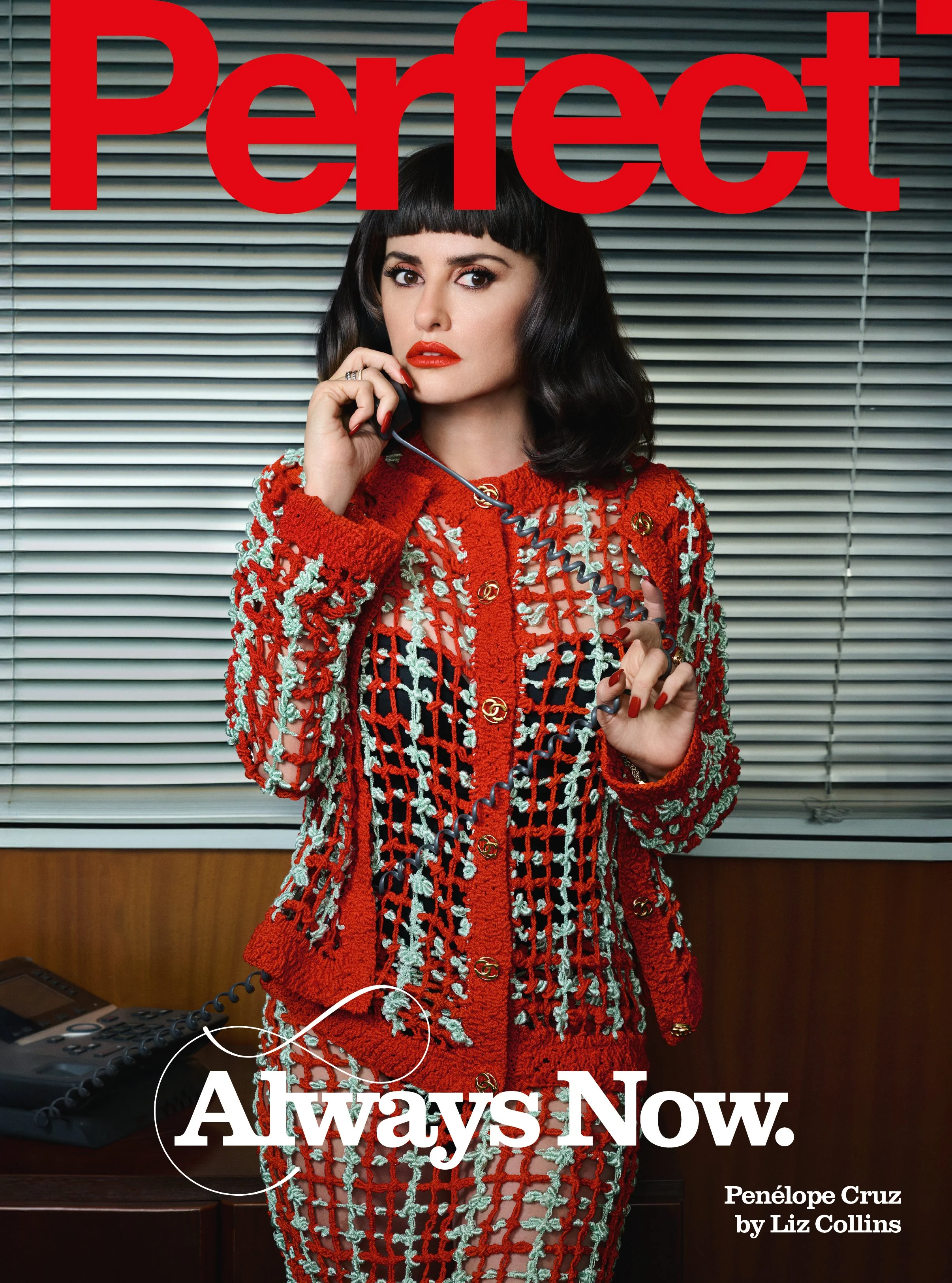
She told her friend to stop the conversation right there. ‘I feel very, very, very grateful, but I was getting kind of scared because I was thinking, when are we going to have time to promote all these movies at the same time that I’m finishing my documentary?”’ The documentary in question is a labour of love on which Cruz has been working as producer and director for four years. ‘That is my number-one thing that I have to do. It is my biggest secret, and it will come out this year and then I will talk about it nonstop. But I don’t want to talk about it until I’m completely done.’
Other upcoming releases she can talk about. There’s Bunker, which she’s in the middle of filming when we speak, written and directed by the acclaimed playwright Florian Zeller, and starring Stephen Graham and Cruz’s husband, Javier Bardem. It’s about an architect who’s commissioned to build a nuke-proof bunker for a survivalist tech billionaire: ‘A really good script and a really intense shoot.’ There’s The Invite, a comedy directed by Olivia Wilde, who also stars alongside Cruz, Seth Rogan and Edward Norton: ‘We did that in a studio in LA in one month, and it was such an incredible process.’ October sees the release of The Black Ball by ‘Los Javis’, the Spanish writer/director/producer duo of Javier Ambrossi and Javier Calvo; it follows the lives of gay men across 65 years and also stars Glenn Close. ‘They did something really, really, really great. It talks a lot about our history in Spain, before and after the civil war, and in modern times.’
But first on this year’s list of Penelope Cruz films is The Bride, Maggie Gyllenhaal’s second feature as director and her first completely original script, a wildly imaginative and riotously entertaining feminist reimagining of The Bride of Frankenstein. Cruz completed shooting on this way back in the summer of 2024 but didn’t get to see the final picture until October last year, ‘when I went to LA for two days for the awards at the Academy Museum’. (Modestly, she skips the fact that she was attending the annual Academy Museum of Motion Pictures gala to be honoured with the 2025 Icon Award.) ‘Maggie offered to put this screening together because she really wanted me to see it on a big screen – and I wanted to see it on a big screen; after that much work, you don’t want to see it at home on a little screen with interruptions.’ Her verdict? ‘Oh, I really loved it. I’m so proud of her,’ she says of Gyllenhaal. ‘I think she’s an incredible director and writer. She did something that is so modern, so rock ’n’ roll, but still with so many layers, so much depth, so much humour and emotion.’
Gyllenhaal had got in touch with Cruz when she started work on the script. ‘She she told me that she was thinking of me for the detective, and then she sent me the entire first draft, and it was already an incredible script. And I loved my character.’ Cruz plays Myrna, a police detective working in 1930s Chicago on the hunt for Frankenstein’s monster (Christian Bale) and his resurrected partner in crime, the eponymous Bride (Jessie Buckley). Myrna soon discovers she shares with them an antipathy towards the system they’ve fallen foul of, while also battling the ingrained everyday misogyny and sexism of the Chicago police force.
‘I think there are many, many good actors, and I think there are a tiny handful of brilliant actors, and I think that Penelope Cruz is one of them,’ Gyllenhaal tells me when I ask her about why she chose Cruz to play Myrna. ‘She’s this incredible combination of fiercely powerful and extremely vulnerable and very, very smart, and also capable of a kind of totally irrational, wild thinking. I see that in all of her work that I admire. And I wanted Myrna to be all those things.’
In a script full of passion, fury and larger-than-life characters, what distinguishes Myrna is her emotional containment and cool detachment from the carnage around her. This, Cruz reasons, is a logical consequence of the period and the male-dominated structure the detective is working in. ‘How many times she has been told “Don’t express your emotions” or “Don’t cry in front of people, or they’ll see you as weak”? She’s putting her work first in a time where she could not combine proving that she was great at her job with sharing her tears and her emotions.’ ‘Although Myrna has to be contained emotionally in the world that she lives in in order to survive in it,’ Gyllenhaal notes, ‘I feel so many deep emotional things happening under the surface all throughout [Cruz’s] performance.’
Myrna’s quiet stoicism stands in contrast not only to the rest of The Bride’s cast but also to the parts Cruz is best known for. Possibly her most high-profile role for US audiences was the one for which she became the first Spanish actress to win an Oscar, in 2008’s Vicky, Cristina, Barcelona, playing an artist whose extreme emotional volatility explodes into gun-toting calamity. Just as the depiction of Barcelona in the film played up to American-tourist stereotypes of the city – Gaudí’s famous cathedral looms on the horizon in so many shots – so Cruz’s role seemed to trade on public perceptions of the star. This is the actor of whom Pedro Almodóvar, the master of melodrama who has directed seven of her films, once said: ‘She is someone who is extremely emotional, and if she was not an actress it could be a problem for her.’ ‘I was comparing myself to the character,’ says Cruz of Myrna and her stiff-upper-lip attitude in The Bride, ‘and I’m somebody who would be crying in a lot of those moments.’
As well as the nature of male supremacism, The Bride has a lot to say about the history of cinema and its importance as a site of collective imagination: Frankenstein’s monster is a passionate cinephile, regularly seeking sanctuary in the darkness of the auditorium where he melts into the silver screen. He is emotionally invested in one star in particular, and the script has plenty to offer on the subject of screen idols and their influence: even the name of Cruz’s detective is a reference to Merna Loy, the Hollywood actor who made her name playing femmes fatales in the silent era. The powerful allure of cinema is a subject close to Cruz’s heart; she would watch films obsessively in her teens and decided to become an actor after seeing Pedro Almodóvar’s Time Me Up! Tie Me Down! on its release in 1990. Within two years she had landed her first starring role, in Bigas Lunas’s twisted libidinous comedy Jamón! Jamón! alongside Javier Bardem, whom she would marry 18 years later.
From the very beginning of her career, Cruz’s looks and her screen presence seemed to place her within the iconography of arty midcentury European cinema: she was variously likened to a young Sophia Loren, Monica Vitti, Gina Lollobrigida, Brigitte Bardot. She quickly found a way to straddle credible independent European filmmaking and big-budget, star-studded high-profile Hollywood productions (Captain Corelli’s Mandolin, sequels to Zoolander, Sex and the City and Pirates of the Caribbean); the ease with which she moves between these scales and geographies of filmmaking was underlined when she reprised her role in Alejandro Amenábar’s Abre los ojos in its 2001 US remake by Cameron Crowe, Vanilla Sky. As Cruz notes, she still makes ‘a lot of smaller independent films, and I have always felt very, very blessed to be able to be a part of both worlds. It has been really a dream come true to be able to continue to do both things.’ Among other things, it means she continues to reach mass audiences while retaining creative credibility; significantly, The Bride is a film that scores highly on both fronts.
No wonder then that the Academy Museum of Motion Pictures has officially sanctified her as an icon, but it’s not the first mighty cultural institution to notice. In 2009’s Broken Embraces, Almodóvar wrote a scene for Cruz that reads like a tribute to her own status as a screen idol. As an aspiring actress called Lena, we see her in hair and make-up prepping for a screen test, where she is styled first as Audrey Hepburn, then Marilyn Monroe, to the adoring gasps and sighs of the creative team around her. The scene only works because Cruz is able to channel both the look and the charisma of each star so easily. It’s no coincidence that her face literally sold Broken Embraces, and also Almodóvar’s next release, Volver: the posters for both films featured a graphically worked portrait of Cruz, cementing her image in pop iconography as surely as Warhol’s screen prints of Marilyn Monroe. The fashion industry has been keen to recruit this iconic power. She has appeared in campaigns for Loewe and Ralph Lauren, and has been a brand ambassador for Chanel since 2018; for the house’s autumn 2024 collection she starred alongside Brad Pitt in a short film by Inez & Vinoodh, an homage to Claude Lelouch’s A Man and a Woman – thus aligning her with yet another midcentury European screen legend, Anouk Aimée.
Speaking to Vanity Fair around the release of Broken Embraces, Cruz mentioned that the intensity with which she embodied Lena’s role led her to have panic attacks during the shoot. Myrna in The Bride was a less emotionally frenzied prospect, but from her comments it’s clear Cruz still empathised deeply with the character. So I was curious to know whether, as an actor who identifies so closely with the characters she plays, she finds it difficult to detach emotionally after a day’s shooting, and whether this has changed over the years.
‘When I was younger,’ she replies, ‘I went through that experiment of “OK, the more I torture myself, the better it will be” just to see if it was true. And I realised it wasn’t true. I’m glad I was able to test that way of living and working before I had kids’ – she has two, Leo and Luna – ‘because by then I had learned that you have to be able to get in and out of that dance between fiction and reality.’ She now finds it makes sense to stay within a character’s mindset once she’s there so that she can completely detach at the end of the day. ‘So if the scene is gonna take all day, I might not even cut for lunch. If the scene happens in a small room on the set, I will stay in that room. Even if they are relighting, I will stay there in a corner, and I will eat there, and I will stay there in that bubble. But then the end of the day comes, and I will not take that home.’
Not only is this detachment less brutal on her own emotional wellbeing, it also offers her a broader perspective on her own performance. ‘It gives you the possibility of seeing what you’re doing from many different points of view,’ she notes, rather than solely from within the character’s head. ‘But yeah, I had a few years of, like, hardcore Method, but it doesn’t make my work better to do that. And I feel it wouldn’t be an honest thing to do, because it’s like you’re burning yourself to a point where you are creating a pain or discomfort that is yours, rather than the character’s.’
‘It’s a very thin line,’ she continues, this boundary between her characters and her own self, ‘it’s a very delicate limit. And of course, there are situations where you have to put yourself so close to that limit.’ One example: 2015’s Ma Ma, in which she plays a teacher living with terminal breast cancer. ‘The first thing I had to do before I started shooting was to spend an entire day at the doctor’s and do all the tests that were not due till six months later. But I had to do them before I started the movie, because I could not be mixing both things, giving mixed signals to my own self.’ Ma Ma, a critical success in Spain earning three Goya nominations, was the second film produced by Cruz, and in 2022 she partnered with Barcelona-based Mediapro Studio to set up her own production company, Moonlyon (the name is a reference to her children); it is through Moonlyon that she is making her hush-hush documentary.
Which brings us back to the subject of Cruz’s busy release schedule for 2026 – another year in a long and prolific career. ‘I feel very lucky, really, to be able to work since I was so young in this industry,’ she says. ‘I love acting so much. And that never goes away, you know? The fear, and the wanting to keep learning, and the challenge… I love that feeling so much.’
What is it about the experience of acting that keeps you coming back for more after over 60 films? You must really love it, because you don’t have to do it.
‘But I do have to do it, because I have to work like everyone else! I feel very blessed that I have a job that I love. It’s like my nutrition – nutrition for my soul, you know? The main thing in my life is raising my children – that’s the best thing I’ve done in my life. But my profession really helps me grow. I don’t use it as therapy… but in a way it naturally is. Because I’ve said a lot of things through my characters that maybe I haven’t been able to say – not even to my therapist, you know?’
So acting gives you permission to vent certain emotions that you couldn’t in real life?
‘Yeah, it gives you permission to explore so many different corners inside of you and to look at them in the face. It’s not like I use it for therapy, but… (laughs) naturally, it is a little bit.’
In The Bride we see the magnetic allure of movie icons. When you were growing up, were there any film stars who fulfilled that role for you, in whom you invested so much emotion?
‘Yes. It was with Almodóvar, and with Marilyn, with Victoria Abril, with Meryl Streep. So with all of them, I was like Frankenstein (laughs) in our film. I would watch them over and over and over again, and… kind of follow Almodóvar around also a little bit, like, trying to go to places where I thought he might be. I love the innocence of Frankenstein. I love that [in the cinema] he becomes a child, and the same with the Bride, and that my character falls in love with that quality that they have. For my character, they are the sane ones. Everyone else out there is crazy.’
I love how The Bride celebrates the emotional value of cinema.
‘Yes, and we cannot lose that. And for younger generations, to respect the act of going to a place where there’s no phones, no interruptions for two hours, just to have that experience. It takes so much effort to make a film – not just so much money, but so much effort: a lot of people working together in the same direction to create that magic. And when it works, when it’s good... I don’t think it’s a feeling that people should ever stop having access to.’
You mentioned following Almodóvar around. When you were a teenager, you were really determined to become an actor, weren't you? Where do you think that confidence or determination to achieve this ambition came from?
‘So, [my family] didn’t know anybody in this profession, so I didn't think it was really possible. But deep in my heart, I felt like, ‘OK, if there is like a one per cent possibility, I’m gonna go for it.’ So every night in bed, I was kind of praying, in my own way. I don’t have a religion but I believe in God, so all my life I’ve talked to God in my own way. And since I was about five years old, I was asking: “Please, God, don’t give me a job where I will be locked in an office doing something that I don't like.” And then I started to ask more specifically about this dream of being an actor or a dancer. So I think that maybe had something to do with it. Also luck, also effort, also the fact that my parents allowed me to go to castings when I was very young, to find an agent when I was very young. My agent is 83 today and she’s still my agent in Spain. She said, “OK, I will represent you. You’re too young, but I will represent you,” because I came back three times to her office. So, very persistent also!’
In The Bride, there’s an awkward moment where one of the characters comes face to face with their screen idol in real life and it doesn’t go well. It’s like a cautious note on the gap between the mythology of the film star and the reality of the actor. Are you aware that audiences project ideas or hopes onto the characters you embody, and also onto you personally? And does that come with a responsibility to those audiences?
‘It doesn’t happen all the time. But I think it’s important to listen when somebody comes up to you and they start talking about a specific film, a specific character, and the moment in their life when they watched it and it did something to them – they’re telling you something that is important for them. I think those moments are very delicate, and it’s very important to really listen to what that person is telling you. And also, making it less about yourself, like, not ‘how can I cause that reaction in you?’ It's not you – you are part of that film with, like, a hundred people working together, with an incredible story, an amazing director. You’re just one more piece in that puzzle that made that person feel something that she still remembers or will remember for so long. But I think it’s important to listen, because that has happened to me with other people who’ve made movies that have had an impact in my life. And it has happened to me with actors [where] I felt like, what if I meet them and I want to share that with them, and their reaction is not warm? I would be devastated! But I’ve been very lucky with that, with the people that I have [met]… Like, the obsession that I had with Pedro [Almodóvar], that I still have today. That person influenced me so much in so many ways. He was the person whose movies made me decide, let’s try to get an agent, let’s try to make a living out of this. [Meeting him] was scary because I felt, ‘What if…?’ But he couldn't have been nicer when I met him. I was very happy – (laughs) he just listened to what I had to say!’
When you were a teenager wanting to become an actor, was fame part of the allure for you? And now, is fame something you would rather wasn’t part of being a successful actor?
‘I feel like you need training for it! I started very young, and at the beginning, it was hard to understand. The highs were very high and then the lows were very low in terms of, like… A great review would send you to the sky with adrenaline; a bad review would make you cry. You would believe all the positive, all the negative. Then you realise that you cannot believe any of it, that everything is very relative, because you can love something and maybe your neighbour will hate it – it’s just whatever your taste is. I’m talking about the work – then there is the part where your personality will also sometimes be analysed or judged. So you learn not to believe too much the good or the bad that you hear, and just believe more in what you receive from the people in your life, the people you trust, your friends, your family. Like, my mom is very young and very close to me, and she will always tell me the truth. And from the beginning she’s always kept my feet on the ground. But fame… (Pause) It's not the best thing for your dopamine. I don’t know what to say. It’s not the best thing, especially when you start very young.’
It must take a lot of effort to protect your privacy. Does it help that you live in Madrid? Is that easier to remain private there than if you lived in the States?
‘I think it’s easier. Also, all our families are there, and the friends from childhood and from our teenage years; it’s easier to have a normal life, you know? Yeah, you have to make an effort to keep a part of your life private. But I think when you have children, it’s really important. And they deserve that, they completely deserve that. Later they can decide what they want to do in terms of their work and everything. But they need to have that freedom and not be exposed to things when they are little.’