PROCESS: Marc Jacobs in conversation with Bryan Yambao.
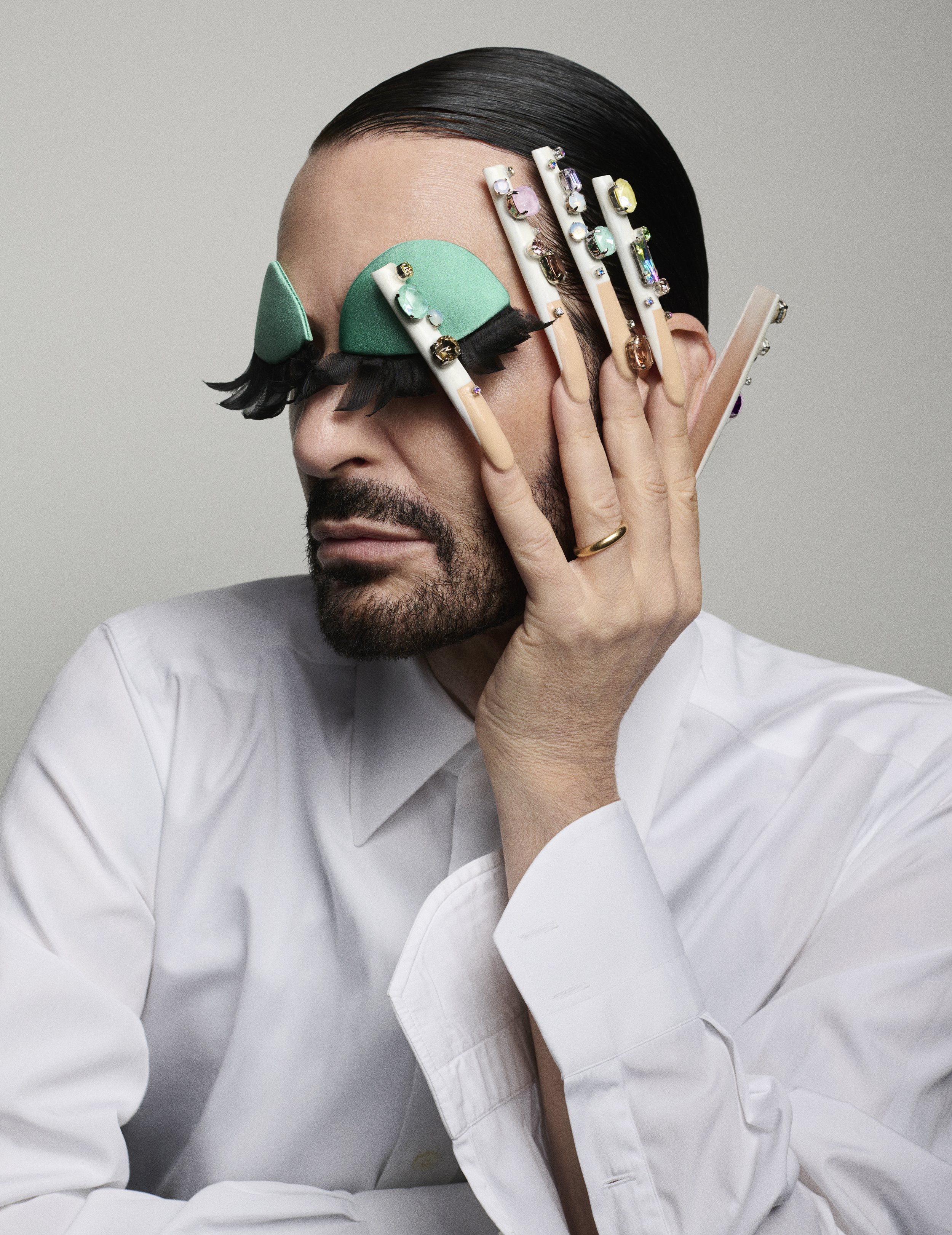
Portrait by Nick Newbold
Marc Jacobs interviewed by Bryan Yambao for Perfect Issue 7
Every little gay boy with an interest in clothes and aesthetics has that one hero who forever shapes their view of fashion. This often one-sided relationship with a fashion figure is so profound and enduring because it goes beyond mere admiration: it can shape one’s identity, courage, creativity and self-worth. I often joke with many of my slightly more mature friends that I can guess their ages based on their fashion heroes – the Gaultier gays, for example, or the Helmut Lang gays. For me, it’s Marc Jacobs.
I was 15 years old when Marc joined Louis Vuitton in 1997. I remember flipping through magazines and my eyes would light up whenever I encountered images of his work. Those moments were more than just a visual delight; they were a spark of inspiration that remained with me forever. While I was happy to enjoy his imagery as a spectator, of course I had a burning desire to own a tangible piece of his beautiful world too. Finally at 19 I bought my first item: a glittery rainbow-striped elastic belt with a pair of yellow enamel pears from his diffusion line, Marc by Marc Jacobs. It took three months to ship to the Philippines!
What I find endearing in most of Marc’s collections is that they often invite interpretation and personal projection, leaving enough room for one’s imagination to run wild. This open-ended approach elicits a deep reaction to his collections, as viewers are not merely passive observers but become active participants in the narrative. When a fashion show transcends the realm of spectacle and becomes a powerful medium for expression and connection, it creates memories that endure long after the final model has left the runway. That’s what makes many of his shows impactful and unforgettable.
‘Joy, period’ succinctly captures the essence of Marc Jacobs’ vision for his autumn 2024 collection: a bold declaration of exuberance and self-expression. A sentiment that resonates deeply in today’s sociopolitical climate. A sartorial middle finger to societal expectations and norms. His latest outing is a laserfocused unapologetic celebration of silhouette and vibrant colour. The range of shapes and proportions highlights his knowledge of the feminine form. It’s a poignant reminder of how his work continues to inspire and uplift.
Marc’s impact on me doesn’t fade over time; it evolves. His influence remains a life-long guiding force. Fifteen years after our paths first crossed on MySpace, we found ourselves reconnecting online once again, this time on video via Zoom, to talk about the collection.
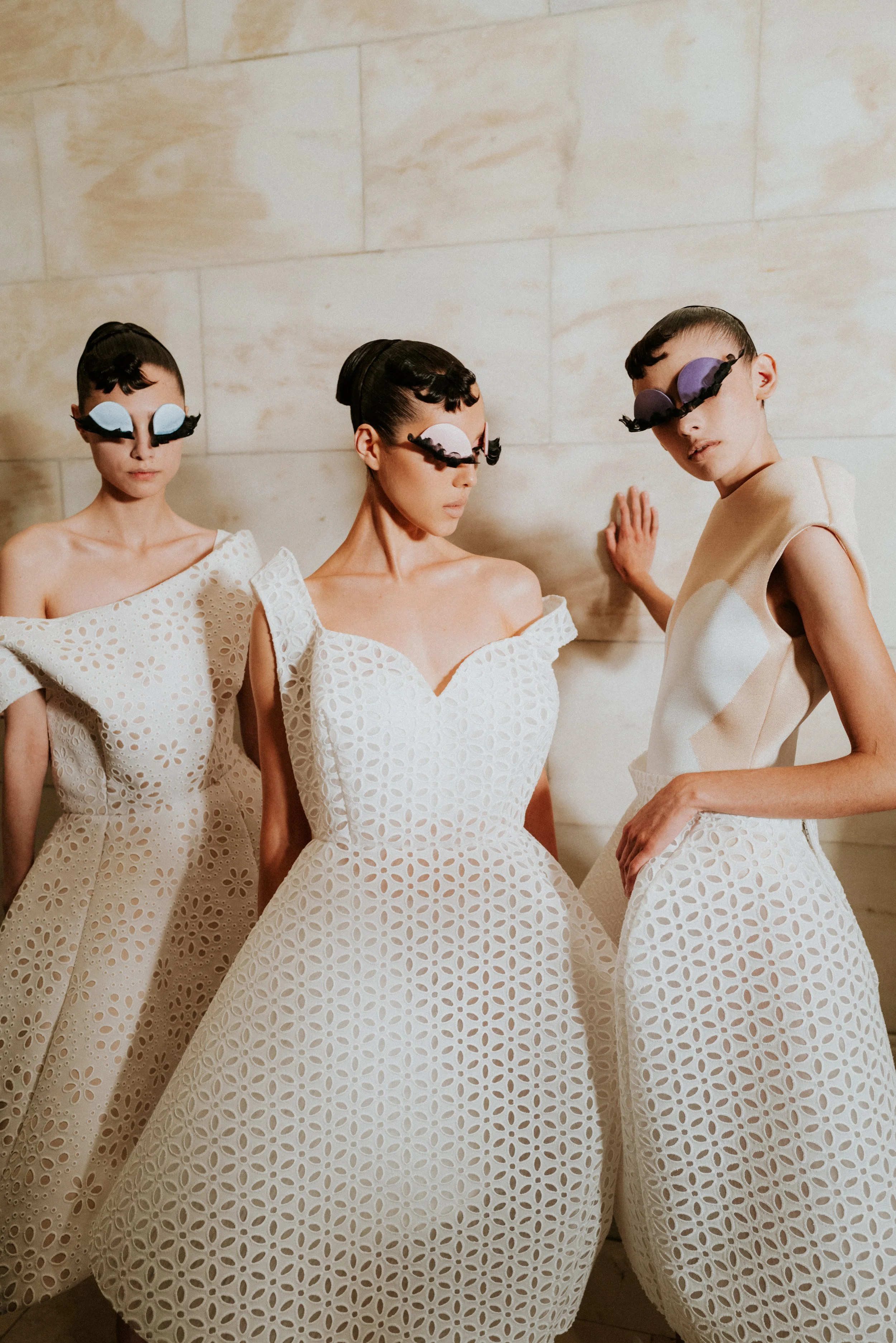
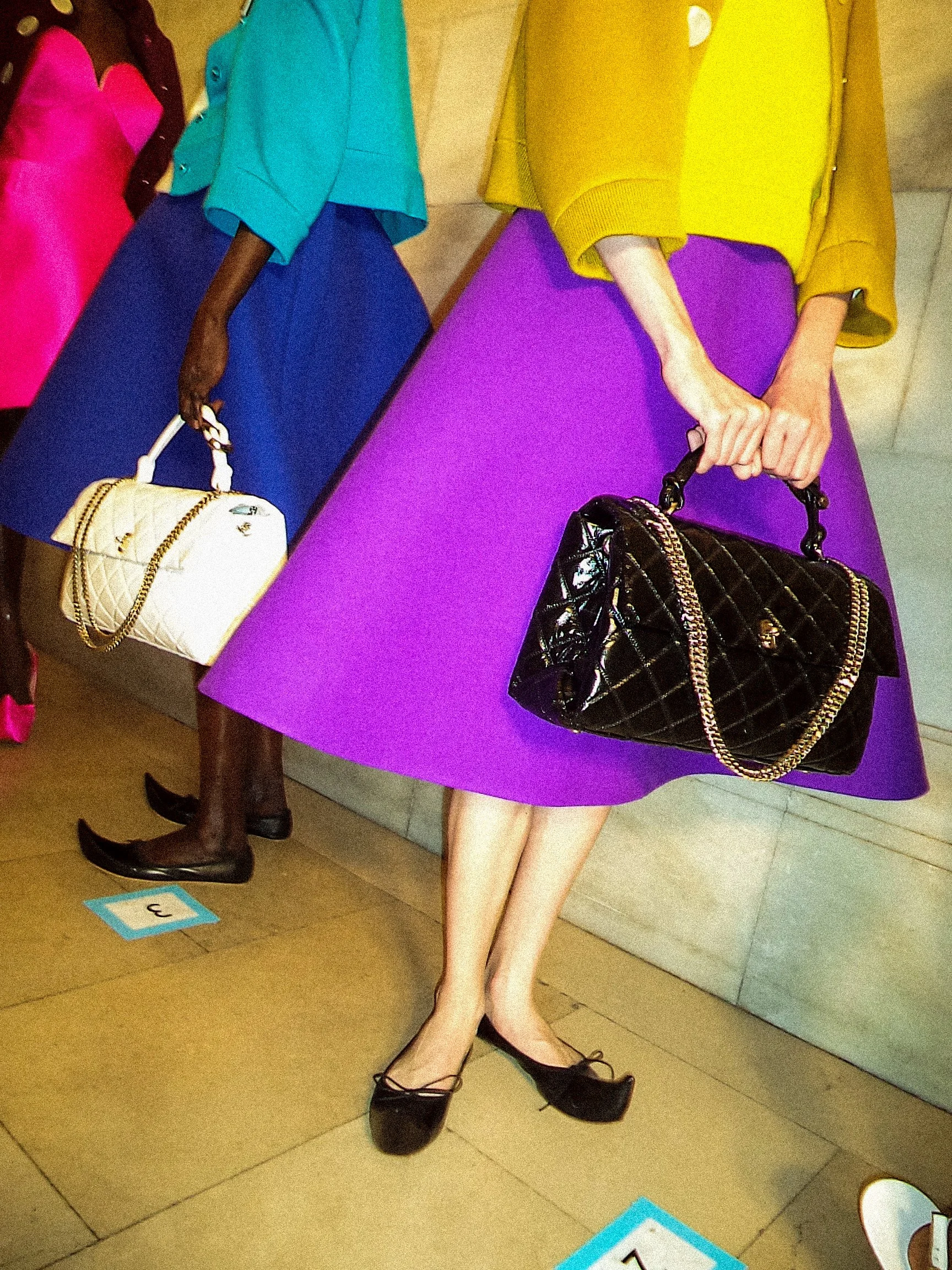
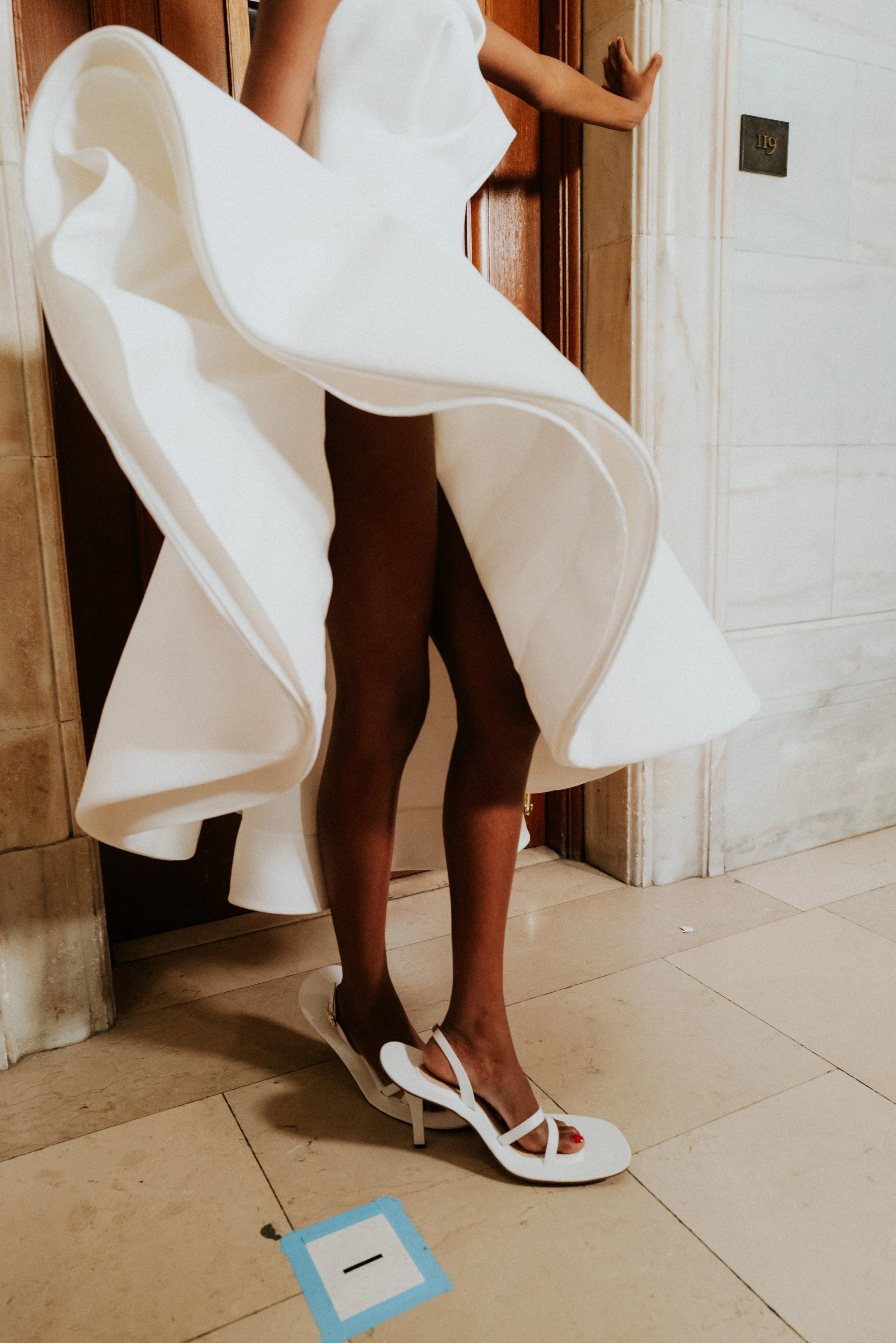
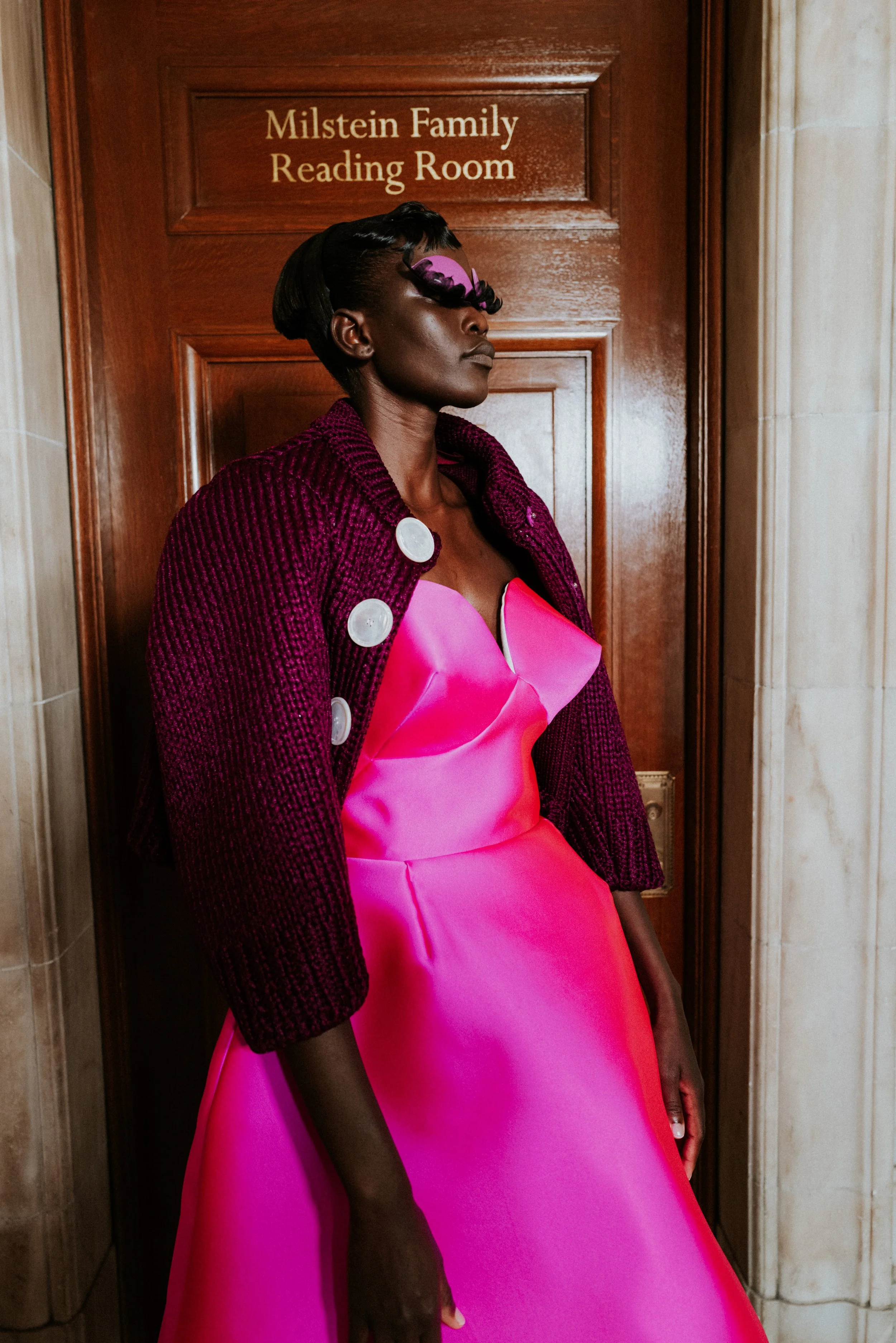
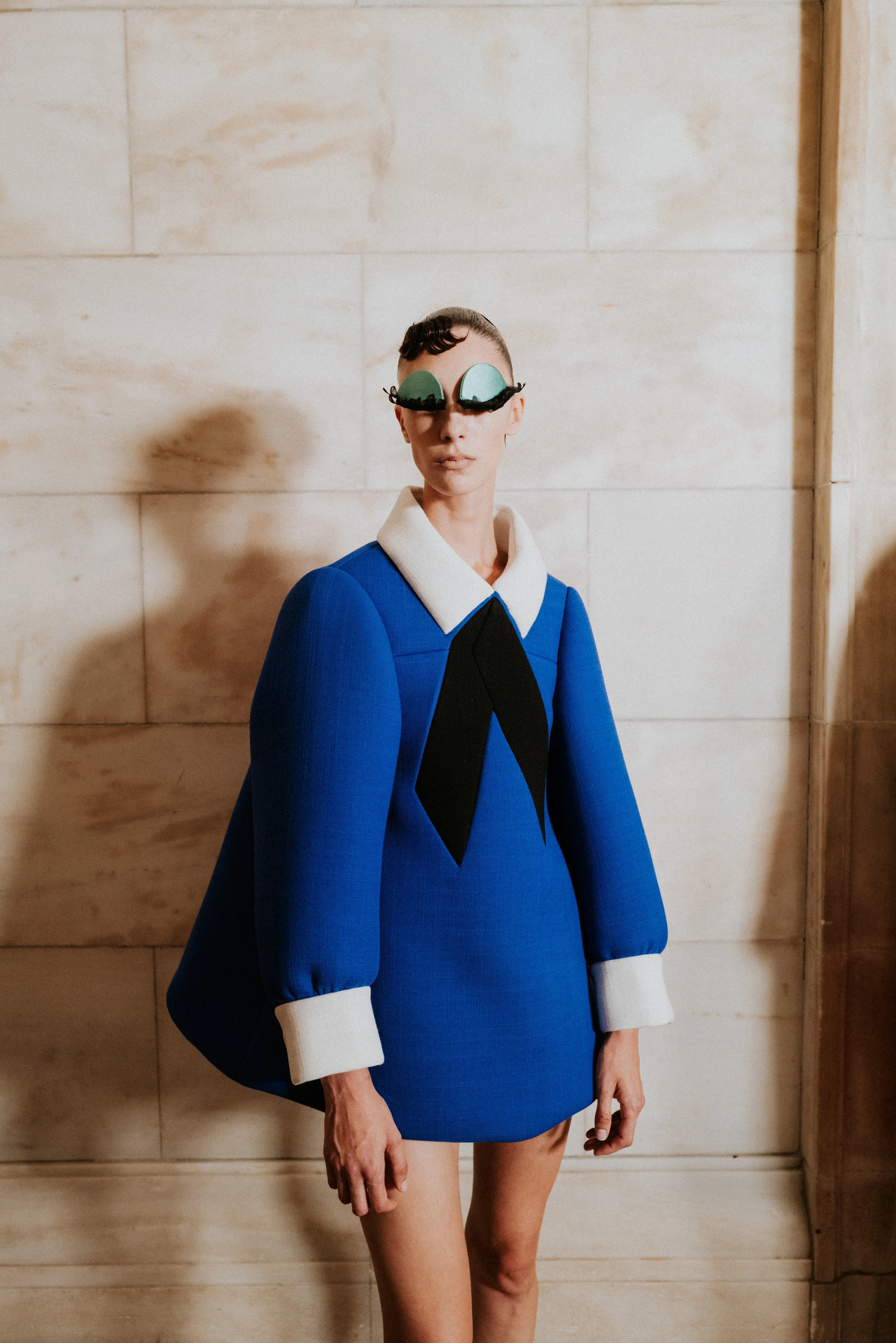
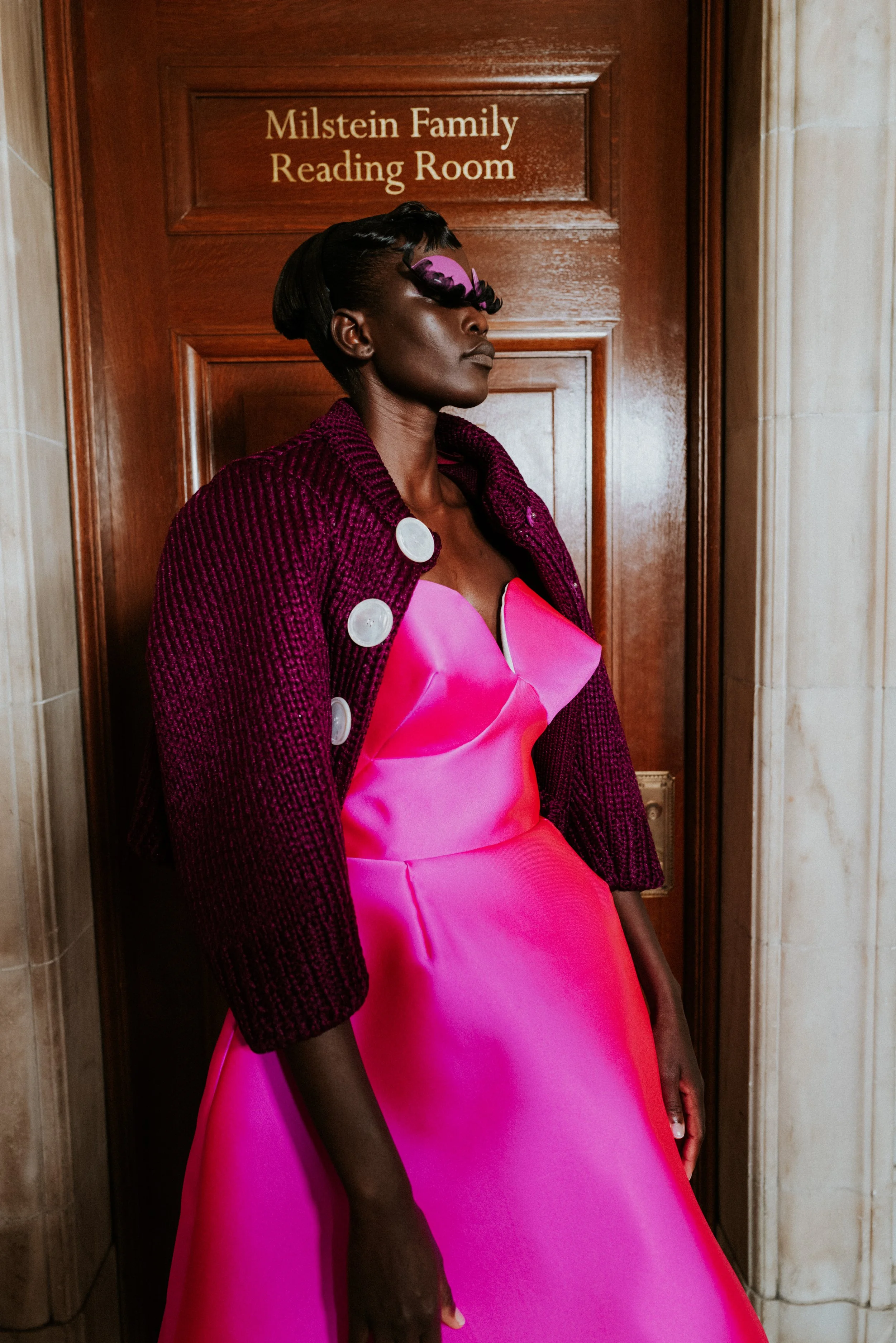
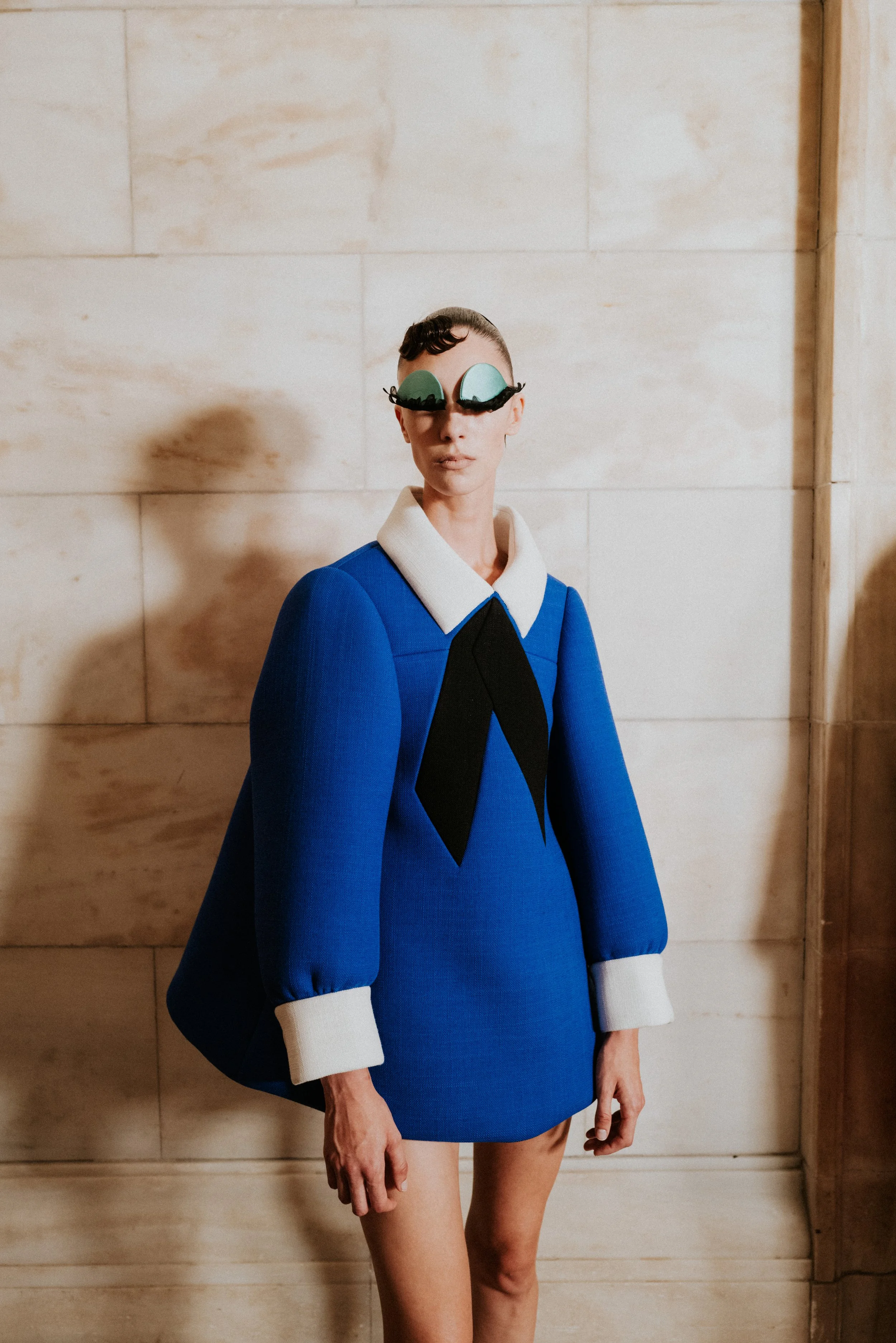
Marc Jacobs AW 2024
BTS photography by Alexandra Arnold
BB: If I were to teleport myself into your office in New York and plonk my handbag on the table, what am I going to see on your desk and around me?
MJ: I don’t really have a desk. I have a little office where I sometimes sit to eat lunch. And on the table in that office are books that haven’t been put away, Post-its with notes that I’ve written to myself that I haven’t thrown away even though they’re long overdue, some toothpicks… I don’t know, just a bunch of junk, really. There’s nothing in the place where I sit that’s really pertaining to what we’re doing. Where I usually work is what we call the design room, and I’m there with typically Matt, Ryan, Jesse and Sam sometimes, and Joseph, who is the head of women’s design and creative direction. That’s where I would typically be. In the beginning of the process, we’d usually be looking at fabrics and saying, ‘We don’t know what we’re doing. How can we choose fabric?’ That’s kind of how every season starts out. ‘Well, how are we going to pick fabric when we don’t know what we’re doing?’ I always think of this quote from this art critic who I like very much, Jerry Saltz. He says, ‘Of course you don’t know what you’re doing. You haven’t done it yet.’ So that’s exactly where we are — we’re in that place where we don’t know what we’re doing because we haven’t done it.
I feel like you really invest in fabric and have a sense that fabric development has always been your thing. I can spot a Marc Jacobs fabric from a mile away.
I think it depends what you call developing fabric. Anything could be developing fabric – choosing colours or doing prints – but I never think of what we do as being highly developmental. I think in my head developing fabric is like challenging the mills to create new weaves or new textures, new things like that. Sometimes we do develop things like with the starting point of an old fabric or, uh, something that isn’t done any more. I tend to like things that are dry and that hold a shape. Typically people don’t like fabric like that any more; they like things that are soft to the touch and feel easy. I think my thing has always been that I love those really beautiful old couture fabrics, especially around the 1960s. Sometimes we want to just straight out recreate something, but you can never really recreate something because the yarns are different today and the way things are woven is different. The mills use different types of looms etc. Even when you want to really, really recreate something, it typically comes out different because you’re talking about something that existed 60 years ago and everybody’s moved on. We do some kind of development. We do our own prints and patterns and we certainly do our own colour palette. We often go to different mills and ask for customisation. But it’s not like really pushing them in terms of technological advances in fabric.
Your fabrics have always had a good weight or a structure. The knits are always chunky, the bonded jerseys, there’s always something new. They’re really distinct and I never see them anywhere else.
I think you know when I talk to you about this, it’s very different trying to explain to people who don’t understand as much about fashion as you do. It’s interesting to me sometimes for non-fashion people who don’t know what bonded jersey means; they don’t know what double knit means. And to try to technically explain what you’re doing is like... I think it’s very interesting to learn about process and I think it’s very interesting to learn about what goes into making something – you know, the skill and all that. But a lot of people just aren’t interested. I guess we have these interviews for the people that are interested.
I saw a quote from Karl Lagerfeld the other day, something like: ‘I want to explain how many hours went into making this dress. It shouldn’t matter, you know. You should love it. It’s not valid because of the time put into it.’ But I mean, you know, he was very snippy about things like that. And certainly when I look at couture, I do admire the craftsmanship and I do appreciate the time, the effort, the mentality that goes into it. But then there are all those other people who are just like, ‘Whoa, amazing dress.’ What’s always interesting with Karl is that a lot of his chat was part of his character and part of the way he presented himself – it’s part of his arrogance and part of his uniqueness. He turned a lot of heads and got a lot of attention for behaving in that way. I find it highly unbelievable that he had no appreciation for the craft and skill that it required. There are days where I’m very down to post something about the process, and then days where I’m just like, ‘Here’s a picture – either like it or don’t, keep scrolling, whatever.’ My interest in sharing about process changes from day to day. But I do love the process. I do find it really exciting and interesting and difficult and magical.
What was the starting point for the latest show?
I always feel a collection has to do with a group of people and what they’re thinking, and what comes up through the process and excites us all. So as I told you, we were looking at fabrics saying, ‘How are we going to choose fabric? We don’t know what we’re doing.’ But we have to go through the process, so we started looking at fabrics. And then I think it was Joseph who said to me, ‘It’s going to be very hard to go back to normal fabric after using fabrics [last collection] that were bonded or framed because they gave so much shape; it’s going to be hard to look at like limp fabrics or fabrics that don’t perform immediately.’ And I agreed with him. So I said, ‘Well, why don’t we not move on? Why don’t we just start with what we left off with?’ I mean, I was really, really happy with the last show [spring/summer 2024]. So that was a thought that was planted, although it didn’t really have any shape to it yet. And then we were at the Met Gala and we saw all of these dresses on all of these different women. Joseph and I talked about what we thought looked good and what we thought didn’t look good, and we thought our dress on Venus looked amazing.
She looked great — definitely my best dressed!
And then there was Dr Lisa Airan, who was wearing Cristóbal Balenciaga from the 1950s, a silk gazar coat over a silk gazar dress. We just thought she looked so precise and so chic and it was very colourful. So I was like, ‘Well, I think we know what we want to start with: we want to start with structured fabrics again.’ Last season was very black and camel and grey and navy; there was some colour, but it was much more sober. So I said, let’s just do white and colour. But then we started to think about that, and about maybe trying to make some of those structured fabrics more fragile. We looked at lace, at broderie anglaise and things that had a lightness, and at how we could make those light things stiffer or structured. Already it felt very different than the previous season.
We loved the idea of using this couture fabric that Balenciaga was so fond of called silk gazar. It’s very hard to work with and it’s got this very wiry kind of hand to it. We decided to bond it rather than do all the construction that he would have done underneath it. We decided to treat it the way we treated fabrics last time. So that was the beginning of the season, that was the beginning of getting going.
I really wish I saw the show in person! Looking at it online, it feels like it started with Marilyn Monroe and closed with Miss Piggy, with Olive Oyl and Minnie Mouse in between. They’re not some obscure 1960s socialite but iconic American characters that transcend generations…
I wonder if they are, though. Like, we know them. But again, this is that kind of thing where I try to avoid saying, ‘Oh, everybody knows this,’ because everybody doesn’t know it. I can tell you that the model we put that white dress on didn’t look at herself and get Marilyn Monroe in The Seven Year Itch. Not everybody has this library in their head of iconic references from a certain period.
Minnie Mouse?
Well, Minnie Mouse maybe, but I don’t even know if that’s true. I think those iconic images are forever ingrained in my brain so they come up when they come up. I mean, there was Daisy Mae from DogPatch, there were all these different characters. But the character assignment was second. The idea for The Seven Year Itch dress was that we wanted to do a stiff dress that had a movement built into it. So that whole first group of white dresses, there were all kinds of subtle movements in them. In other words, we were trying to give our own story to the idea of creating what we would have considered in the past to be like abstract movement.
We built a fold into the skirt, we made the seams asymmetric, so it suggested wind blowing it or something like that. That was as avant-garde as we could be. Everything when we take it on always has that kind of dressmaker naive quality so it’s not super sophisticated, but it’s actually sophisticated in its naivety. You know what I mean? It’s not like a haute couture kind of mechanism.
These characters really happened organically. Like we love the idea of this big polka dot... and I thought just as much of Vivienne Westwood’s mini-crini collection as I did of Minnie Mouse. I could give you a hundred references to an oversized polka dot. But the context of this show – because of the Marilyn reference, because of the other thoughts – I think everybody thought, ‘Cartoon, cartoon, cartoon, doll, doll, doll.’ It’s what happens when one looks at something where the iconography or the image is so strong that after seeing the first one, you see the third one, then the fifth one, and you’re like, ‘This is what this is.’
The white dresses reminded me of the Carousel show…
Alistair who works with me putting the show together, when he saw the broderie anglaise dresses, he said the same thing: ‘Oh, it reminds me of that Louis Vuitton show where you had the girls on the carousel.’ And I was like, ‘That really wasn’t the reference.’ There was something in the spirit of that show which I worked on with Katie [Grand], which was about it looking overly pretty and overly fragile. And that probably came as a reaction to the show we did before it.
There was this feeling that we wanted prettiness and we wanted joy and we wanted beauty and we wanted lightness and brightness and all of this stuff. And that’s what I think for us was very clear early on, in terms of the spirit. We wanted to say, ‘Let’s not overthink this; let’s have a good time; let’s make something pretty and bright and light and joyful.’ And that was the mood within this in the studio the whole way through, even when things were going wrong. There was a good humour; we all all came into work smiling. It was like whatever we were living individually had a lot of impact on the choices we made design-wise.
What about the hair and beauty? The oversized eyelids – are they made out of satin?
The eyelids… People came up with so many references as to where those came from. Some people thought they were from the eye mask that Audrey Hepburn wore in Breakfast at Tiffany’s. Some people thought they were from the Muppets – Janice or Miss Piggy. We made them out of duchesse satin over a light piece of foam. They were stitched together by hand, and the lashes were all bias organza that was pinned down and all zigzagged meticulously to go from small to large on the outside edge. They were really beautiful things. And then, of course, they were stuck with a wig tape onto the girls’ foreheads.
Directly on the girls’ faces? Wig tape and not some kind of wiring? Wow.
I’d wanted to do those for a long time. There were a couple of things that I’d wanted to do for a long time in this show that we finally did. Another was the specific piece of music we used. Like the eyelids, they’d come up on other occasions and they just weren’t right, but this time they seemed perfect.
The music – Philip Glass!
Katie knows me, I love Philip Glass. And I love that opera [Einstein on the Beach] in particular. But it’s that specific piece from that opera that I love, where she recites this spoken-word play about being in an air-conditioned supermarket and finding this bathing cap which had plumes on it in red or yellow or blue. I just love the whole thing. I just thought it was so twisted in such a sophisticated way.
I felt like I was tripping watching it. It really moves you. I was really hypnotised by it all, seeing all of the models walking with that music.
I think it’s safe for me to say that with every show we do, what I’m really looking for is not the audience to say, like, ‘Oh my God, that dress was so beautiful.’ I’m looking for them to say, ‘Wow, I really felt something in that seven or eight minutes.’ You know? For me, it’s just a little piece of theatre that I want. I want to get some sort of emotional reaction – whether it’s joy or whether it’s ‘I hated that. That was boring,’ you know? I want some kind of real response in terms of emotion. So although the clothes individually were important to me, it’s the reaction of the audience to the music, to the hair, to the make-up… I just feel when it all comes together in the right way, it’s like the perfect storm, you know? It takes you somewhere.
That’s the beauty of your shows – you’re such a perfectionist. You know how to draw an emotion from many of us. You don’t need the bells and whistles of a big production, big set distraction. It’s really just the music and the clothes – that’s what I’ve always felt.
I mean, we definitely did some pretty amazing productions, both at Marc Jacobs and at Louis Vuitton, that were mind-blowing in terms of the size of the production. But in this current chapter of my professional and personal life, I feel that I want the clothes to tell the story, and the hair and make-up, and music have to support those clothes. And even if we choose one prop or one sculpture or one detail that supports the collection, it really is the clothes that have to tell the story. That’s the most important thing.
You don’t feel like your clothes have always told a story? You’ve had great collections with a bare set, no prop, no nothing, even no music –
I didn’t say that. I just think about it more than ever. It’s also how I feel about fashion. I have evolved and we have evolved over the years. I look back at some of my old shows and I realised it used to be so exciting to people, like, a show with pink sweaters and pleated skirts. And I look at that now and I think, how could that have got that reaction? But in those days, in the early Nineties or mid-Nineties, that’s what fashion looked like. And it was very exciting to see something so simple on those incredible models, on Naomi and Shalom and Kristen McMenamy and Christy and Kate. To see them in something simple and fresh was incredible fashion.
But that’s not what incredible fashion looks like right now, not to me. I don’t think it’s about the people in the clothes, I think it’s about the clothes themselves. We’re trying to tell a story with clothes that’s about fashion. I think some other people are telling a story about fashionable clothes that they’ll want to wear. But that’s not my position. I’m not making clothes that I think are going to fill women’s wardrobes next season – which is good and fine – but that’s just what our choice is at the moment. But we did at one point make incredible fashion shows where lots of young people wanted to wear and did wear [the clothes]. so it’s very different for me to look back; but again, it’s so time-specific too.
What excites you in fashion at the moment?
Fashion! Our work is exciting to me still, which is a great gift. I think I get excited when I see a photo I love. I love the Rihanna cover [of Perfect issue 6.5] so much, I thought that was incredible. There was also Dust magazine, and it was Inez and Vinoodh who took pictures, one of them being Naomi Watts. She was wearing this little shrunken jacket of ours and smiling. I absolutely love that photo. So I think there are reminders for me of how much I love fashion and fashion imagery. I love seeing an exciting picture – that’s just like, wow.
And then I also love being at an event and seeing someone like Venus; it’s just, wow, it doesn’t happen very often — but it never really happens very often. Maybe a little bit more in the past, but I think that’s because we have social media and other outlets now. We’re so inundated with so much imagery that the special stuff sometimes gets lost. I mean, what’s special to me sometimes gets lost.
What’s special to you nowadays in this day and age? What stimulates you? What takes your breath away?
Well, right now, I mean, the thing that excites me the most is my house and buying things for my house. Looking at art, antiquities and furniture has been exciting to me. It’s always been exciting to me, but it’s particularly exciting because I’ve got a house to furnish, and beautiful shelves to fill. I love reading. Reading books has been something that I’ve gone back to and really enjoyed. And that’s been exciting for me. Work is still exciting for me – I like my job.
How is self-expression important to you? You’ve worn a camel toe, you’ve worn a pigeon suit and these days, the nails and pagoda shoulders. You’ve always expressed yourself in a way that’s bold and courageous.
Well, it’s really important. It’s hugely important. Sometimes, even though it doesn’t look like I might be expressing myself, I am. Even when I can’t get it together to put on a look, you know, then what I choose to wear is showing that I’m not in the mood or I’m in a place where I just want to get dressed and get out the door and go. But when I’m in a great mood or a good mood, I tend to want to adorn myself. I love the suits with that pagoda shoulder. Every time I have an event where I know I can wear one, it means I’m going to get out the high heels, I’m going to get my hair and make-up done, I’m going to wear my favourite cufflinks. I love the process of getting ready and just really turning it out. That always excites me. I think ever since I was a young boy I was drawn to fashion because of its self-expression properties. You know, I liked the idea of getting dressed up and creating an identity or presenting myself as a certain thing or idea. That’s been with me since I was nine.
That’s what makes fashion exciting – fashion is a very important tool to express ourselves.
The older I get, the more I reflect on things. And I feel in some ways I become enlightened, but also more confused than ever; also, kind of happier in this self-expression. And that is the fact that the nine-year-old me had to negotiate whether I was willing to be teased or bullied to express myself. And the answer was yes, I will take the mean, nasty bullies, because it was more important for me to wear the jeans jacket that I’d painted and glued feathers on the shoulder. I had to be true to myself. And now as I get older and we live in a different world, it’s become easier. I’m in a very protected bubble. I mean, not everywhere in the world can a boy have long nails with Swarovski crystals and have their hair in a bob and wear ballerinas with a big-shouldered jacket. My shrink always says I’m in a bubble that’s safe, which is very different than when I was nine. I was out there among kids who were afraid of who I was and what I looked like.
Do you think the kids nowadays have slightly more freedom?
I guess yes and no. I think because of this bubble that we’re in, there’s this huge questioning of gender norms, non-binary identification etc. And I think that that’s true, probably, among young people in a place that never existed before. But it is definitely not a worldwide popular opinion; we know that through the politics that we unfortunately live with. Life is different now, but there’s still all those people with a huge voice and many supporters who are still afraid of what they don’t know or understand. So again, it’s important to really look [at that], especially for us, for fashion people, because we are very, very quick to say, ‘Oh, everybody is open now,’ when no, everybody is not open now. Everybody does not know what Rihanna looks like on the cover of Perfect.
Forty years on, after all these years, do you still read reviews?
Marc: Yeah, I do. I always say that there’s an equation, there’s this process – and the process is not complete at the end of the show. The process is complete when somebody in the world buys a bag or a piece of clothing you made. And in between is the critic’s opinion, the audience’s reaction, what’s written, how they interpreted it. And I do read those things. I mean, the next day [after the show], Michael Ariano sent me the New York Times and WWD [reviews] and all these things to read. And some of them I got very excited by, because they seem to really get what we did and appreciate it on a level that really meant a lot to me. And then there were other people who saw something very similar to what we were seeing or thinking, but then they had a kind of quirky other take on it. Sometimes I read something and I think, it’s not what we were thinking, but they really got it. Like, I thought this [comment about the last show] was interesting. I don’t know who wrote this, but it said: ‘Joy, period. One of the most compelling things about the collection are the cloth eyelids placed over the model’s eyes. This showcases that they are blind to other people’s perception of them for Marc Jacobs. Sometimes joy means blocking out the haters.’ And I thought: wow, that’s pretty cool. Like I didn’t think of that, but maybe she’s right.
Sometimes it almost makes me question whether that was what I was thinking – then the conversation becomes very interesting. That’s when I really love it. A lot of that happened during the ChatGPT season [autumn 2023] because people read into that so much. And I felt like, well, maybe they’re right. Maybe that was what we were thinking all along, even though I’ll insist that it wasn’t.
Out of 40 years of putting yourself out there, what’s the harshest review you’ve ever had — and disagreed with?
I can tell you the review that made me angriest.
Go ahead!
I’ve had bad reviews where I was like, ‘This is a great bad review.’ Especially for the grunge collection at Perry Ellis. There were a lot of very bad reviews but I thought, ‘Wow, it’s kind of cool that people are so hateful of what we did.’ It made me feel very rebellious, even though where I was coming from wasn’t a place of rebellion. I was coming from an adoration of a type of music that inspired me and the style that went with it. I didn’t feel like I was angry or aggressive doing that. But people were so offended. So those bad reviews I thought were great. But there was a season, and it was the one with the show that went backwards. It was kind of surreal. It was the one where Victoria Beckham was in the ads.
And one review that’s so good and memorable?
That honour belongs to Cathy Horyn. I’ll tell you why. It was not the best review, but what happened was Cathy wrote a very bad review for grunge. But 20 years later, she called me and she said, ‘I want to rewrite my review. I was wrong.’ And I was like, what? A journalist who admits they were wrong? That’s gotta be the first time that ever happened! I mean, I’ve received some really beautiful reviews for collections. Bridget Foley has really been a champion of mine from day one. I think Bridget is a brilliant writer. I think she’s a fashion lover with a history-of-fashion background. I always feel her reviews have this weight to them that I appreciate – they’re really knowledgeable and interesting to read. I couldn’t tell you which is my favourite good review. But I can tell you the one that meant the most to me was when Cathy Horyn rewrote her bad review. You know what it symbolises to me? An open mind. We keep growing by keeping an open mind, by being curious. And you have to be willing to make mistakes in order to grow and learn.
When was the last time you did something for the first time?
I’d never had very, very long nails until I went to the manicure salon. So that was a recent first. I’ve had nail art, but I never had like triple-XL-length nails.
Are you gonna keep them for long?
Well, it’s been like two months with different sets. I’m still into it.
I saw TikTok the other day when you were referencing this… How do you feel about TikTok?
I don’t have TikTok. I tried during the pandemic. Where did you and I meet?
We met online on, gosh, Blogger? Typepad?
MySpace!
Oh yes, MySpace with Jason!
I just thought it would be funny to mention that you and I know each other from back in the days of MySpace – a lot of people probably don’t even know what that is. But I don’t have TikTok. I tried to understand how to participate in TikTok during the pandemic, but I found it very confusing. I’m really an Instagram person.
Do you feel as a designer, as a creator, like your work is judged by many, many more people now, as opposed to a limited few, say, 20 years ago?
I think that my work is seen by the same amount of people as it always was. Because again, I don’t kid myself about the runway show part of the work – it just doesn’t get into a lot of people’s lives. I know that the tote bag that we do has reached many, many people, and that’s great. But the runway part of this job is still very niche. I don’t know if it works the opposite way. Like, the success of the tote bag can exist because of the runway, but I don’t think the success of the tote bag brings people to look at the runway. I don’t know. Maybe it does, but it doesn’t seem like that. I’ll use Instagram to explain why I say this. I put up a couple of posts from the show, and the amount of engagement, the amount of comments was so small compared to when I post a reel of me doing this (curling his fingers, showing off the nails). So the nail community is seeing this and is not interested in the runway.
That’s because of the algorithm. We are in some ways slaves to the algorithm. We do not have control on what people will see.
That’s what it is! The post office is the post office. You can scream and yell all you want about how quickly or slowly the mail gets to you, but the post office operates a certain way, or used to. I don’t know if there’s such a thing as a post office any more. But if we are going to live online with an iPhone or a smartphone or whatever, then its rules are what govern us. If they make an algorithm, we signed up for that. That system dictates in part what you see and what can stay outside the algorithm, I suppose, if you’re glued to your phone all the time.
How do you feel about the future?
I have faith. I mean, I’m frightened about what’s happening in the world. It’s a very scary moment in politics for the US. I’m frightened to death of the idea of Trump being president again, but I’m not moving to Canada if it happens. [But] fearing the future doesn’t help me enjoy today. I don’t want to spend a lot of time thinking about what the future might bring. I’d like to believe that I’m going to enjoy today. And when tomorrow comes, I’ll enjoy it too. That’s my immediate future. And maybe that’s as far as I should look, so that I don’t live in fear.
Marc Jacobs Perfect Issue 7.
BTS Photographer: Alexandra Arnold
Writer: Bryan Yambao