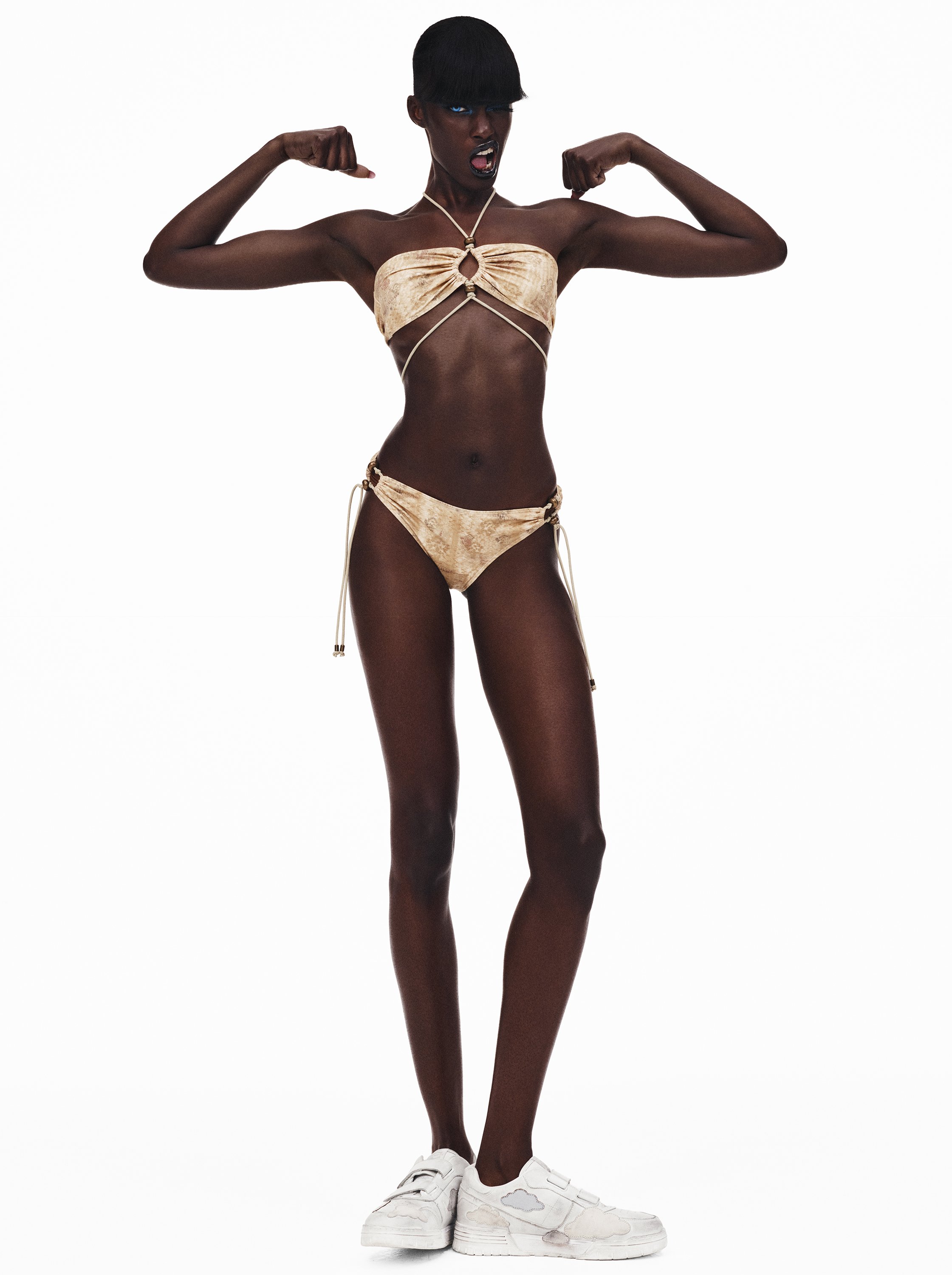
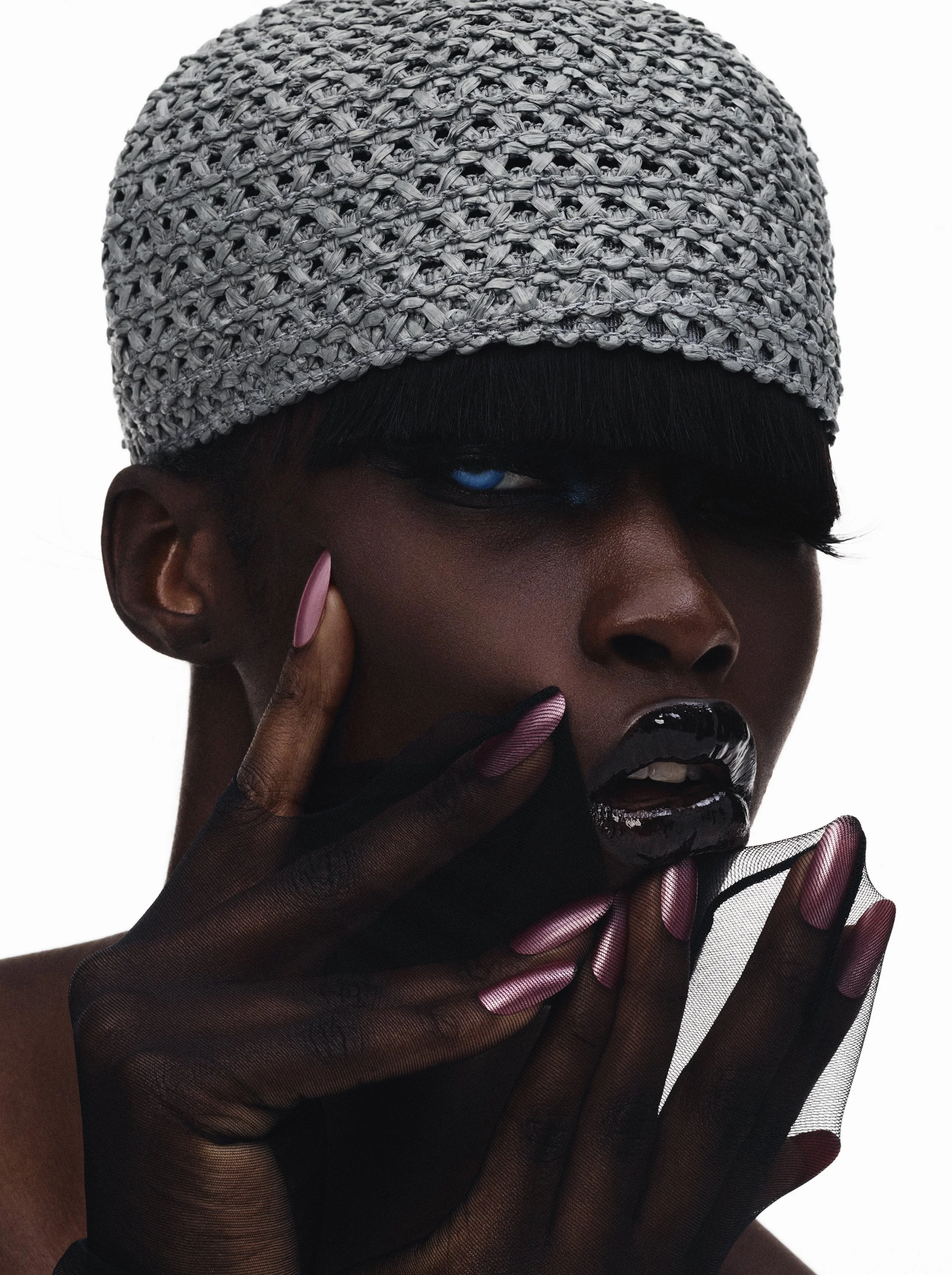
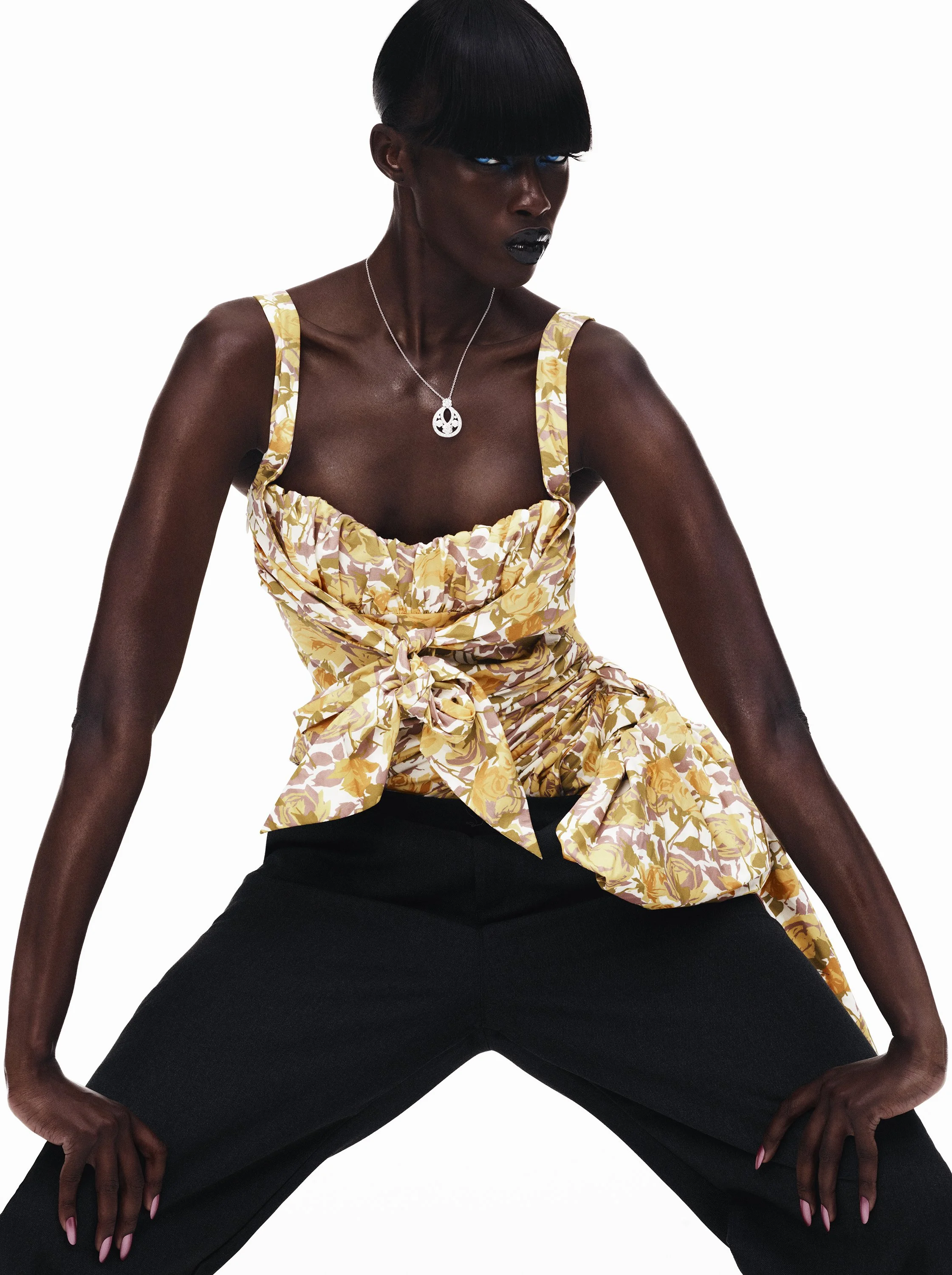
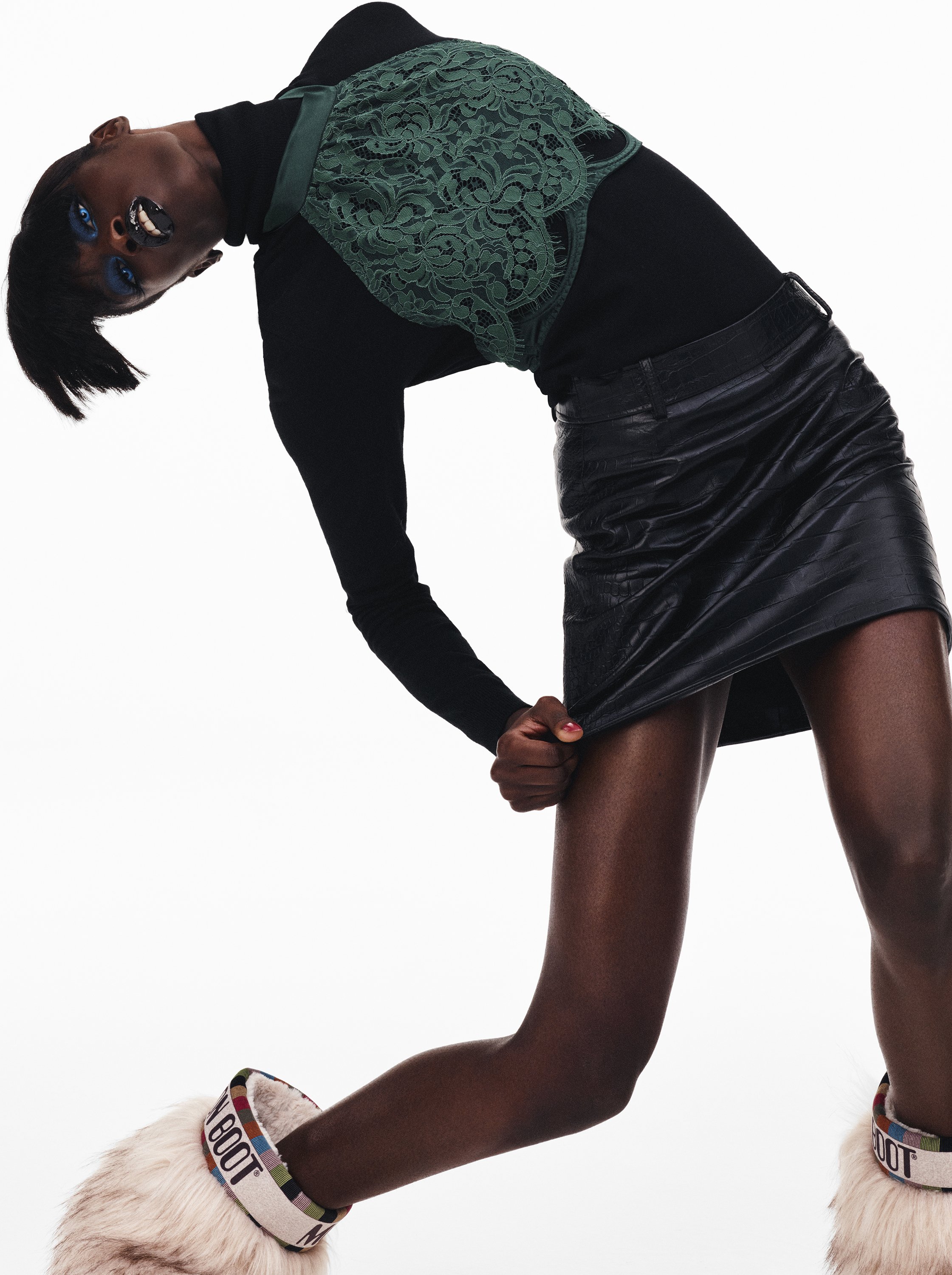
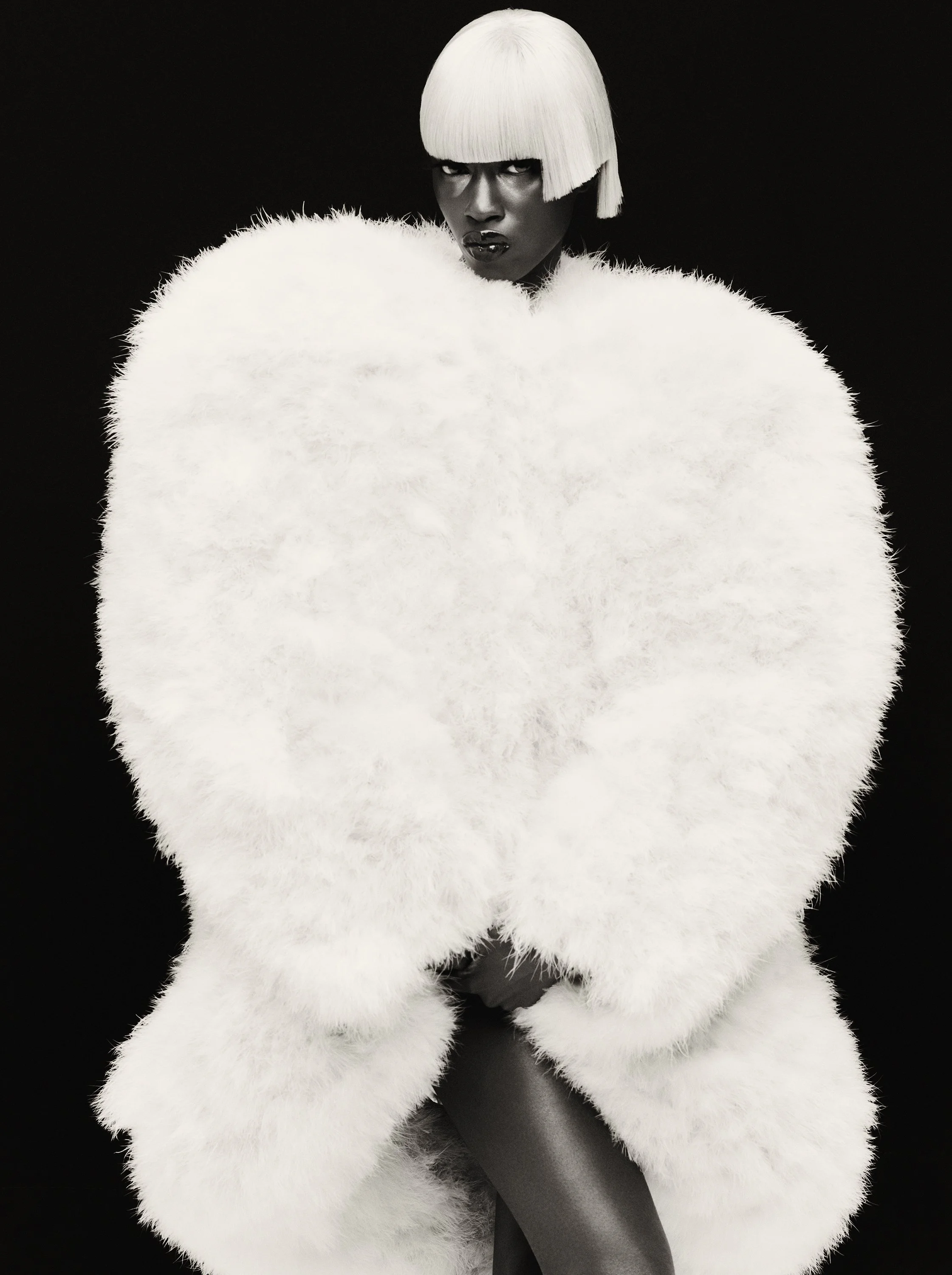
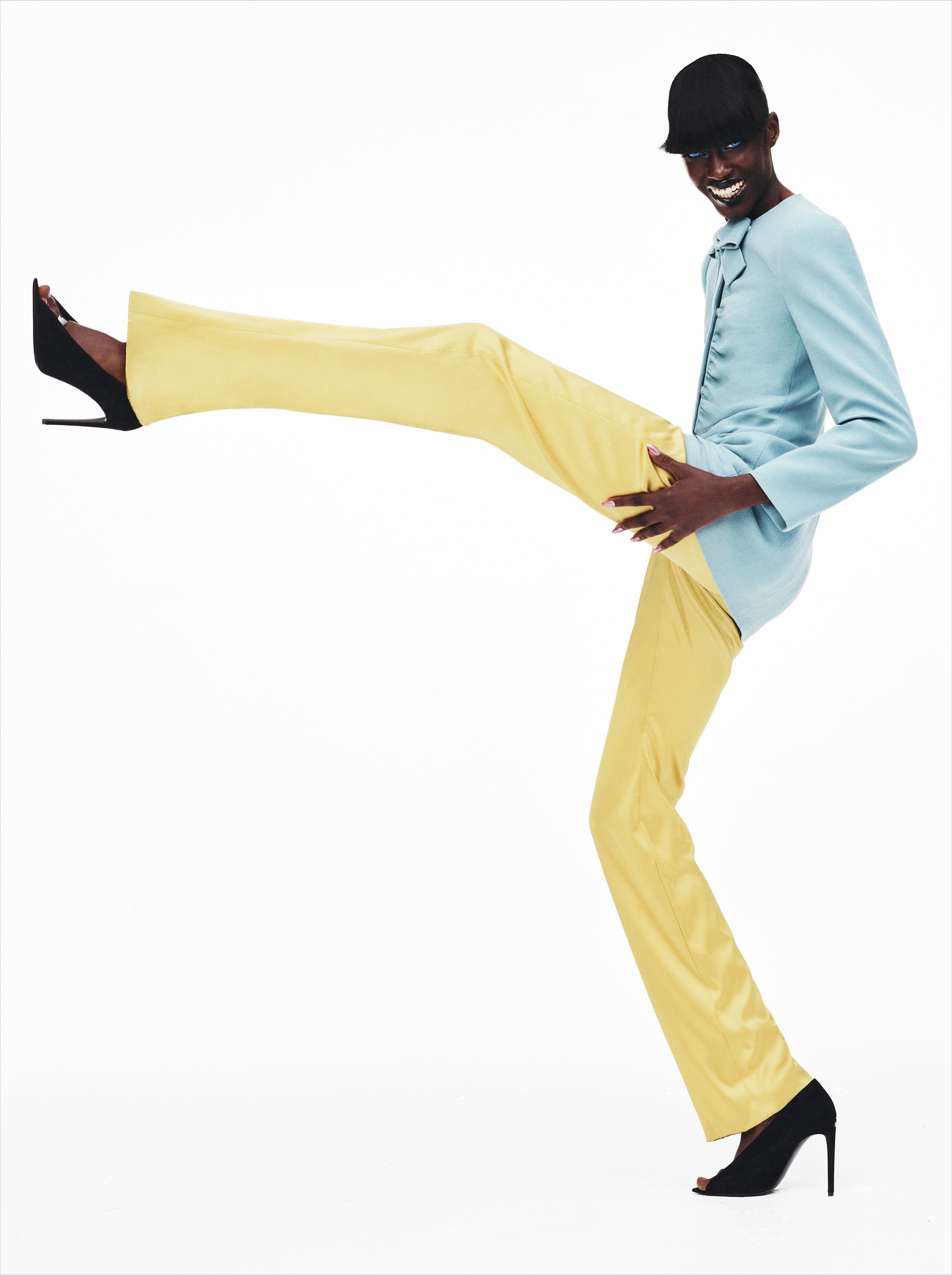
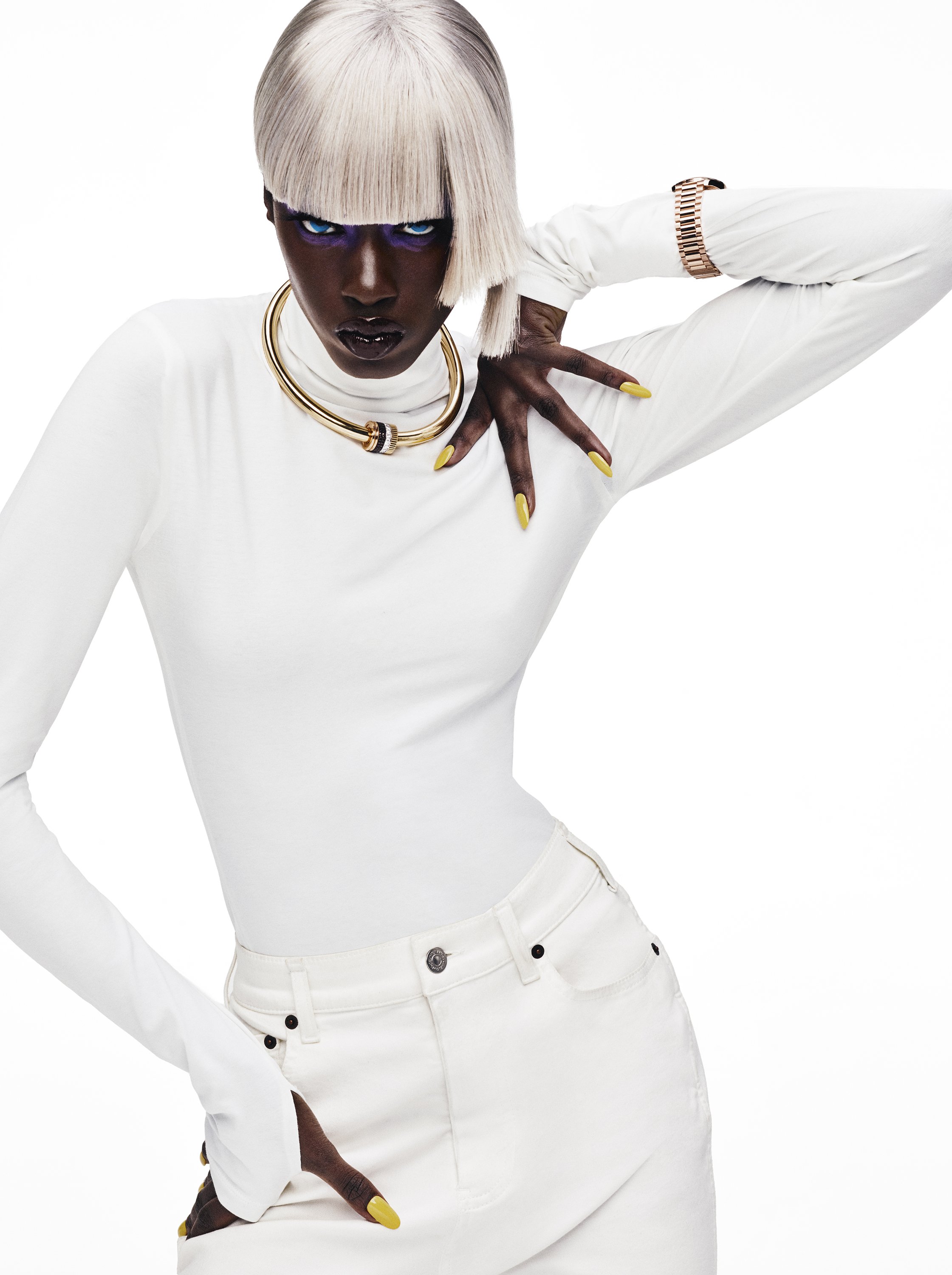
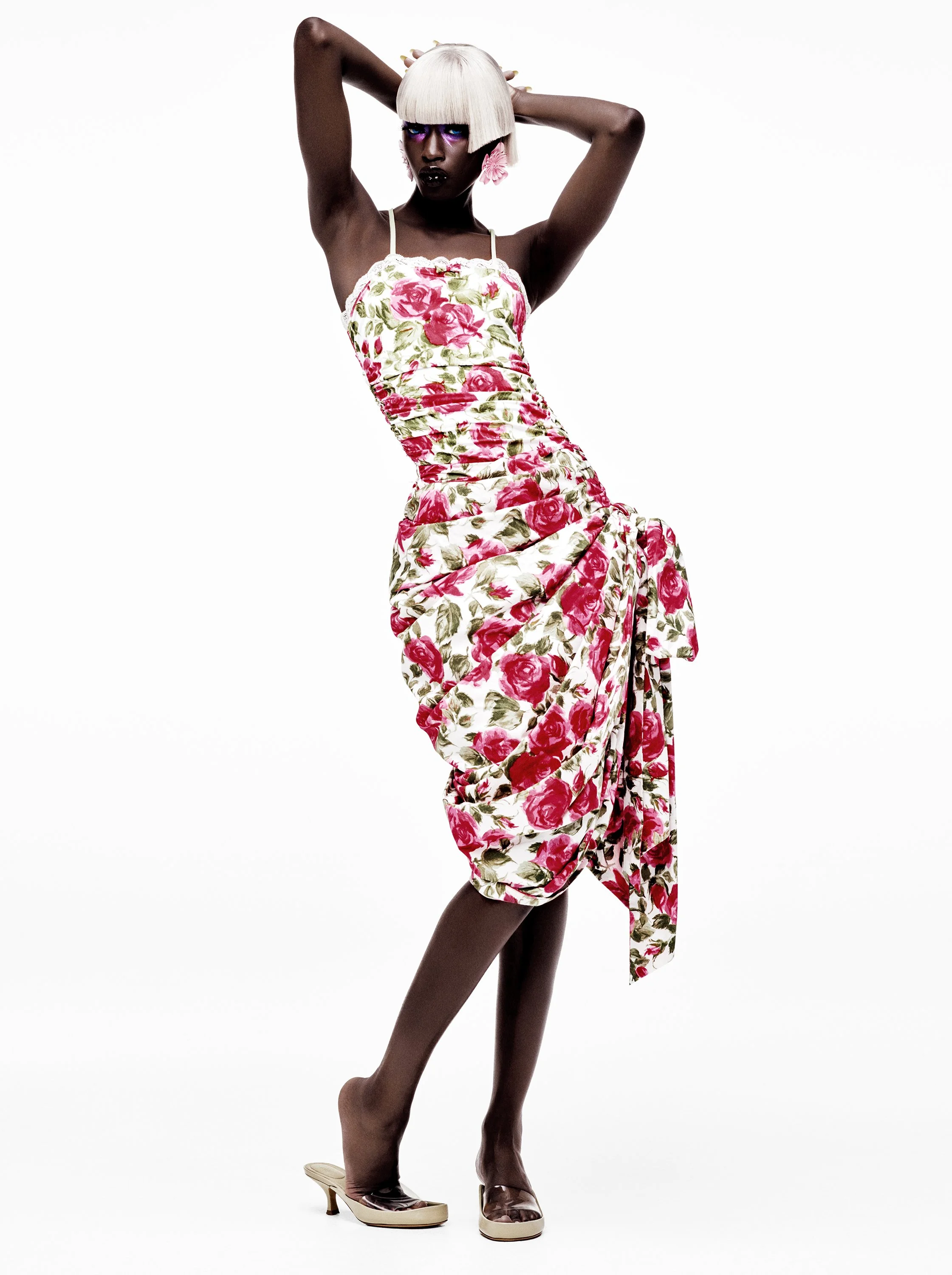
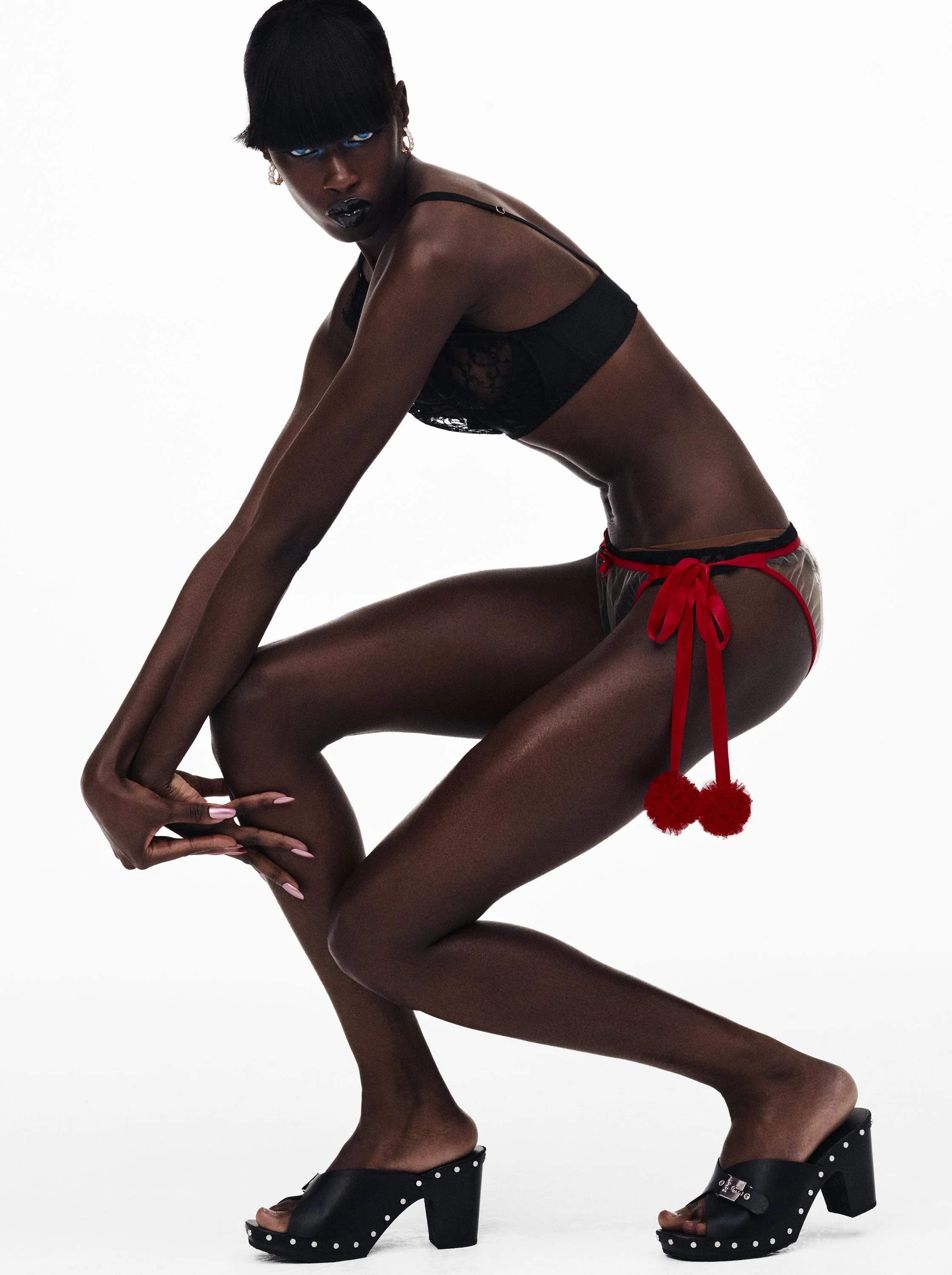
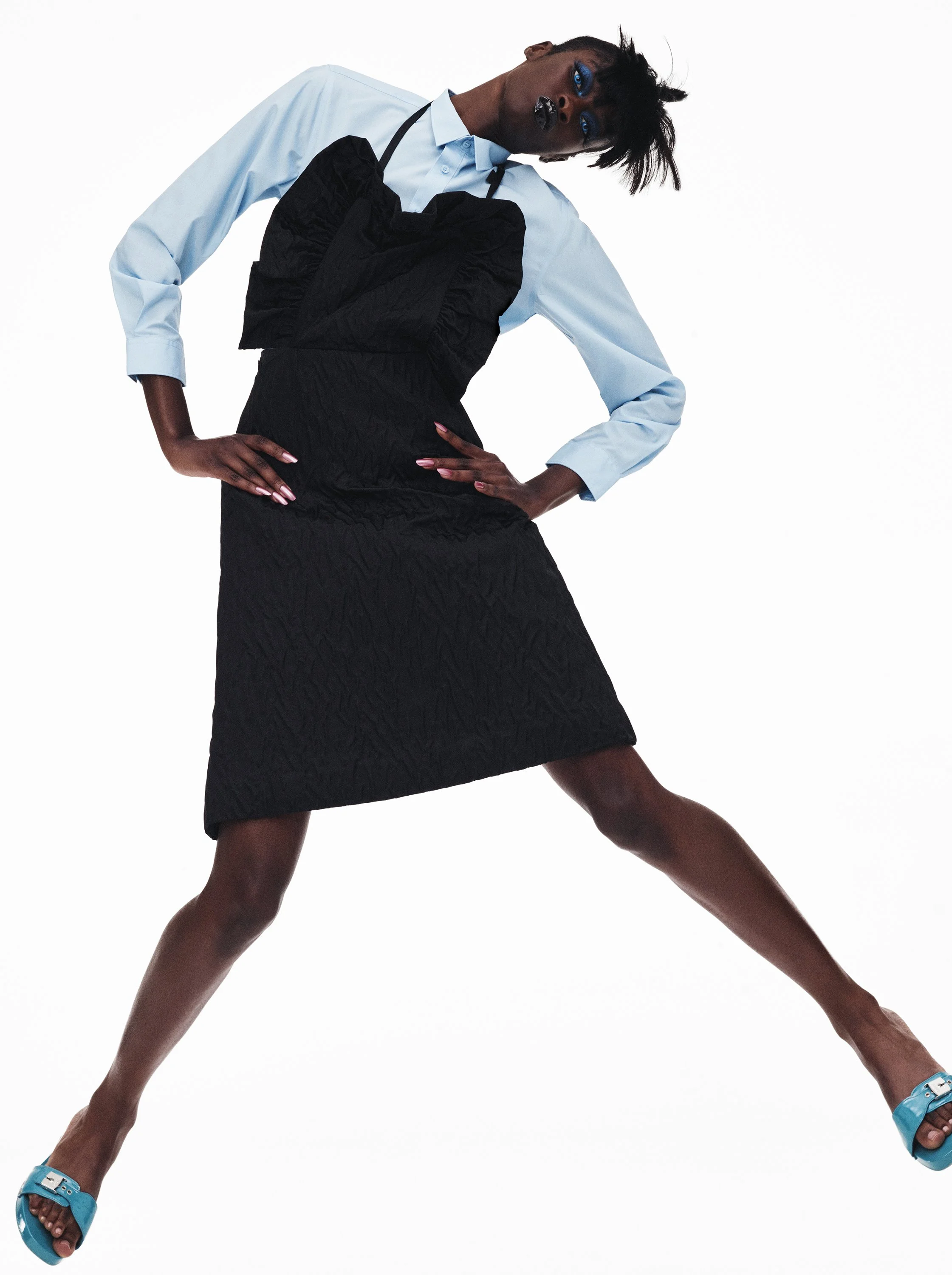
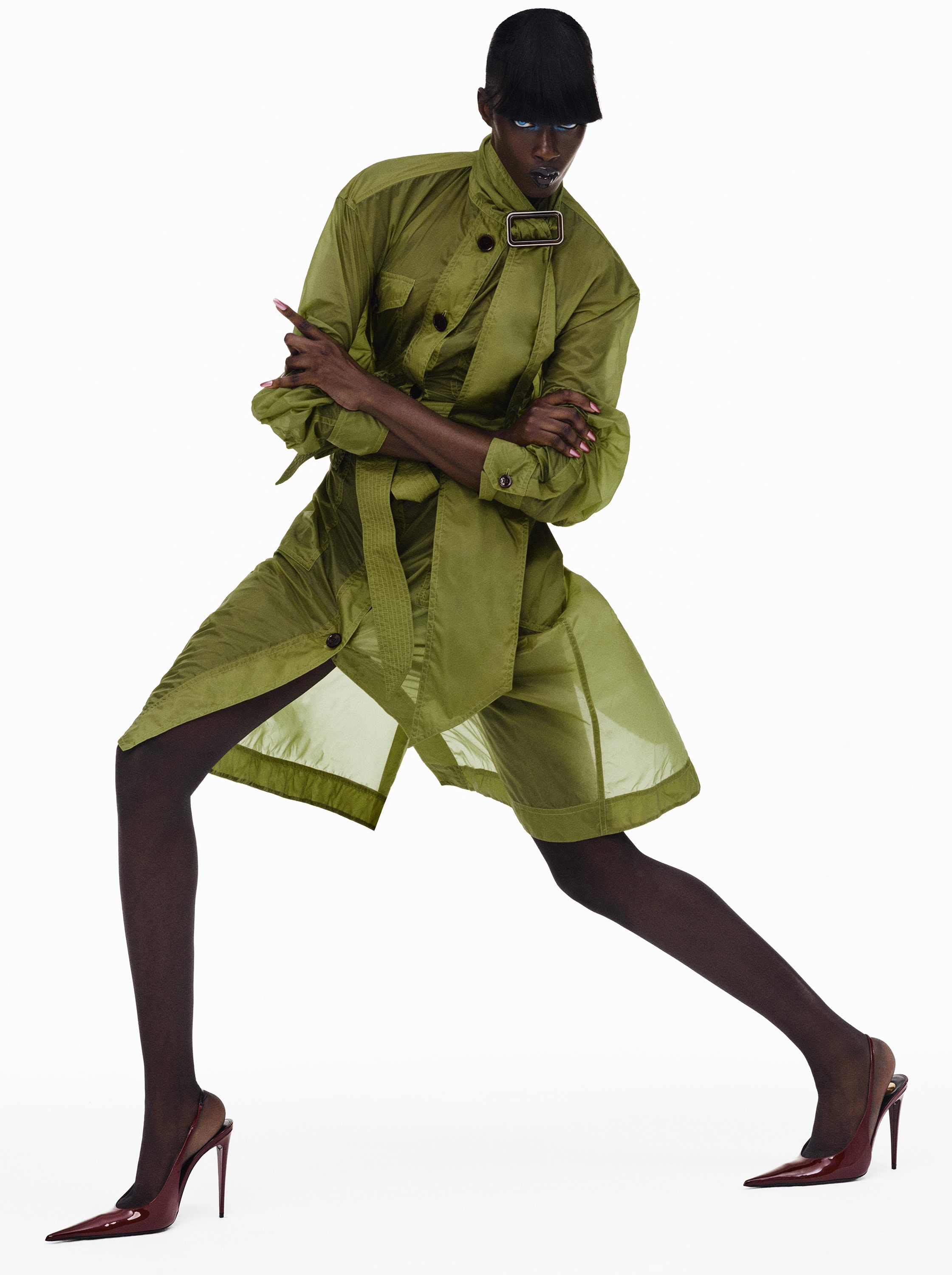
Sheila Bawar for Perfect Issue 10
Photographer: Rafael Pavarotti
Fashion Editor: Katie Grand
Interview: Murray Healy
It’s clear to anyone who’s seen her work that Sheila Bawar loves modelling, and, as these words spoken after only a few minutes in her company attest, it appears she loves talking about it almost as much. In the two short years since she made her Paris Fashion Week debut, her editorial output has been distinguished by the enthusiasm with which she devotes herself to making an extreme look work. In Perfect alone, she has appeared on the cover in one of the voluminous padded lace ensembles from John Galliano’s final Margiela couture collection, an epitome of elegance in an outfit that requires assistance to get into; and, last issue, she posed variously in a massive floor-length Balenciaga puffer gown, shiny metal armour and a leather corset in the imposingly aristocratic surrounds of Eglingham Hall in Northumberland. ‘I love that shoot so much,’ she says. ‘The house already tells a story, you know. And the clothes, they are huge and they also tell the story. You just have to play along with it. It’s not that difficult, you know?’ When the volume is already turned up to 11 on the aesthetics, a lot of models might find it intimidating, trying to pitch a performance to match, but she makes it look and sound effortless. ‘It’s my favourite thing to do!’ she beams.
The story which first demonstrated Sheila’s passion for playful absurdism in the studio appeared in the June 2024 issue of W magazine. Shot by Rafael Pavarotti and styled by Katie Grand, it showcased the most extreme and sculptural silhouettes of the season, demanding a model with a personality big and bold enough to shine amid such overstatement. She duly transformed herself into not only a variety of wildly different characters but objects too, from a heart to a floor lamp. Amid all the surrealism-inspired craziness, one image in particular stood out. It showed Sheila dressed like a 1950s suburban housewife in a Prada cardigan and skirt with a big blue fish strapped to her forehead, her face contorted in a grimace of cartoonish proportions; shades of Grouchy Smurf, Marge Simpson and a disgruntled Minnie the Minx. This iconic pose came to be known fondly as ‘fish face’ on set. In an industry where a model’s reputation has historically been determined by how faithfully they cling to conventional definitions of beauty, few would have had the confidence to mug to camera like this so early in their career, and fewer still the stage skills to pull it off.
That was a long shoot, Sheila recalls – ‘from 7am until 4am the next day’ – but an exhilarating one. ‘It was amazing for me. I was tired, but I was so energised, because I was so excited. The set was easy, everyone was laughing and the playlist was great. All that stuff makes it easier, you know?’
She relishes these more adventurously styled shoots, she says, ‘because it’s a chance to dress myself up and be extreme’ – as she notes, her own more day-to-day style is more understated: ‘I love to mix streetwear with tailoring.’ When we meet in London, where the Brazilian-born model now lives, she is wearing a sensible-sophisticated ensemble of grey pinstripe zip-up top, wide black wool trousers and an oversized black leather coat. Editorial work allows her to burst forth beyond her own sartorial constraints. ‘Like, to wear huge things, huge dresses – I don’t usually even wear dresses! And sometimes I take the references used on set to change my own style.’
On these more imaginative shoots, beyond potentially expanding her personal wardrobe, there are broader cultural considerations motivating her too. ‘Every time I do editorial, the more different or strange I look, the more interesting and beautiful could be the result. Because I think there’s something quite… boring in just being pretty. I imagine how cool it is to be pretty in a weird way. I think this is the most pretty thing to do, because it’s not easy.’
‘Fish face’ is a good example – she’s not exactly trying to look pretty in that shot, is she? What role do ideas about ‘beauty’ play in what she does? It’s an interesting question, she replies, ‘because personally, when I was younger, I didn’t feel like I was a beautiful girl. So I tried to compensate: I needed to be smarter, or I needed to be funnier, because I didn’t feel pretty. But when I started to do modelling, I started to discover beauty in me. Not only in the way that people always talk about beauty – like, in a superficial way, just the face or just the body. I was trying to be beautiful other ways.’
Sheila was 13 when she was first spotted by a model scout in Galeria do Rock, a vast upmarket shopping mall in Sao Paolo. ‘It’s really famous in Brazil because a lot of fashion people go there to do their hair and buy clothes and get tattoos.’ Her mother, who had moved to Brazil from Guineau-Bissau, worked as a hairdresser in a big salon there; as a single parent, she would take Sheila and her sisters Lara and Mara with her to work when they weren’t at school. One day, Sheila remembers, ‘this stylish person was walking around the mall and saw me and my sisters inside the salon. My sisters, they are twins and they are also albino – I think this is what caught her attention.’ Initially Mrs Bawar refused the scout’s requests to take snapshots of her daughters, but after three months of repeat visits she eventually relented. ‘We did this editorial for Nike about Black History Month, and it went viral in Brazil. We even appeared on TV shows. So it was a huge thing.’
This was 10 years ago, and at the time, Sheila says, she had ‘no idea about the fashion world from the models’ perspective’, because becoming a model was not a possibility that had ever occurred to her. She was, however, fascinated by clothes, collaging cut-outs from magazines and making paper dresses for her dolls. Her awareness of clothing’s ability to communicate meaning was sharpened by the contrasts she saw in the world around her. ‘At home my mom was wearing traditional clothes from Guineau-Bissau, but at school I saw a completely different way to dress. So this caught my attention a lot when I was a kid. And I was like, “OK, can I mix both worlds at the same time?” But modelling? I had no idea about that. I didn’t know any models. Only Naomi. And Gisele, because she was from Brazil as well.’
In the wake of that Nike shoot came more modelling work, with Mrs Bawar on set with her daughters at all times. ‘Me and my sisters were like, “Oh, this is amazing.” We got attention and we could have fun in front of the camera. But at some point my mom was like, “OK, this too much. I need you guys to finish school. You can do modelling after, if you want.” At the time I was upset – like, whyyy?!’ Sheila wails, and laughs. ‘But now I think she made the right decision.’
Teenage Sheila continued her studies and, worried that the world would forget her in the five long years until she finished school, entertained other career possibilities. She was good at science, ‘so I was really interested in becoming a neurosurgeon.’ And then at 17 her uncle, worried that she was too shy and lacked the courage to talk to people, enrolled her in acting classes. ‘And I fell in love with the theatre,’ she says. ‘It became my favourite thing.’ It also succeeded in making her more socially confident. ‘It was like I’d found a new version of myself.’
When she turned 18, Sheila returned to modelling, and it turned out that the world hadn’t forgotten her after all. In April 2022 she got her first editorial in Vogue Brasil; later that year she starred on the cover of the magazine September issue. Her agency gave her lessons in how to walk runway and sent her to castings for Sao Paolo Fashion Week that November. ‘At my first show I felt so great when I was walking. I was like, OK, I want to do this again.’
In that debut season she ended up doing 14 shows. ‘Knowing that people are looking at me while I’m walking in these major clothes, and my heart going boom, boom, boom, boom… It was awesome. It was the same feeling as when I was doing plays in the theatre. So I was like, ‘OK, I love this.’ It wasn’t only the spotlight rush of being out on the runway that appealed to her: the whole backstage mayhem of other models and fittings and hair and make-up excited her too. ‘If you sit for two hours having your make-up done, you can learn a bunch of stuff about another person. It is amazing, the exchanges. You can see life from another perspective, you know?’
At the start of 2024 her agency sent her to Paris. ‘I was like’ – she shrugs, her face completely emotionless – ‘OK, I’ll go. But nothing’s gonna happen. I didn't really believe it was possible in that place, you know?’ Then the Saint Laurent studio called her in.
‘Even even doing the fittings, I was like, maybe they’ll change their mind. I only really believed it the next day when I was backstage and almost ready to walk in the show. I remember – and this was really important to me – I had other Brazilian girls with me backstage. It was their second or third time doing the show, and they were like, “Oh, Sheila, we’re so happy for you.” So I didn't have time to be that anxious, because they were hyping me up so much.’ By curious coincidence, the woman counting down the models to the moment when they stepped onto the catwalk was also called Sheila. ‘So when it was my turn, she said, “From Sheila to Sheila, go and have fun.” So I was like, (fast, eager) “OK, let’s go!”’
This pivotal moment in her career is etched so profoundly in her memory that she doesn’t describe it so much as ecstatically reenact it. The melodramatic show soundtrack by SebastiAn, for example – she starts singing it. ‘It was like a heartbeat – boom, boom, boom, boom – and then the violins – di-di-di-di-di-di-di-di-di… And I remember how many steps I have to walk, and I start counting in my mind – one, two, one, two – and I was like, OK, I cannot forget that I have to turn…’
Backstage, the entourage that had given her so much encouragement were watching. ‘When I finished, all the girls were like, “Yay, yay, yay! You looked so beautiful.” And I was like, “Oh my God, I really did it,” and I called my mum, and I was crying so much. It was amazing.’
I’ve always assumed that, because you’re performing for a live audience, walking in a show must feel like theatre, while the role of the camera in editorial means it’s more like film or TV. But Sheila disagrees. ‘I think it’s the opposite. Runway is like TV acting, because you cannot make a mistake; you don’t have the chance to do a second take. Whereas editorial is theatre: if you do something wrong, the public don’t know.’
So in catwalk you have to stick strictly to the script, but on a shoot there’s freedom to improvise? ‘Yeah, you improvise – that’s the great thing. I know it doesn’t pay the bills and stuff, but editorial is my favourite thing to do because it’s so similar to theatre: I get into character and tell the story with my body. And I can make mistakes – because if no one else knows, it’s not a mistake, you know? So I can see myself in a different way, in different characters – different faces, also. Because I change myself completely.’